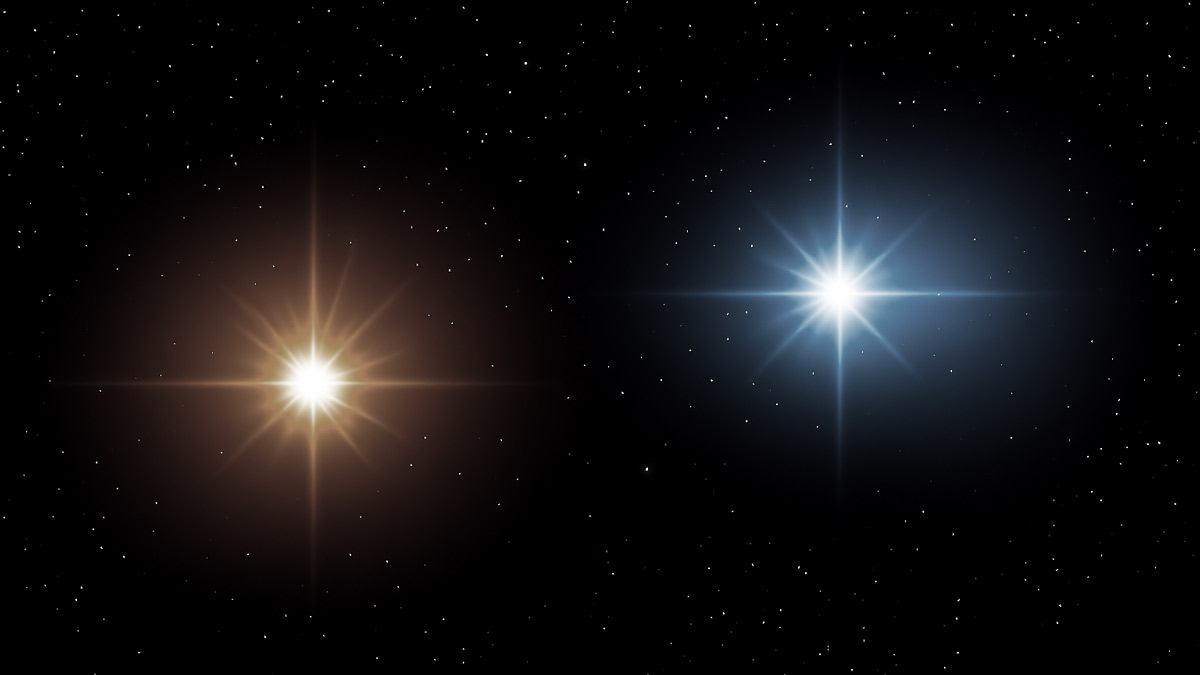
One of the joys of amateur astronomy is discovering celestial treasures that often go unnoticed. One such hidden gem lies in the summer constellation Serpens, specifically in the region known as Serpens Caput (“the Serpent’s Head”). Here, you’ll find a subtle but noteworthy system: a triple star officially designated Struve 2007, which is a rewarding object for observers equipped with small to medium-sized telescopes.
The AB components of Σ 2007 were first recorded by John Herschel and James South on May 6, 1823, who estimated a separation of 31.94″ at a position angle of 328.7° and noted the primary as yellowish‑white and the secondary as blue. Friedrich Georg Wilhelm von Struve later confirmed these measures in 1830, finding nearly identical values (31.97″ at 328.3°) and describing both stars as white. According to John Nanson on the Star Splitter site, Sissy Haas, who authored Double Stars for Small Telescopes, describes STF 2007 as a “wide pair with pretty colors — an ideal object for low power. It’s a Sun yellow star with a little red companion.”
A much wider AC component (6.9 / 10.8 mag at 162.9″, PA 137°) forms a hierarchical triple, but the true delight lies in the tight AB duad.
Struve 2007 stands out as a visually pleasing double. Its combination of accessible brightness, wide separation, and subtle coloration makes it a must-see for amateur double-star enthusiasts exploring the Serpens constellation.
My Observations
| Date | June 18, 2024 |
| Time | 11:26 p.m. |
| Location | Seattle, WA |
| Magnification | 169x |
| Scope | Meade 8″ SCT |
| Eyepiece | 12mm |
| Seeing | Above Average |
| Transparency | Above Average |

Tonight, from my home near Seattle, I make my way through the constellation Serpens. In a tall tree by the nearby lake, an eagle calls out every few seconds. Its cry carries across the area as my thoughts drift toward the heavens—and to the double star Struve 2007. This pair proves more intriguing than I expected, based on the early descriptions I’ve read.
It rests in an attractive starfield, and the primary star shines with a rich orange hue. Tonight, I see it more as orange than yellow-white. The color of the dimmer secondary star is harder to pin down. As I continue to study it, I begin to detect a hint of blue, but I wouldn’t fault anyone for simply seeing white. I’m not entirely sure whether my eyes are playing tricks on me, but I’m not seeing red as Sissy Haas recorded. Regardless, this is one of Serpens’ finer doubles, in my opinion, and well worth the effort to track down.
I also spot the system’s even dimmer third component—a faint white star positioned below and to the right of the main pair. The three stars almost line up perfectly.
Key Stats
| Constellation | Serpens |
| Best Viewing | Late Spring, Summer |
| Visual Magnitude | +6.9 | +7.9 |
| Distance from Earth | 712 ly |
| Separation | 37.7″ |
| Position Angle | 322.4° |
| Milky Way Location | Orion Spur |
| My Viewing Grade | B+ |
| Designations | SAO 101922, HD 144563, HIP 78873, STF 2007 |
Sources and Notes
Sketch by Wayne McGraw
Star info from: Stelle Doppie. (n.d.). WDS 16060+1319 STF 2007 AB (HD 144563). Retrieved July 19, 2025, from https://www.stelledoppie.it/index2.php?iddoppia=64977
 The Garden Astronomer