
Messier 22 (M22), one of the brightest and closest globular clusters to Earth, is a standout target for amateur astronomers. Located in the constellation Sagittarius, M22 offers not just beauty through the eyepiece but also scientific insight into the early days of our galaxy. German astronomer Abraham Ihle discovered the cluster in 1665 while searching for Saturn. This early observation is unusual for a globular cluster, since most were cataloged in the 18th century. Years later on June 5, 1764, Charles Messier viewed the cluster for the first time, added it to his famous catalog.1
M22 sits just east of the lid of the “Teapot” asterism in Sagittarius, making it relatively easy to track down. Use the star Lambda Sagittarii (Kaus Borealis) as your starting point. From there, it’s about 2 degrees northeast, a short hop with binoculars or a wide-field telescope.
In dark-sky conditions, M22 can be seen with the naked eye as a faint, fuzzy patch. Through binoculars, it appears as a misty glow. A small telescope will begin to resolve the outer stars, while a larger scope reveals the densely packed core and shimmering halo of stars surrounding it.
What Makes M22 Special
M22 isn’t just bright and nearby. It’s one of the few globular clusters known to contain a planetary nebula—an extremely rare feature in such dense star environments. This planetary nebula, dubbed GJJC1, is evidence of a dying star shedding its outer layers, a phenomenon almost never seen in globular clusters due to their old, stable star populations.
It’s also been found to contain two black holes, according to Nature, making it an object of ongoing interest in astrophysics. The stars in M22 are metal-poor, meaning they formed early in the universe’s history. That makes this cluster a fossil of the early Milky Way, providing clues about the galaxy’s formation.
Messier 22 is more than just a pretty cluster; it’s a scientific goldmine. Its proximity, brightness, and rich star population make it one of the best globular clusters to observe and study. Whether you’re a backyard stargazer or an astrophysicist, M22 offers a glimpse into the ancient structure of our galaxy, and it’s only a telescope away.
My Observations
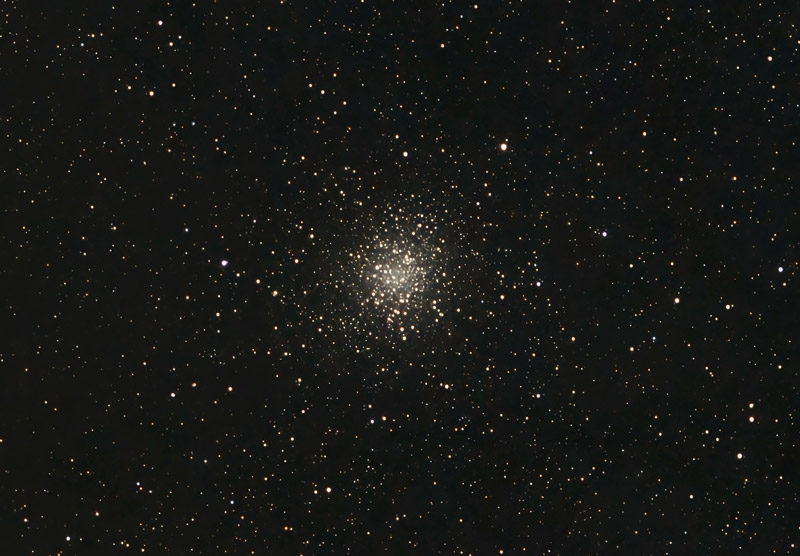
Observation on July 26, 2025, at 10:30 p.m.: After years of trying to spot Messier 22 from the Pacific Northwest, where it always seemed to hide just beyond the reach of the tall trees in my backyard, I finally had my chance in Tampa, Florida. From this southern location, the globular cluster stood higher in the sky, clear against the summer stars.
I was still setting up my telescope when I decided I couldn’t wait any longer to capture it, seizing the moment on a rare night of clear skies after weeks of evening thunderstorms. Capturing Messier 22 on the e-scope Seestar S50 in all its glory felt like both a reward for my patience and a reminder of why I love the hunt for deep-sky treasures. I look forward to returning to the 8-inch scope to sketch this wonderful cluster when the skies afford the chance.
Key Stats
| Constellation | Sagittarius |
| Best Viewing | Summer |
| Visual Magnitude | +5.1 |
| Absolute Magnitude | -8.5 |
| Distance from Earth | 10,600 ly |
| Diameter | 97 ly |
| Apparent Size | 32 arcmin |
| Milky Way Location | Orion Spur |
| My Viewing Grade | A- |
Historical Observations
Charles Messier’s observation on June 5, 1764
“Nebula, below the ecliptic, between the head and the bow of Sagittarius, near a star of 7th magnitude, 25 Sagittarii, according to Flamsteed, this nebula is round, it doesn’t contain any star, & one can see it very well in an ordinary telescope of 3.5-foot [FL]; the star Lambda Sagittarii served for determination [of its position]. Abraham Ihle, a German, discovered it in 1665, while observing Saturn. M. Le Gentil observed it in 1747, & he made an engraving of it. Memoirs of the Academy, year 1759, page 470. Seen again March 22, 1781; it is reported in the English Atlas. (diam. 6′)”
William Herschel first observed the cluster on July 4, 1783
“With a small 20-feet Newtonian telescope, power 200, it is all resolved into stars, that are very small and close. There must be some hundreds of them. With 350, I see the stars very plainly; but the nebula is too low in this latitude for such a power.”
A year later on July 12, 1784, William Herschel viewed it again:
“A most beautiful extensive cluster of stars, of various magnitudes, very compressed in the middle, and about 8′ in diameter, besides the scattered ones, which do fill the extent of the field of view.”
Sources and Notes
1Historical observation from messier.seds.org.
Nick’s Astrophotography. (2024, November 10). M22: A guide to the brightest globular star cluster. https://nicksastrophotography.com/2024/11/10/m22-a-guide-to-the-brightest-globular-star-cluster/
Strader, J., Chomiuk, L., Maccarone, T. J., Miller‑Jones, J. C. A., Seth, A. C., & et al. (2012, October 3). Two stellar‑mass black holes in the globular cluster M22. Nature, 490(7418), 71–73. https://doi.org/10.1038/nature11490
Photo and sketch by Wayne McGraw
 The Garden Astronomer