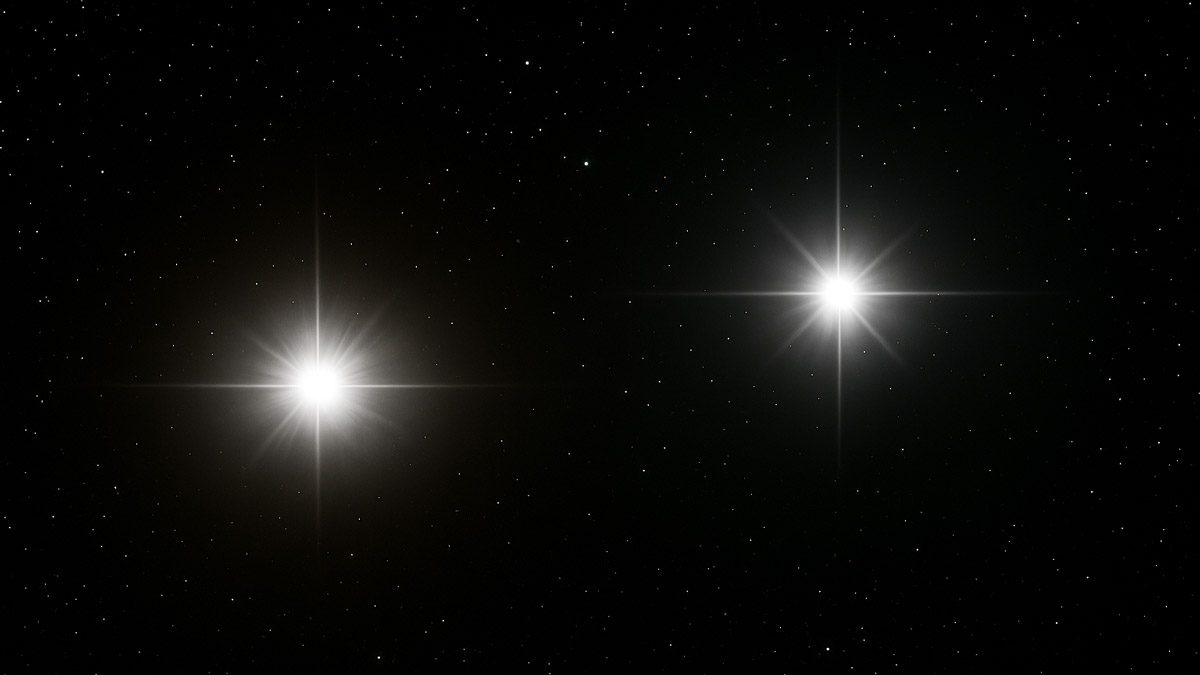
The constellation Ophiuchus graces the late spring and summer skies, offering a rich tapestry of double stars and deep-sky wonders. Among the serpent bearer’s treasures is 61 Ophiuchi, a fairly bright binary star with enough separation between its two components to be resolved even through smaller telescopes. On July 15, 1781, William Herschel recorded his observation of this stellar pair. Decades later, in 1827, Friedrich Georg Wilhelm von Struve cataloged 61 Ophiuchi as STF 2202 in his monumental work Catalogus Novus Stellarum Duplicium et Multiplicium, cementing its place in the annals of double star astronomy.
The primary star shines at a magnitude of around 6.1, while the secondary is fainter, at about 6.47 magnitude. That puts both stars within reach of small amateur telescopes. What makes 61 Ophiuchi especially approachable is the angular separation between the two stars: around 20.7 arcseconds. That’s wide enough for even modest magnification to reveal the two stars as distinct points of light rather than a blended blur.
According to John Nanson on the Best Doubles website, author Sissy Haas observed the binary as a pair of “straw-yellow” stars. Meanwhile, Admiral Smyth saw the “neat” pair as a “silvery white.” For me, I tend to lean toward Smyth’s take as they appear silvery white. The website Stelle Doppie says the stars are classified as A1IV-V, suggesting they are closer to 10,000 K in temperature making them hot, white stars.
This pair isn’t just a pretty sight. They’re a physical binary, gravitationally bound and orbiting each other. But for visual observers, the appeal is simple: 61 Ophiuchi is an easy, satisfying target that shows off what even a small scope can do.
My Observations
| Date | July 15, 2023 |
| Time | 10:50 p.m. |
| Location | Seattle, WA |
| Magnification | 169x |
| Scope | Meade 8″ SCT |
| Eyepiece | 12mm |
| Seeing | Average |
| Transparency | Above Average |

On this midsummers night, I now turn my attention to this neat binary. Both stars appear white to my eyes—clean, evenly matched in hue—and nicely separated, making the pair an easy and enjoyable sketching target.
While reading up on the system, I notice John Nanson mentions a component “C” on his website. I look for it during my session but can’t confidently identify which star it is, or even if it’s officially cataloged as part of the system. Either way, the main A and B components are worth the trip over as they make a clean binary hanging in the summer sky.
Key Stats
| Constellation | Ophiuchus |
| Best Viewing | Late Spring — Summer |
| Visual Magnitude | +6.13 | +6.47 |
| Distance from Earth | 276.68 ly |
| Separation | 20.782″ |
| Milky Way Location | Orion Spur |
| My Viewing Grade | B+ |
| Designations | 61 Oph, Struve 2202, STF 2202, SAO 122690, HD 161270, HR 6609, HIP 86831 |
Sources and Notes
Sketch by Wayne McGraw
Stelle Doppie. (n.d.). 61 Ophiuchi (WDS J17465+0307). Retrieved August 3, 2025, from https://www.stelledoppie.it/index2.php?iddoppia=71150
 The Garden Astronomer