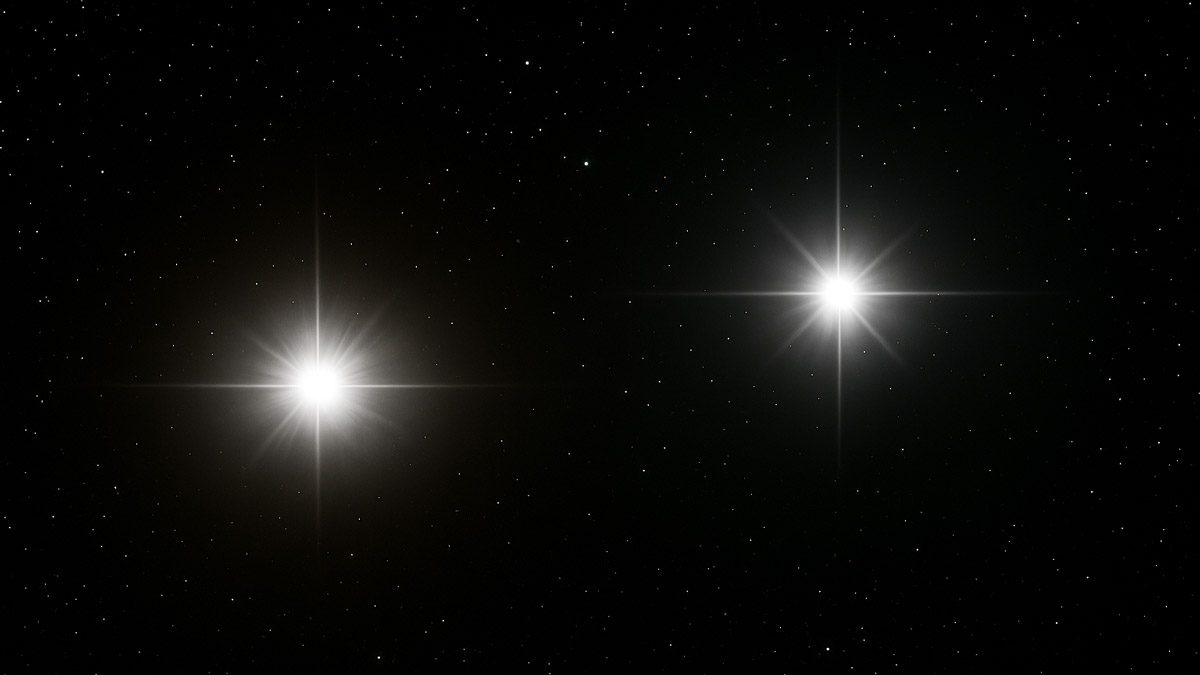
Tucked away in a quiet corner of the summer sky, the constellation Equuleus, the Little Horse, rarely draws attention from stargazers. This modest collection of faint stars sits overshadowed by its spectacular neighbors: the winged horse Pegasus, the soaring swan Cygnus, and brilliant Lyra with its jewel-bright Vega.
But Equuleus holds secrets for those willing to look closer. Among its subtle stars lies Struve 2793, a triple star system first catalogued by the astronomer Friedrich Georg Wilhelm von Struve in his groundbreaking 1827 work, Catalogus novus stellarum duplicium.
The primary star, shining at magnitude 7.4, is a hot, white star larger and more luminous than our Sun, but not yet evolved into a true giant star. Hidden just 0.1 arcseconds away lurks its closest companion, far too close for amateur telescopes to separate.
The second star, 26 arcseconds away from the primary, shines at magnitude 8.9. It’s this star and the primary we see when looking through the telescope. At a distance of roughly 282 light-years from Earth, this stellar duo offers an excellent target for anyone interested in the art of “splitting” double stars.
While Equuleus may never compete with summer’s showier constellations, it reminds us that even the sky’s quietest corners can reward patient observers with unexpected beauty.
My Observations
| Date | September 9, 2023 |
| Time | 9:56 p.m. |
| Location | Seattle, WA |
| Magnification | 169x |
| Scope | Meade 8″ SCT |
| Eyepiece | 12mm |
| Seeing | Average |
| Transparency | Below Average |
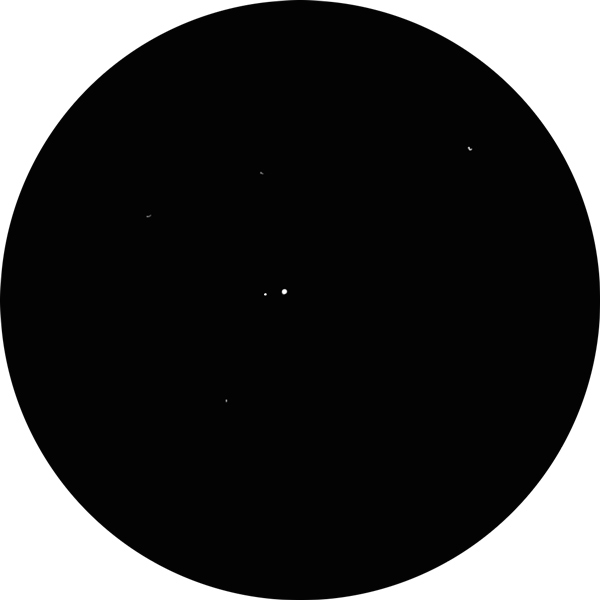
STF 2793 is not as attractive as STF 2725, which I just observed ten minutes ago, but I’m glad to be paying the small horse a visit tonight to see what it has to offer. The primary star appears white with a hint of blue, perhaps, while the secondary is tough to discern due to its dim magnitude, though I think it’s white.
Key Stats
| Constellation | Equuleus |
| Best Viewing | Summer-Early Autumn |
| Visual Magnitude | +7.4 | +8.9 |
| Separation | 26.4″ |
| Position Angle | 241.4° |
| Distance | 282.91 ly |
| My Viewing Grade | B- |
| Designations | SAO 126783, HD 203943, HIP 105743 |
Sources and Notes
Stelledoppie.it. (n.d.). Struve 2793. Retrieved August 11, 2025, from https://www.stelledoppie.it/index2.php?iddoppia=94857
Wikipedia contributors. (n.d.). Friedrich Georg Wilhelm von Struve. Wikipedia. Retrieved August 11, 2025, from https://en.wikipedia.org/wiki/Friedrich_Georg_Wilhelm_von_Struve?utm_source=chatgpt.com
Sketch by Wayne McGraw
 The Garden Astronomer