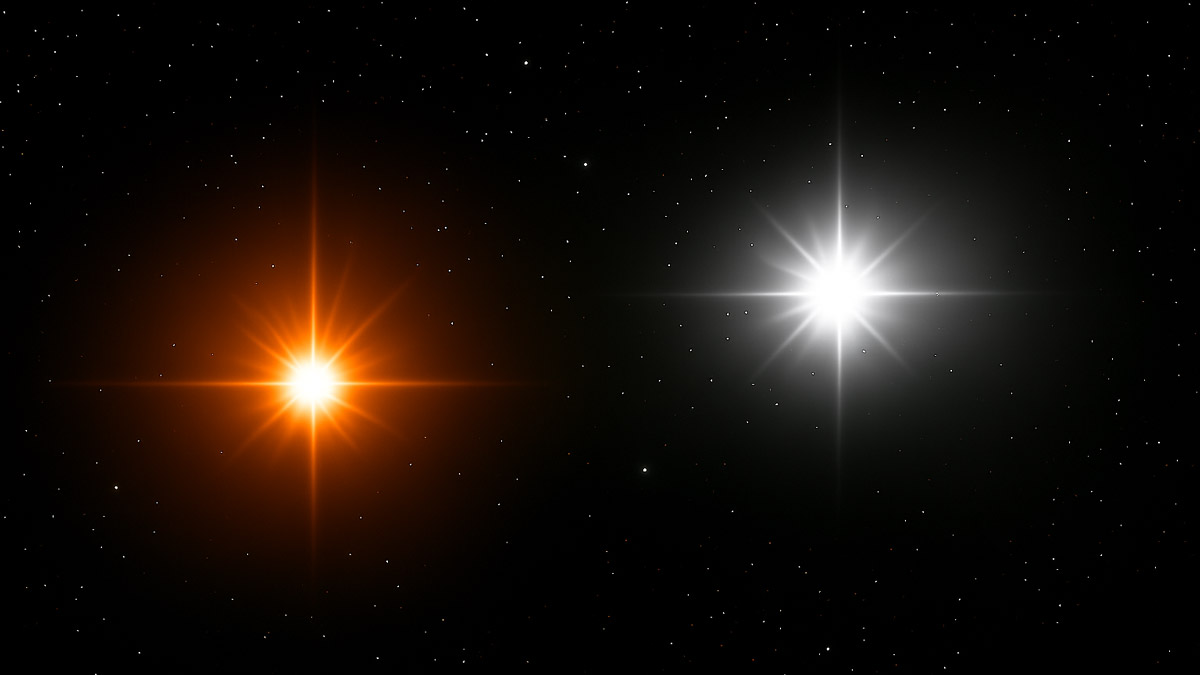
When spring evenings roll around, most amateur astronomers point their telescopes toward Virgo for one reason: galaxies. The great Virgo Cluster sits here, with countless island universes to tempt our eyepieces. But hidden among these deep-sky treasures is something a little closer to home and every bit as delightful—an attractive double star called Struve 1677. The astronomer William Herschel was the first person to record this double star. He penned his observation on February 17, 1782.1
I just realized something as I write this observation. Since starting this site three years ago, my observations in Virgo have focused on its rich galaxy collection. The only double star I’ve observed so far in Virgo is the notable Porrima. Thus, nearby Struve 1677 is the second of hopefully many more doubles. On a related note, I like how John Nanson of Star Splitters puts STF 1677 into a group called “Porrima’s Pals!”
STF 1677’s two stars are close together, but you can comfortably split them since they are 16 arc seconds apart. The primary star is a yellow-white giant classified as an A7 (III) star, and it shines at a magnitude of +7.3. Meanwhile, the nearby and fainter companion shines at a magnitude of +8.1.1
Sometimes, amid the grandeur of distant galaxies, it’s the quiet companionship of two stars that brings the night sky a little closer.
My Observations
| Date | April 28, 2023 |
| Time | 10:15 P.M. |
| Location | Seattle, WA |
| Magnification | 169x |
| Scope | Meade 8″ SCT |
| Eyepiece | 12mm |
| Seeing | Average |
| Transparency | Average |

Other observers have seen the primary star as white, and the secondary star as either gray or slightly yellow. I find my observations differ slightly. The primary, which is the bottom star through my eyepiece and on the sketch, appears white with a very slight touch of yellow. The secondary looks gray to me, though it may be just a dim white. Since this is a close, but fairly easy double to separate, backyard astronomers should definitely check it out when they go looking for galaxies and Porrima in this region.
Key Stats
| Constellation | Virgo |
| Best Viewing | Spring |
| Visual Magnitude | +7.3, +8.1 |
| Separation | 16″ |
| Position Angle | 348° |
| Spectral Class | Primary=A7(III) |
| Absolute Visual Magnitude | +0.16 |
| Distance from Earth | 188 ly |
| Milky Way Location | Orion Spur |
| My Viewing Grade | B+ |
| Designations | SAO 138952, HIP 62234 |
Sources and Notes
1 The herschel 500 double star list. (n.d.). Retrieved May 6, 2023, from https://www.handprint.com/ASTRO/Herschel500.html
Sketch by Wayne McGraw
Updated on August 15, 2025
 The Garden Astronomer
One thought on “Struve 1677: A Close Pair of Stars Near Porrima in Virgo”