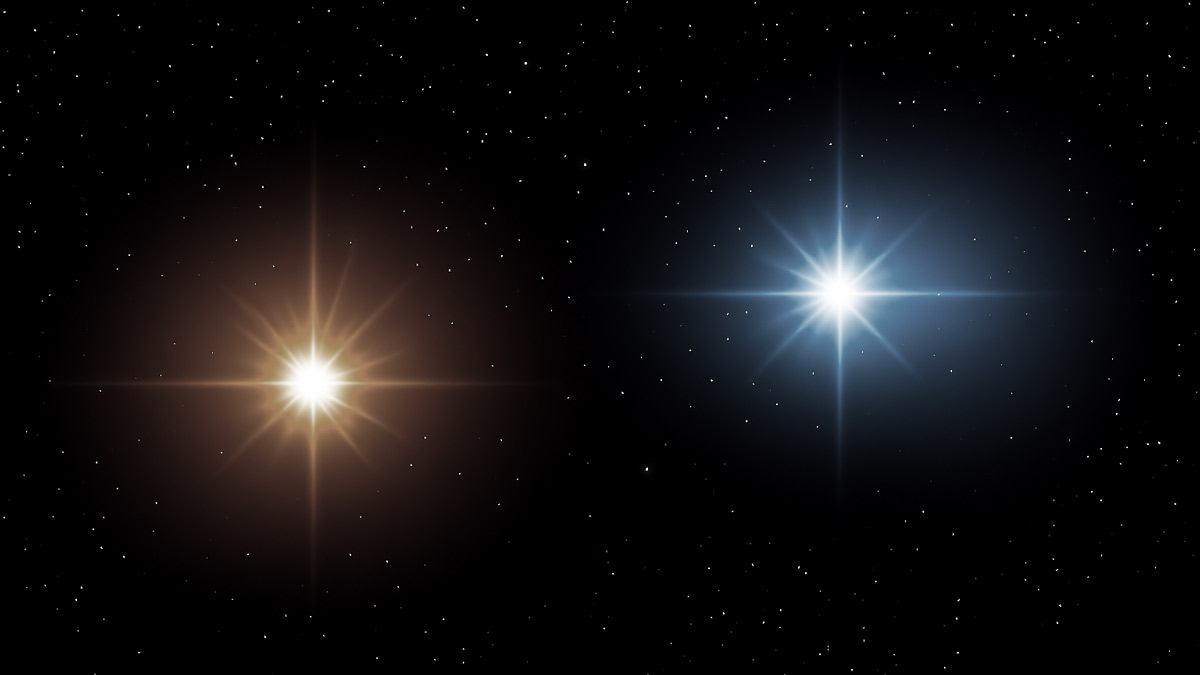
Sagitta, the Arrow, is one of the smallest constellations in the night sky. Tucked between Aquila the Eagle and Vulpecula the Little Fox, this tiny pattern is easy to overlook, yet it holds a quiet gem worth pointing your telescope toward: Zeta Sagittae (ζ Sge).
At first glance, Zeta Sagittae doesn’t stand out. Shining at magnitude 5.0, it’s just on the edge of naked-eye visibility under dark skies. But appearances can be deceiving. What looks like a single, faint star is actually a double system—and more precisely, a triple.
A Closer Look at the System
The main pair, Zeta Sagittae A and B, is separated by about 8 arcseconds, making it a genuine binary system and a rewarding target for backyard telescopes. Zeta Sagittae A is the brighter of the two, glowing around magnitude 5. This A3V star appears white with a faint bluish tint.
The companion, Zeta Sagittae B, shines at about magnitude 9. Its dimness compared to the primary makes it a bit challenging to spot, but under steady skies, it appears nestled just beside the brighter star. A third member, Zeta Sagittae C, lies farther out, around 76 arcseconds away, glowing faintly at magnitude 11.
Finding Zeta Sagittae
To track it down, start with Altair, the bright star at the heart of Aquila. From there, slide your gaze northward to spot the small, arrow-shaped pattern of Sagitta. Zeta Sagittae sits along the shaft of the arrow, easy to hop to once you’ve traced the tiny constellation.
Even in small constellations like Sagitta, treasures await anyone willing to pause, point their scope, and look just a little deeper. So next time you’re scanning the summer sky, take a moment to visit Sagitta. Find Zeta, split its light, and enjoy the quiet reward of uncovering one of the Arrow’s hidden jewels.
My Observations
| Date | September 14, 2023 |
| Time | 9:34 p.m. |
| Location | Seattle, WA |
| Magnification | 169x |
| Scope | Meade 8″ SCT |
| Eyepiece | 12mm |
| Seeing | Above Average |
| Transparency | Above Average |

The primary star glows white to me, and tonight I don’t notice the blue tint that some online observers have mentioned. The secondary companion is dim, but even from my suburban location, I can see it clearly. It also appears white, though at this magnitude it’s hard to be certain. A handful of relatively bright stars surround the pair, so I’m not entirely sure which one is the true companion. I’ll need to do a bit more research to confirm.
A few minutes ago, on my tour through Sagitta, I observed Epsilon Sagittae. It shows more color and is easier to split, but I still appreciate Zeta for being a tighter binary, which makes it just as enjoyable to observe.
Key Stats
| Constellation | Sagitta |
| Best Viewing | Summer |
| Visual Magnitude | + 5.09 | +9.01 |
| Separation | 8.26″ |
| Position Angle | 310.9° |
| Distance | 255 ly |
| My Viewing Grade | B |
| Designations | SAO 105298, STF 2585, 8 Sge, 8 Sagittae, HR 7546, HIP 97496, GC 27431, HD 187362, BD+18 4254, ζ Sge |
Sources and Notes
Stelle Doppie. (n.d.). Zeta Sagittae (ζ Sge) double star system. StelleDoppie. Retrieved August 17, 2025, from https://www.stelledoppie.it/index2.php?iddoppia=115377
Sketch by Wayne McGraw
 The Garden Astronomer