
Imagine standing on the edge of a brightly lit city at night, the skyline blazing behind you. Off in the dark countryside, you notice a faint village on the horizon, its lights steady but subdued. That’s NGC 7006 compared to the Milky Way, a distant outpost glowing quietly at the galaxy’s frontier. On August 21, 1784, astronomer Sir William Herschel peered deep into the constellation Delphinus and recorded this far-flung cluster.
A Crowd of Stars in the Cosmic Wilderness
Globular clusters usually orbit in the Milky Way’s halo, like bees around a hive. But NGC 7006 stands apart. Lying 135,000 light-years away, it is nearly five times farther from us than the galactic center—an extreme suburb in cosmic terms. Its stars, ancient and tightly bound, have endured in this lonely stretch of space for billions of years.
NGC 7006 Likely Formed in Another Smaller Galaxy
In a paper submitted to arxiv.org in June 2001, we learn that astronomers tracked the motion of the globular cluster NGC 7006 over 40 years and found it racing through space at nearly 280 km/s. That’s about 626,000 miles per hour! Its orbit around the Milky Way is one of the most extreme known, stretching over 100,000 light-years from the galactic center. Unlike the smoother orbits of small satellite galaxies, NGC 7006’s path is wildly elongated, hinting that it likely formed in a smaller galaxy. The study suggests that NGC 7006 originated from a system similar to the Fornax dwarf galaxy and was subsequently absorbed by the Milky Way.
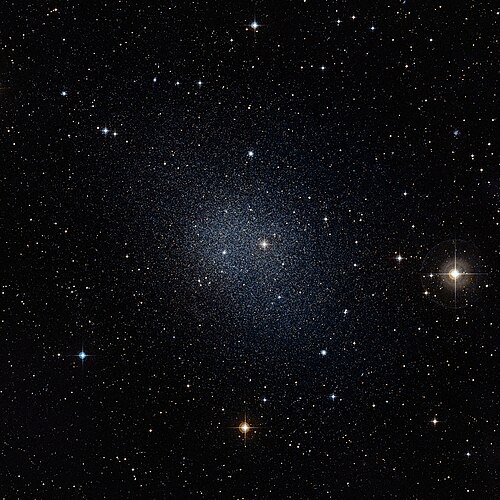
Source: ESO/Digitized Sky Survey 2 | Creative Commons
A Challenge Worth the Hunt
For stargazers, NGC 7006, also known as Caldwell 42, is the definition of elusive. With a visual magnitude of 10.6, it’s far too faint for the naked eye and barely detectable in small backyard scopes. Even in larger telescopes, it appears more like a hazy smudge than a glittering cluster. Its compact size—just 2–3 arcminutes across—adds to the difficulty.
Under dark skies, smaller telescopes may show it as the faintest blur of light. A medium to large telescope (6–10 inches or larger) begins to reveal its concentrated core, and with patience, a sprinkling of stars along its edges. Higher magnification and steady seeing improve the view, while long-exposure astrophotography uncovers its true richness.
The Beauty of Remoteness
Spotting NGC 7006 is not easy. That’s part of its appeal. To glimpse this cluster is to connect with one of the Milky Way’s most distant satellites. It doesn’t dazzle like the Orion Nebula or the Andromeda Galaxy, but its allure lies in what it represents: the vastness of our galactic home. Beyond the Milky Way’s shining spiral arms and crowded core, clusters like NGC 7006 keep circling in quiet solitude, silent witnesses to cosmic history.
My Observations
| Date | September 1, 2023 |
| Time | 9:26 p.m. |
| Location | Seattle, WA |
| Magnification | 127x |
| Scope | Meade 8″ SCT |
| Eyepiece | 16mm |
| Seeing | Average |
| Transparency | Average |
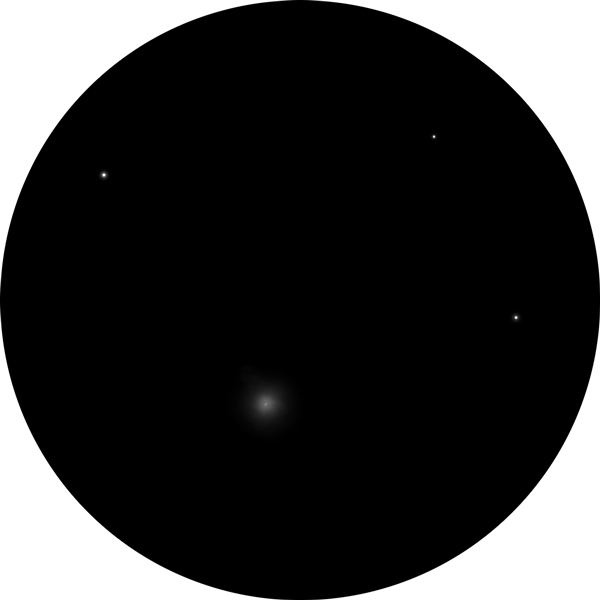
With a waxing moon still hanging in the sky, I slew my scope to NGC 7006. As I let my eyes settle for several seconds and switch to averted vision, a subtle, mottled texture emerges, hinting at a hidden cluster of stars. The glow is soft and diffuse, barely brushing the darkness around it, and no individual stars reveal themselves. I try increasing the magnification, but the smudge only dims, teasing me with its distant, quiet presence.
Key Stats
| Constellation | Delphinus |
| Best Viewing | Late Summer |
| Visual Magnitude | +10.56 |
| Absolute Magnitude | -7.5 |
| Distance from Earth | ~130,000 ly |
| Diameter | 140ly |
| Apparent Size | 3.6 arcmin |
| My Viewing Grade | C |
| Designations | Caldwell 42, C 42, GCl 118, h 2099, OCL 234 |
Sources
NASA. (2023, August 7). Caldwell 42 (NGC 7006) [Image]. NASA Science. https://science.nasa.gov/image-detail/c42-1/
 The Garden Astronomer