
As the Scorpion arches through the summer heavens, it offers a little trickery. In the constellation’s tail is Mu Scorpii, a pair of light blue stars that seem to belong together, but only from our earthly point of view.
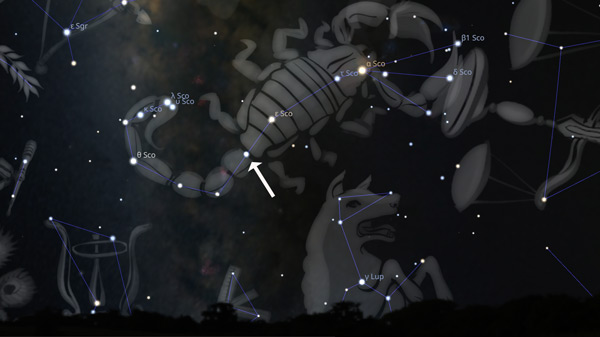
For a long time, astronomers thought the two stars called Mu1 and Mu2 Scorpii were true companions. They sit close together in the sky and even seemed to move in the same direction. But modern measurements revealed they’re not actually bound together. Mu2 is about 515 light-years away, while Mu1 is farther out at 820 light-years. They only look like neighbors.
A Great Pair to View with Binoculars
In binoculars—even small ones—Mu Scorpii creates a pleasing view of two blue stars since they are they are relatively bright (both are easily visible to the naked eye from dark skies) and separated by nearly 5 arcminutes, which is plenty for binoculars.
Mu¹ Scorpii, also known by the name Xamidimura, shines at about magnitude 3.0, bright enough to stand out in the Milky Way backdrop. It is actually a hot B-type star, much more luminous than our Sun. See more about this star below!
Meanwhile, Mu² Scorpii, also known by the name Pipirima, sitting less than 0.1° away in the sky, is fainter at magnitude 3.6, but still easily visible with the naked eye under decent conditions.
Cultural Origins: The Legends Behind Pipirima and Xamidimura
According to Science News, Pipirima (Mu² Scorpii) is named after a pair of fraternal twins, the boy Pipiri and his sister Rehua, figures from a Tahitian legend. In the story, the twins escape their parents by fleeing into the sky, transforming into stars. The parents call them “Pipiri ma” (“ma” meaning “with, and” used after names for “et al.”). In some versions, they become the stars Mu² and Mu¹ Scorpii, while in others, they are represented by different close double stars in Scorpio.
Xamidimura (Mu¹ Scorpii) comes from Khoekhoe mythology in southern Africa. The Khoikhoi people referred to the pair of stars near the scorpion’s tail as “xami di mura,” meaning eyes of the lion. This reflects how the star pair is perceived as bright “eyes” shining side by side. The name Xamidimura is specifically assigned to the primary star, Mu¹ Scorpii, echoing its role in local star lore as part of the “lion’s eyes”
The Intrigue of Mu1 Xamidimura
According to a summary by Jim Kaler, Mu1 is not a single star at all, but a pair of stars locked in a very tight orbit, so close together that no telescope can separate them. Astronomers first figured this out back in 1896 by noticing tiny wobbles in its spectrum (the star’s light fingerprint), and later confirmed it when they saw the pair eclipse each other every 1.44 days. When one star partially blocks the other, their combined brightness dips slightly.
These two stars are massive, together weighing about 21 times the mass of our Sun! They also burn incredibly hot and bright, tens of thousands of times more luminous than the Sun. But here’s the twist: the smaller star is actually the older one. Originally, it was the bigger star of the two, but as it aged and expanded, its outer layers spilled over to its partner. Over millions of years, the stars essentially “swapped roles.” The star that used to be the heavyweight lost much of its mass, while the other ballooned into the more dominant star.
My Observations
| Date | August 20, 2025 |
| Time | 9:50 p.m. |
| Location | Tampa, FL |
| Magnification | 15x |
| Binoculars | 15×70 |
| Seeing | Average |
| Transparency | Average |

Last night, under the heavy blanket of Tampa’s summer heat and humidity, I took my binoculars into the backyard for a little stargazing. My wife joined me on the patio, watching for any gators or snakes from the nearby pond, as I swept my way through Scorpius.
After navigating my way between the pine tree limbs blocking the deep southern sky, I stumbled across a delicate surprise—Mu Scorpii, two small points of light glowing in a soft blue. I’ve never seen this “pair,” and I wasn’t out to see them. I wondered to myself what they were as I made a sketch of the elegant, balanced pair framed between two distant branches of pine trees.
To my eyes, on this humid Florida night, they belonged together. It was a reminder that the sky offers us beauty not just in grand galaxies or blazing planets, but in the small coincidences, too. Sometimes all it takes is a pair of binoculars and a quiet night under the trees to see the heavens in a new way.
Key Stats
| Constellation | Scorpius |
| Best Viewing | Summer |
| Visual Magnitude | + 3.0 | +3.6 |
| Separation | 5 arcminutes |
| Distance | Mu1=820ly | Mu2=515ly |
| My Viewing Grade | A |
| Designations | Mu-1, Mu-2, μ Scorpii |
Sources and Notes
Quintanilla, M. (2018, January 2). 86 stars get official names. Science News. https://www.sciencenews.org/article/86-stars-get-official-names
Kaler, J. B. (n.d.). Mu-1 Scorpii. University of Illinois Department of Astronomy. Retrieved August 23, 2025, from http://stars.astro.illinois.edu/sow/mu1sco.html




 The Garden Astronomer
One thought on “Mu Scorpii: A Pleasant Blue Visual Pair of Stars in Scorpius”