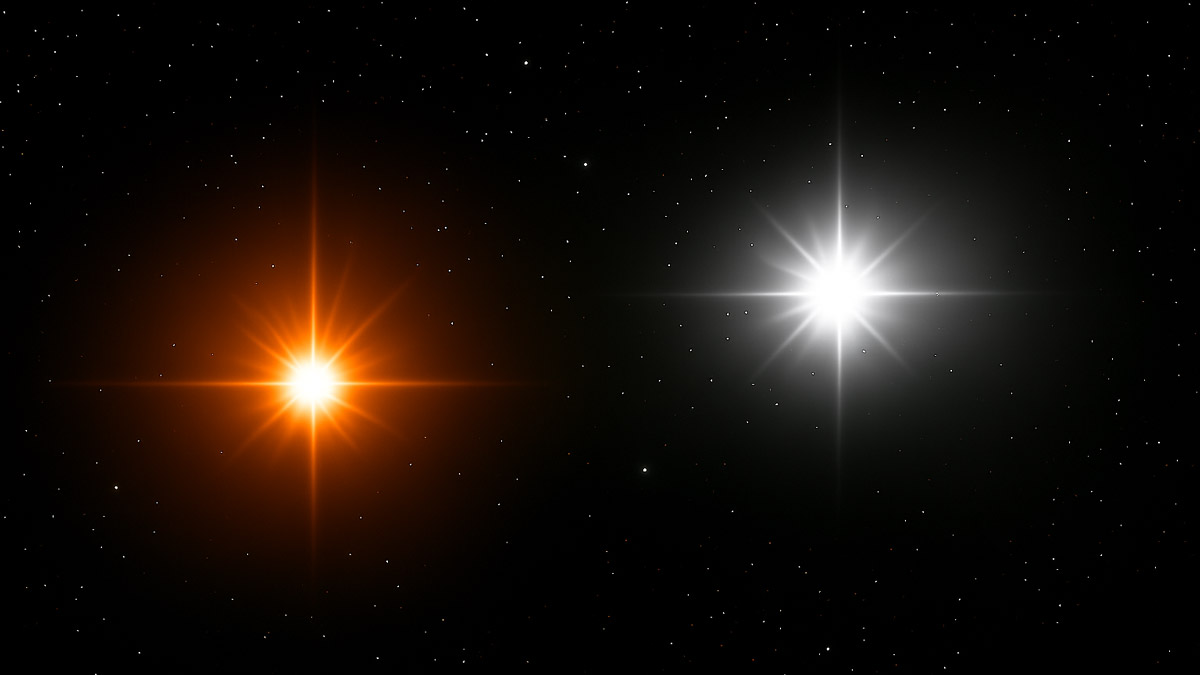
Beta Serpentis, also known as Chow or Struve 1970, is a binary star in the lesser-known constellation of Serpens, the serpent. Late spring and summer are ideal times for backyard astronomers to observe the pair.
When observed without the aid of a telescope, Beta Serpentis appears as a solitary star located in the serpent’s head. The primary star is an A-type main sequence star shining brightly at magnitude +3.7. In contrast, the secondary star lies 30.6 arcseconds away and is a dim K-type main sequence star with a magnitude of +9.7. Of note, an even dimmer star, at magnitude +10.98, lies 202 arcseconds away, but it’s only a visual component.1
Did you know that Beta Serpentis is not just any ordinary binary? In fact, it’s a member of the Ursa Major Moving Group. Astronomers believe this congregation of stars originated from a common stellar nursery. Over time, the gravitational interactions between the stars caused them to move together—and in the same direction—through space. This motion we observe today provides strong evidence for the group’s shared origin and allows astronomers to identify additional member stars that may have dispersed throughout the galaxy.2
Beta Serpentis is one of those stars that has drifted further away from the core in Ursa Major. So when you are looking at Beta Serpentis, let your eyes wander over to the Big Dipper. Take a moment to envision how these sibling stars journey through the galaxy together.
William Herschel first recorded the binary on August 13, 1781.3
My Observations
| Date | June 5, 2023 |
| Time | 11:03 p.m. |
| Location | Seattle, WA |
| Magnification | 169x |
| Scope | Meade 8″ SCT |
| Eyepiece | 12mm |
| Seeing | Above Average |
| Transparency | Above Average |

While not as attractive as Delta Serpentis, Beta Serpentis is still worth one’s time. On this pristine night, the primary star shines brilliantly—almost diamond-like in appearance. I’m having a bit of trouble seeing the secondary star’s color. I was thinking it may be light blue at first glance, but it’s dim and fading into the light-polluted gray sky. Also, according to its classification, the secondary should be warmer in hue (orangish-white). Perhaps it is a faint orange? But I’m unable to tell. However, I can discern that this dim star is not 100% white.
Key Stats
| Constellation | Serpens |
| Best Viewing | Summer |
| Visual Magnitude | +3.7 | +9.7 |
| Absolute Visual Magnitude | +.27 |
| Distance from Earth | 155 ly |
| Separation | 30.6″ |
| Position Angle | 264° |
| Milky Way Location | Orion Spur |
| My Viewing Grade | B |
| Designations | β Serpentis, Chow, Struve 1970, STF 1970, SAO 101725, 28 Ser, HR 5867, HD 141003, HIP 77233 |
Sources and Notes
1“Beta Serpentis.” Wikipedia, 14 May 2023, en.wikipedia.org/wiki/Beta_Serpentis.
2 Talcott, Richard. “Inside the Ursa Major Moving Group.” Astronomy Magazine, 18 May 2023, http://www.astronomy.com/science/inside-the-ursa-major-moving-group/.
3William Herschel’s Double Star Catalog, http://www.handprint.com/ASTRO/Herschel_All.html. Accessed 10 June 2023.
Sketch by Wayne McGraw
 The Garden Astronomer