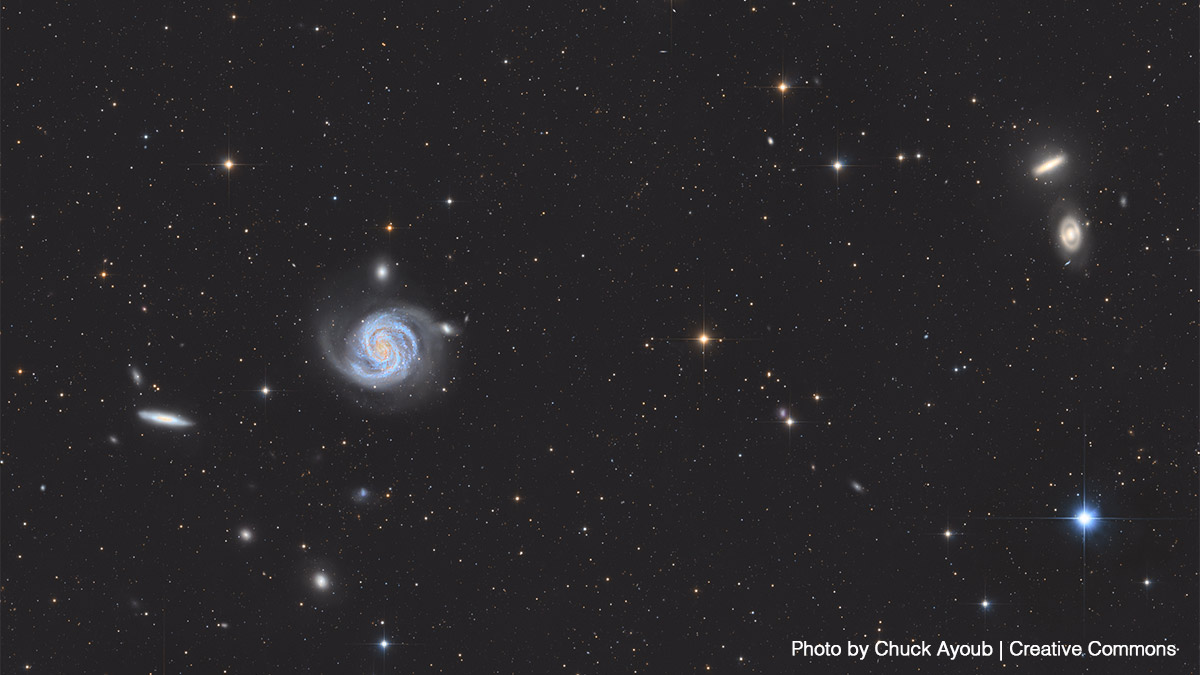
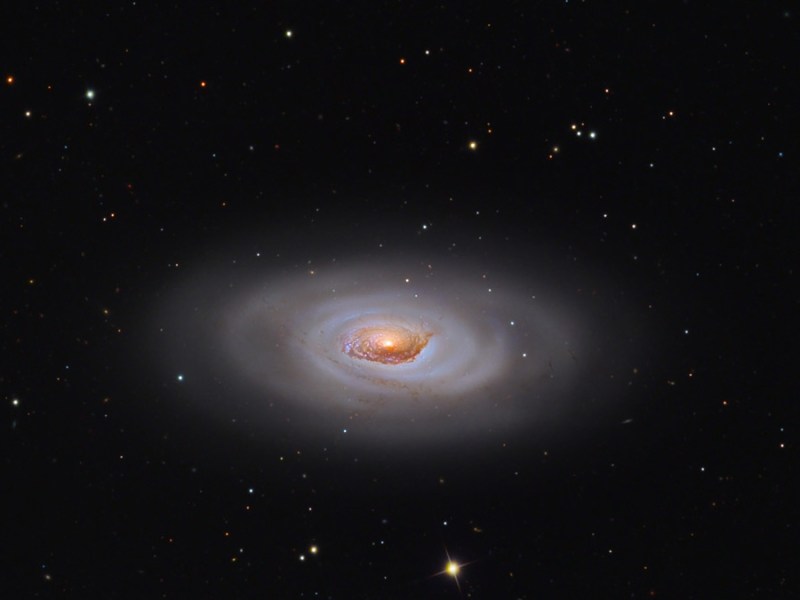
Few celestial objects rival the elegance of spiral structure like Messier 100 (M100), a grand design spiral galaxy nestled in the spring constellation Coma Berenices. Located approximately 55 million light-years away, it is one of the brightest and largest members of the Virgo Cluster. Discovered by Pierre Méchain on March 15, 1781 and catalogued by Charles Messier a month later, M100 remains a highlight for both amateur stargazers and professional astronomers.
A Showcase of Spiral Beauty
M100 is a nearly face-on barred spiral with beautifully defined, symmetrical arms rich in star-forming regions. These arms glow in blue tones from massive young stars and are interspersed with dust lanes and reddish nebulae, marking the ongoing stellar birth within.
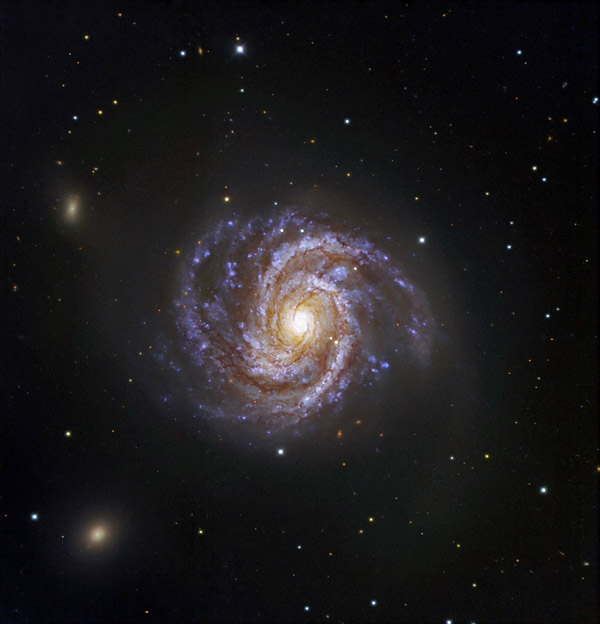
For backyard astronomers, M100 presents different levels of detail depending on equipment and conditions. Through binoculars or a small telescope (3-4 inches), the galaxy appears as a faint, round fuzzy patch with a slightly brighter center. Medium-sized telescopes (6-10 inches) under dark skies begin to reveal the galaxy’s oval shape and brighter nucleus, with the outer regions appearing mottled or uneven.
A Cosmic Pinwheel Worth Visiting
Messier 100 is a visual delight, although its faintness presents a challenge for backyard astronomers in capturing its beautiful light. Charles Messier would relate as we read his observation in his own words, as documented on Messier Objects:
“Nebula without star, of the same light as the preceding [Messier 99], situated in the ear of Virgo. Seen by M. Méchain on March 15, 1781. The three nebulae, nos. 98, 99 & 100, are very difficult to recognize, because of the faintness of their light: one can observe them only in good weather, & near their passage of the Meridian.”
My Observation
| Date | April 26, 2025 |
| Time | 10:43 p.m. |
| Location | Tampa, FL |
| Magnification | ~15x |
| Scope | Seestar S50 |
| Exposure Time | 16 minutes |
| Seeing | Average |
| Transparency | Average |
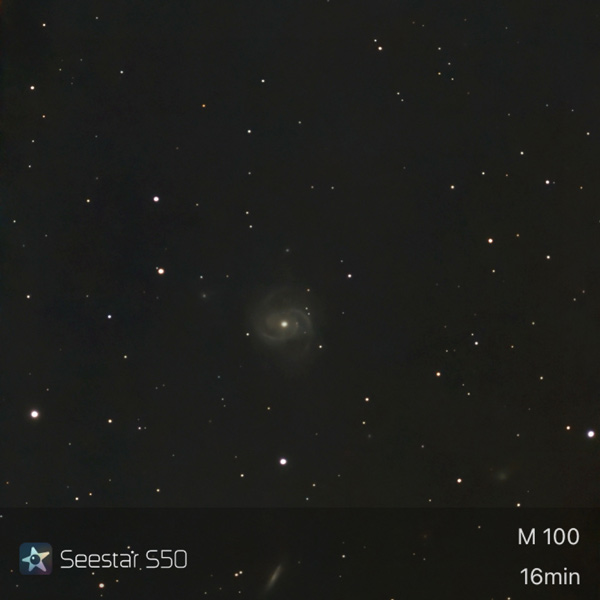
As with several of my observations recorded on this night, I decided to use the small Seestar S50, since Florida’s high humidity made me reconsider setting up my 8-inch scope, which tends to fog up quickly. Next spring, when M100 is in a better position, I plan to spend more time on the galaxy, as my 16-minute exposure just barely brings out its color and arms.
Several years ago in Seattle, I attempted to sketch Messier 100 on multiple occasions, but to no avail due to the region’s light pollution. I did manage to glimpse a very faint smudge as I wiggled the scope, but I felt it wasn’t distinct enough to sketch. I hope to return to darker skies one day to give it another try.
Key Stats
| Constellation | Coma Berenices |
| Best Viewing | Spring |
| Visual Magnitude | +10.1 |
| Absolute Magnitude | -21.8 |
| Distance from Earth | ~55 million light-years |
| Diameter | ~107,000 light-years |
| Apparent Size | ~7.4 × 6.3 arcminutes |
| My Viewing Grade | B |
| Designations | M100, NGC 4321, UGC 7450, PGC 40153 |
Sources and Notes
Banner photo by Chuck Ayoub. Used under Creative Commons CC0 1.0 Universal Public Domain Dedication
Messier Objects. (2020, December 28). Messier 100. Messier-Objects.com. https://www.messier-objects.com/messier-100/
Photo by Wayne McGraw. Seestar S50 image of 16 minutes, stacked

 The Garden Astronomer