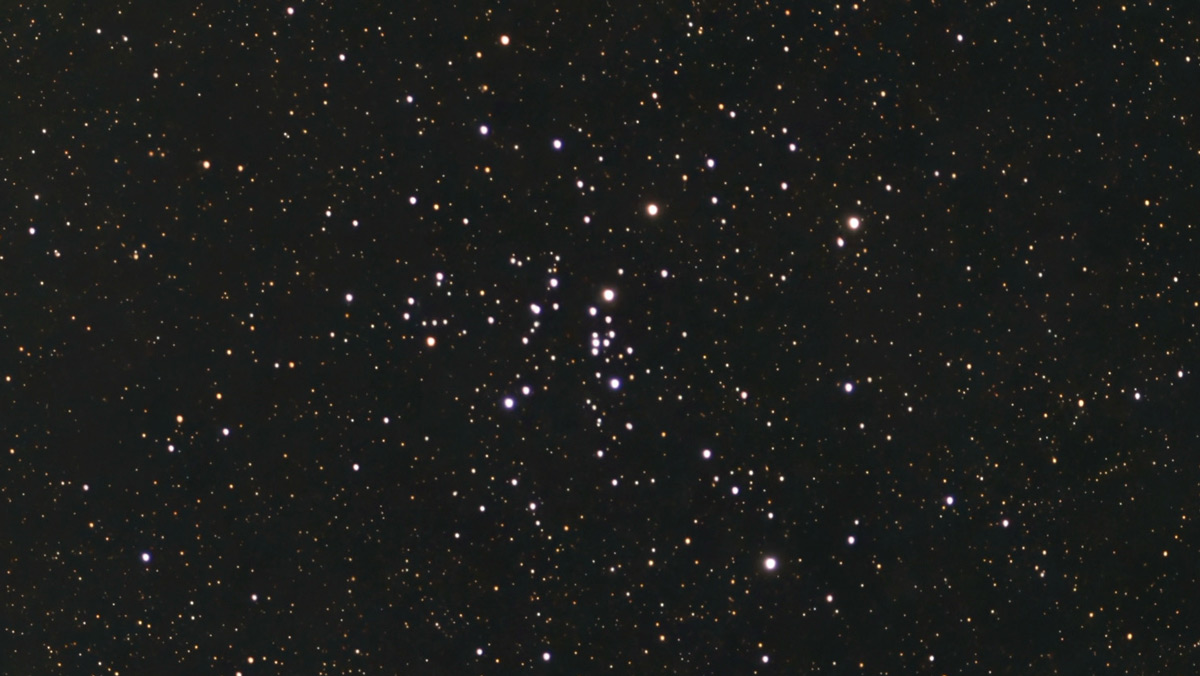
When Charles Messier compiled his famous catalog of celestial objects in the 18th century, he wasn’t looking for pretty star clusters. He was hunting comets. Yet, tucked among his list of “nuisances” that could be mistaken for a comet is one of the loveliest open clusters in the sky: Messier 25 (M25), in the constellation Sagittarius.
Messier added this cluster to his catalog on June 20, 1764. In his notes, he wrote:
“A cluster of small stars in the neighborhood of the two previous clusters [M23 and M24], between the head & the end of the bow of Sagittarius: the nearest known star to this cluster is 21 Sagittarii, 6th magnitude, according to Flamsteed. The stars of this cluster are seen with difficulty with an ordinary telescope of 3.5-foot; no nebulosity can be seen. Its position has been determined from Mu Sagittarii.”
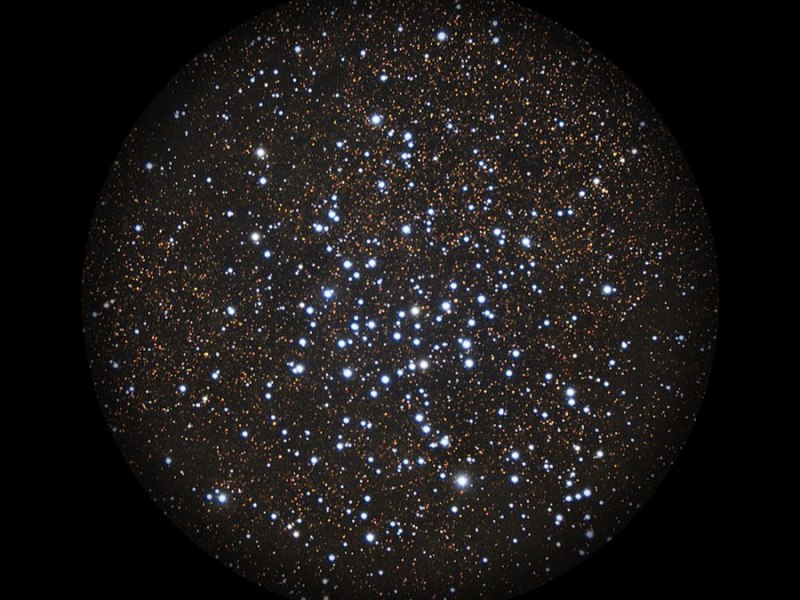
That last remark is important: unlike some clusters surrounded by faint gas, M25 is purely a gathering of stars without any nebulous glow. Today we know that it lies about 2,000 light-years away and contains around 600 stars, spread across a region about 19 light-years in diameter.
What You’ll See
Through binoculars, Messier 25 appears as a scattering of stars against the bright backdrop of the Sagittarius Milky Way. A small telescope reveals its loose, irregular shape. Unlike some compact open clusters, M25 looks more like a patch of sky “salted” with stars.
Later Observers
The cluster also caught the eye of later astronomers. William Herschel observed it but did not include it in his own catalog, likely because of its sparse appearance. His son John Herschel listed it in the General Catalogue as GC 4471. In the 20th century, it found a place in the Collinder Catalog of Open Clusters as Cr 382.
According to Universe Today, the 19th-century Admiral William Henry Smyth described M25 with characteristic flourish:
“A loose cluster of large and small stars in the Galaxy, between the Archer‘s head and Sobieski’s shield [Scutum]; of which a pair of 8th magnitudes, the principle of a set something in the form of a jew’s harp, are above registered. The gathering portion of the group assumes an arched form, and is thickly strewn in the south, on the upper part, where a pretty knot of minute glimmerers occupies the center, with much star-dust around”
A Cluster for Summer Nights
M25 is one of those clusters that rewards a relaxed, sweeping gaze rather than intense scrutiny. It is easy to find, lying north of the brilliant star Mu Sagittarii (Polis). Because it sprawls widely, it looks best in binoculars or a telescope with a low-power eyepiece.
Amid the teapot stars and the hazy band of the Milky Way, pause to linger at Messier 25. It’s not as famous as some of Messier’s other treasures, but it offers a fine reminder of the joy of star clusters.
My Observations
| Date | August 27, 2025 |
| Time | 9:14 p.m. |
| Location | Tampa, FL |
| Magnification | ~15x |
| Scope | Seestar S50 |
| Exposure Time | 5 minutes |
| Seeing | Average |
| Transparency | Average |
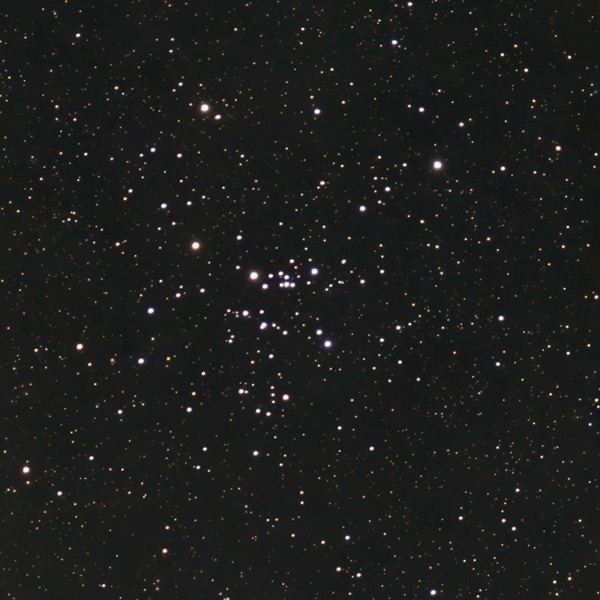
Under the hazy Florida sky, the high humidity had me rethinking my plans to set up my 8-inch scope. Instead, I opted for the efficiency of the Seestar as I’ve been navigating my way through the southern Milky Way. As the Seestar automatically located and tracked the object, I watched on my tablet as live stacking revealed its brilliant collection of stars. While I was disappointed that the weather prevented a visual observation and a chance to sketch the star field, the digital image the Seestar was capturing was a suitable alternative. I look forward to a drier night for a chance at sketching.
Key Stats
| Constellation | Sagittarius |
| Best Viewing | Summer |
| Visual Magnitude | +4.6 |
| Absolute Magnitude | -4.8 |
| Distance from Earth | 2,000 light-years |
| Diameter | 19 light-years |
| Apparent Size | 32 arcmin |
| Milky Way Location | Between Orion Spur & Sagittarius Arm |
| My Viewing Grade | A |
| Designations | M25, IC 4725, Melotte 202 |
Sources and Notes
Quote from Messier: SEDS. (n.d.). Messier 25 (M25) – SEDS Messier Database. Retrieved August 30, 2025, from http://www.messier.seds.org/Mdes/dm025.html



 The Garden Astronomer