
In the sprawling constellation of Scorpius, nestled near the scorpion’s deadly stinger, lies one of the most magnificent and historically significant star clusters visible to the naked eye: Messier 7, also known as Ptolemy’s Cluster. This brilliant stellar gathering has captivated astronomers and stargazers for nearly two millennia, serving as a testament to humanity’s enduring fascination with the cosmos.
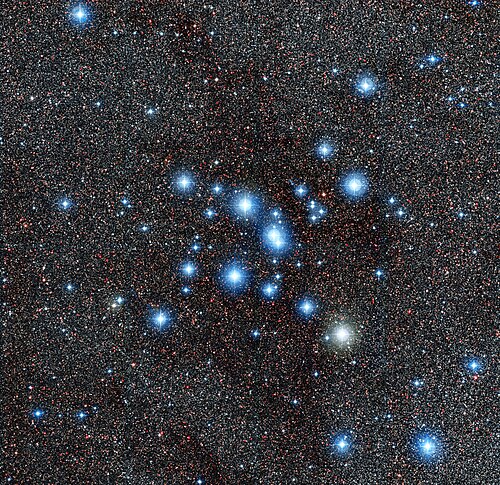
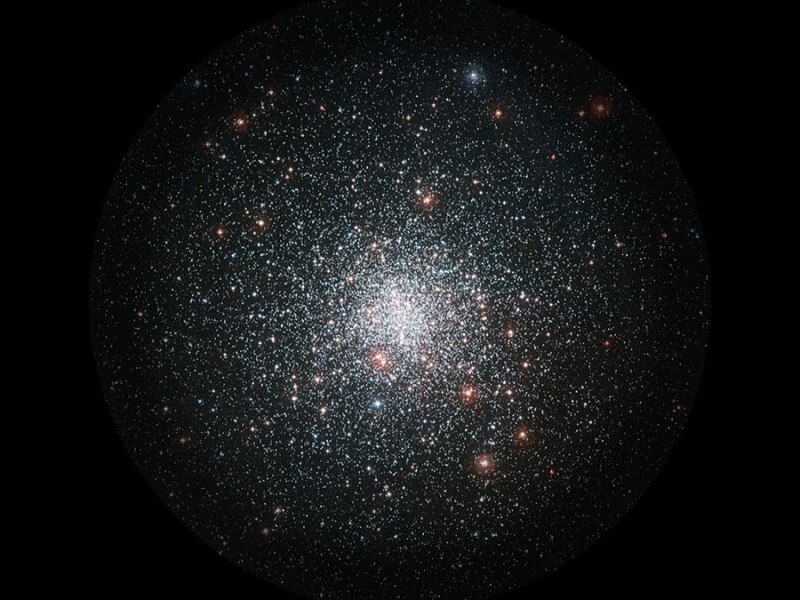
Photo Credit: ESO | Creative Commons
A Window to Ancient Astronomy
Messier 7 holds the distinguished honor of being one of the earliest recorded deep-sky objects in human history. The second-century astronomer Claudius Ptolemy first recorded this open star cluster in 130 AD, earning it the nickname Ptolemy’s Cluster. This remarkable documentation predates Charles Messier’s recording of it on May 23, 1764, making M7 a bridge between ancient and modern astronomy.
Stellar Statistics and Structure
Modern observations have revealed the impressive scope and characteristics of this stellar congregation. At the cluster’s estimated distance of 980 light years this corresponds to an actual diameter of 25 light years. This makes M7 a substantial cosmic neighborhood, containing 80 stars that formed from the same primordial cloud of gas and dust.
For those who want to dig deeper, Ke Hu and Qingya Zhou published general characteristics and mapped a three-dimensional image of the cluster in December 2022 on ResearchGate.
Observing Ptolemy’s Cluster
The cluster presents itself as a great sight, with a combined magnitude of +3.3, making it easily visible to the naked eye from dark locations, such as a beach in the Florida Keys! So, for amateur astronomers and casual stargazers alike, Messier 7 offers one of the most rewarding viewing experiences in the night sky.

The Bigger Picture
For modern observers, M7 provides an accessible entry point into deep-sky astronomy, carrying the weight of nearly 2,000 years of astronomical tradition. Whether viewed through ancient eyes or modern instruments, Ptolemy’s Cluster continues to demonstrate the timeless appeal of the night sky and humanity’s enduring quest to understand the universe around us.
My Observations
| Date | August 27, 2025 |
| Time | 10:06 p.m. |
| Location | Tampa, FL |
| Magnification | ~15x |
| Scope | Seestar S50 |
| Exposure Time | 11 minutes |
| Seeing | Average |
| Transparency | Average |
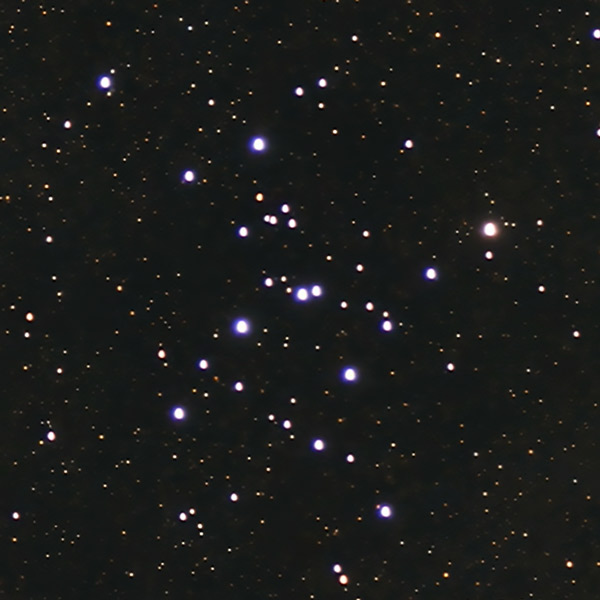
As with several of my observations recorded on this night, I’ve decided to turn to the small Seestar S50, as Florida’s high humidity has me rethinking my plans to set up my 8-inch scope, which tends to fog up quickly. This is a splendid cluster with hues of white, blue, and yellow scattered across the inky cosmos. While I was disappointed that the weather prevented a chance to sketch the star field, the digital image the Seestar was capturing was a suitable alternative. I look forward to a drier night for a chance at sketching.
Key Stats
| Constellation | Scorpius |
| Best Viewing | Summer |
| Visual Magnitude | +3.3 |
| Absolute Magnitude | -4.8 |
| Distance from Earth | ~980 light-years |
| Diameter | 25 light-years |
| Apparent Size | 80 arcmin |
| Milky Way Location | Orion Spur |
| My Viewing Grade | A |
| Designations | M7, NGC 6475, Ptolemy’s Cluster |
Sources and Notes
SEDS. (n.d.). Messier 7 (M7) – The Ptolemy Cluster. Retrieved August 30, 2025, from http://www.messier.seds.org/m/m007.html
Hu, K., & Zhou, Q. (2022). Study of Messier 7 Open Cluster with Gaia EDR3. IOP Publishing.
Banner photo by Wayne McGraw. Seestar S50 image of 11 minutes, stacked


 The Garden Astronomer