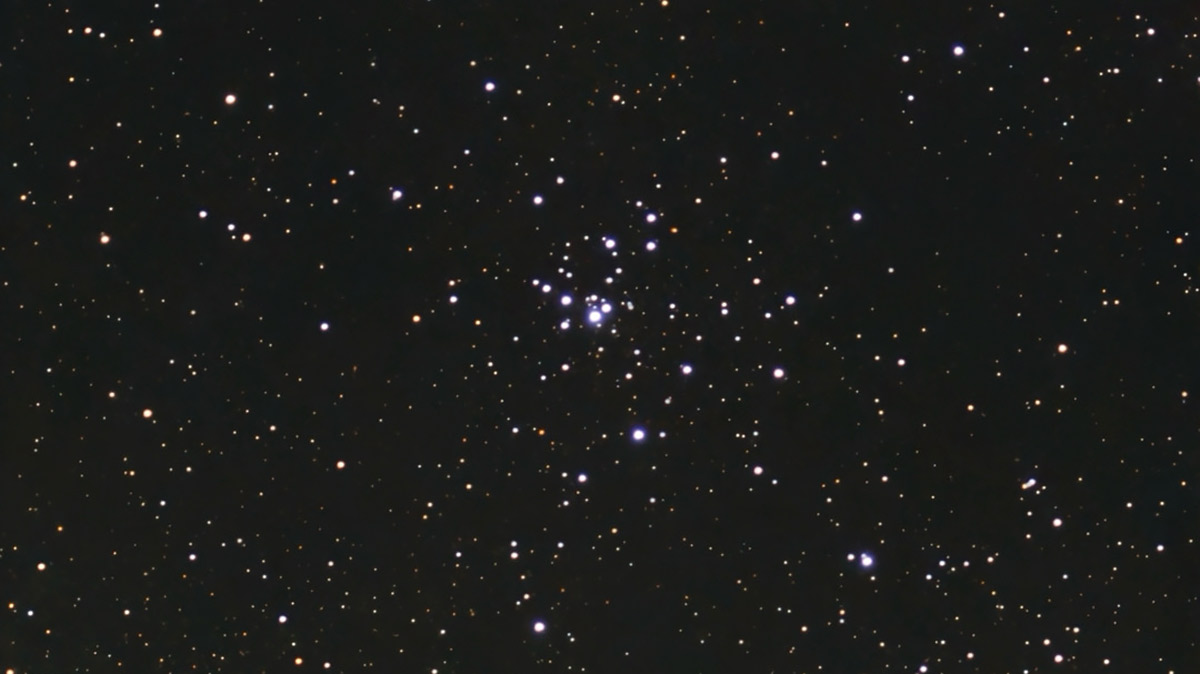
There’s something satisfying about stumbling across an overlooked treasure in the night sky. Messier 21, a compact open cluster in Sagittarius, doesn’t have the same fame as its nearby celestial neighbors like the Lagoon Nebula (M8) or the Trifid Nebula (M20). However, if you take the time to linger, M21 offers a quiet beauty all its own.
Discovery and Description
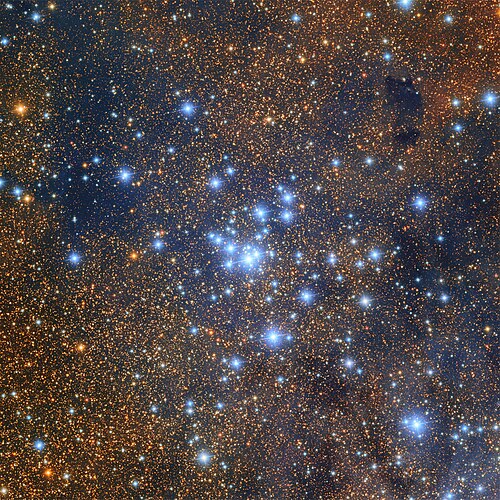
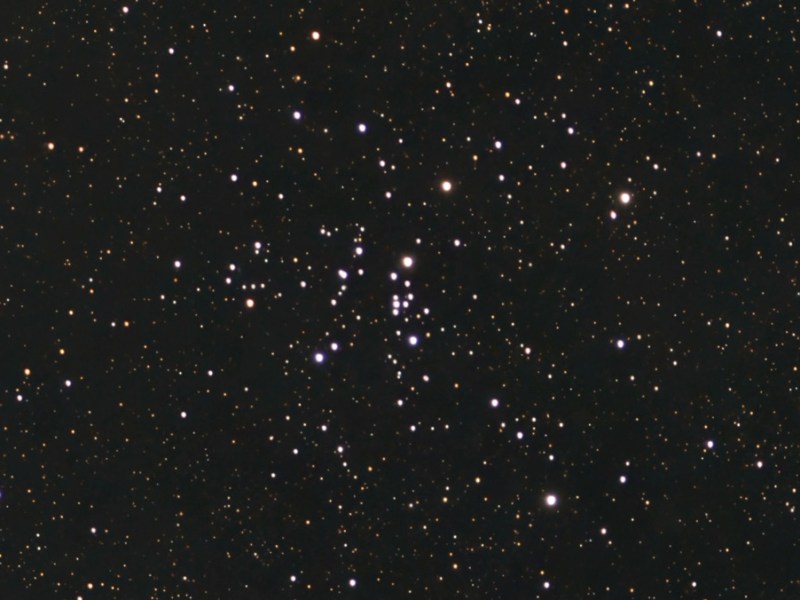
M21 was discovered by Charles Messier on June 5, 1764, the very same night he recorded the nearby Trifid Nebula. In his notes, he described it simply as a “star cluster, near the preceding M20.” And that’s exactly how it looks: a tight cluster of about 57 stars squeezed into a modest patch of sky.
At a distance of roughly 3,900 light-years, M21 shines at a visual magnitude of +6.5 — just beyond naked-eye visibility, but easy to find with binoculars or a small telescope. It spans about 13 arcminutes, which makes it appear about half the size of the full Moon.
What You’ll See
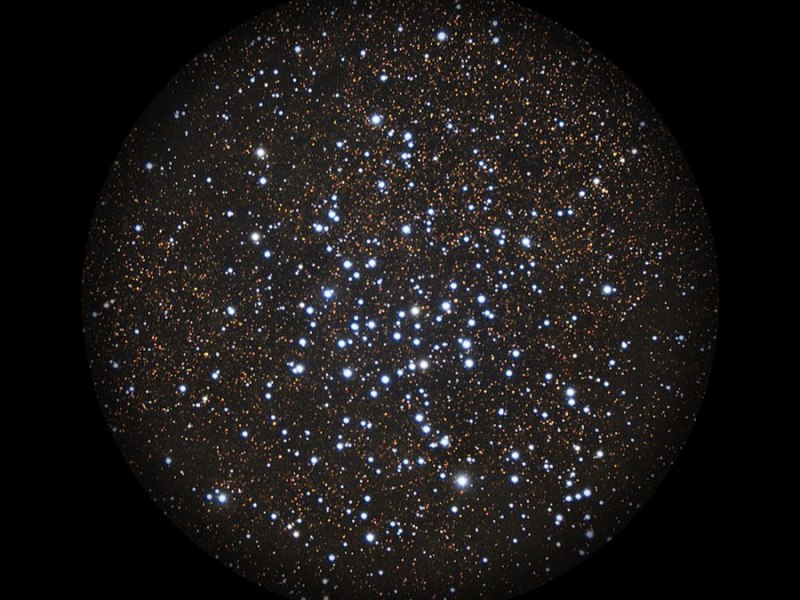
Through binoculars, M21 looks like a small, misty knot of starlight. But in a telescope, the cluster begins to resolve into distinct points, delicate, white-blue stars arranged in a compact grouping. Unlike sprawling clusters such as the Pleiades or M25, M21 has a sense of neatness to it. It doesn’t overwhelm your field of view; instead, it draws your gaze inward.
Neighborhood Stars
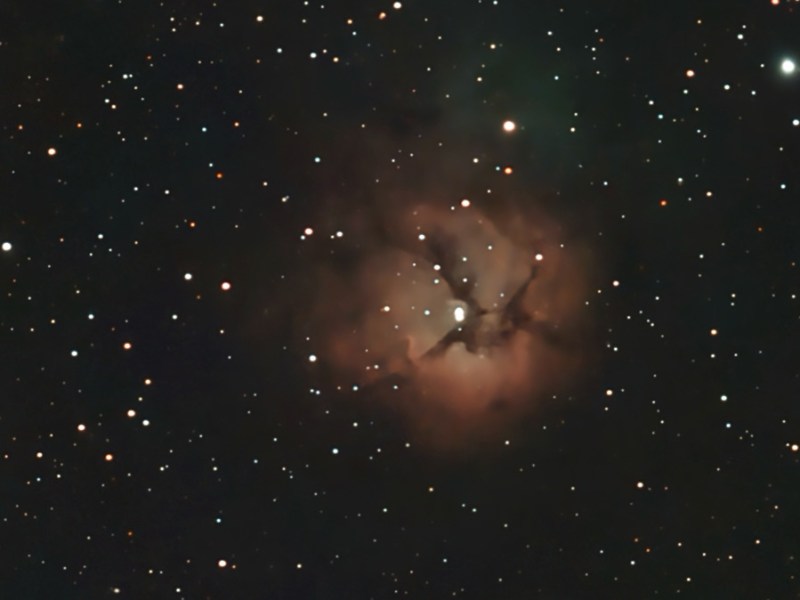
What makes M21 extra interesting is its proximity to the Trifid Nebula (M20). They’re less than a degree apart in the sky, and though they appear to be companions, they’re not physically related. M21 lies in front of M20 along our line of sight, like two postcards stuck together on a bulletin board. That makes for an especially photogenic field if you’re imaging the area.
Observing Tips
If you want to track down M21, start with Sagittarius. Look for the Lagoon Nebula (M8), which is a bright and obvious target. Just north of M8, you’ll find the Trifid Nebula (M20), and a short nudge to the east will reveal M21. A wide-field eyepiece or binoculars can frame M20 and M21 together, which is a lovely pairing.

Because it’s a relatively dim cluster, M21 benefits from dark skies and steady seeing. It may not stop you in your tracks at first glance, but it’s worth pausing to consider: you’re looking at a gathering of stars that were all born together, siblings in the vast stellar family of the Milky Way.
The next time you’re sweeping the Sagittarius region, don’t just skip from Lagoon to Trifid and move on. Take a moment to enjoy Messier 21. It’s like discovering a hidden gem just off the main trail.
My Observation
| Date | August 27, 2025 |
| Time | 9:47 p.m. |
| Location | Tampa, FL |
| Magnification | ~15x |
| Scope | Seestar S50 |
| Exposure Time | 8 minutes |
| Seeing | Average |
| Transparency | Average |
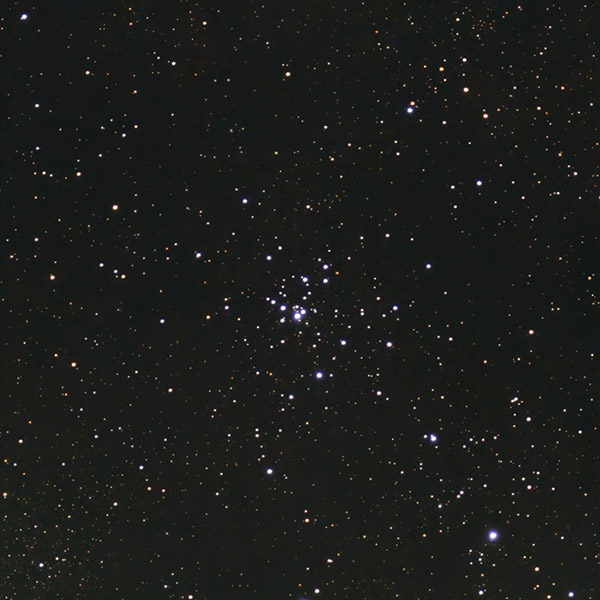
With the risk of my 8-inch SCT fogging up in tonight’s heat and humidity, I’ve decided to use the small Seestar S50. I appreciate “seeing” Messier 21 for the first time, for it has vibrant blue stars. I look forward to sketching it on another evening in the future.
Key Stats
| Constellation | Sagittarius |
| Best Viewing | Summer |
| Visual Magnitude | +6.5 |
| Absolute Magnitude | -5.2 |
| Distance from Earth | ~3,900 light-years |
| Diameter | ~20 light-years |
| Apparent Size | 13 arcminutes |
| My Viewing Grade | B |
| Designations | NGC 6531, M21, Cr 359 |
Sources and Notes
RubinObs/NOIRLab/SLAC/NSF/DOE/AURA. (2025, June 23). Trifid and Lagoon Nebulae excerpt: Messier 21 [Photograph]. NOIRLab, NSF. Retrieved August 31, 2025, from https://noirlab.edu/public/images/noirlab2521ag/
Frommert, H. (2005, May 22). Messier 21. SEDS Messier Database. http://www.messier.seds.org/Mdes/dm021.html
Photo by Wayne McGraw. Seestar S50 image of 16 minutes, stacked



 The Garden Astronomer