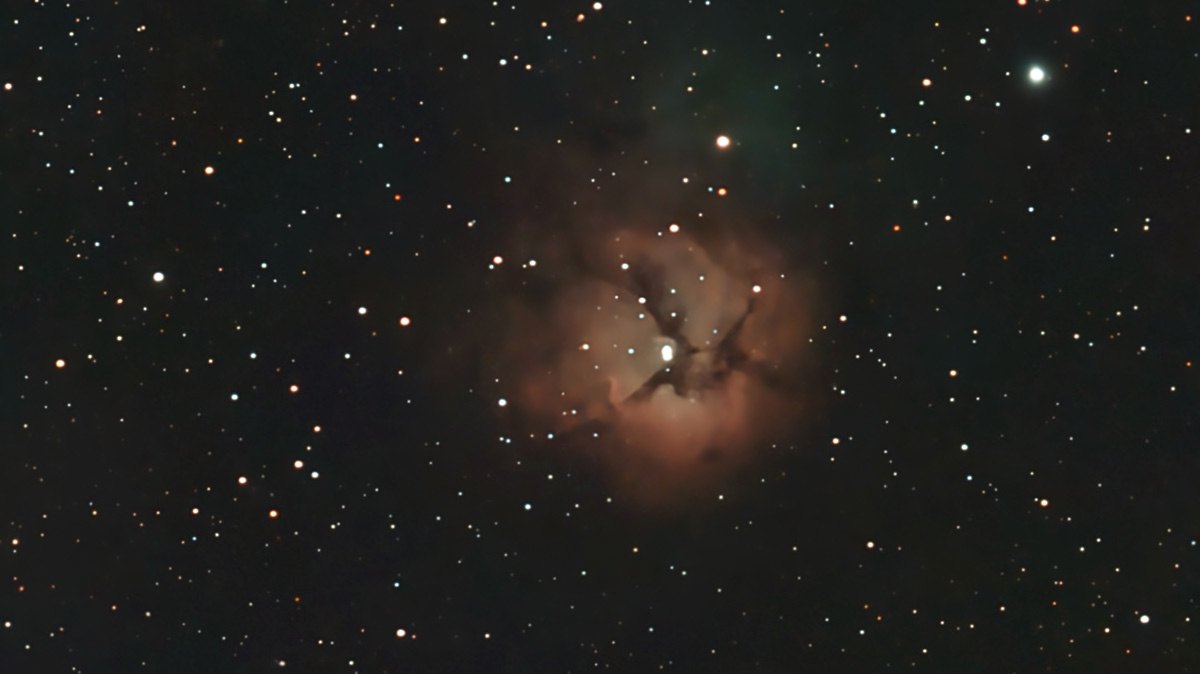
For backyard astronomers eager to glimpse one of the summer sky’s most captivating treasures, the Trifid Nebula awaits in the constellation Sagittarius. You can best view it from June through August when this region reaches its highest point in the sky around midnight. For backyard astronomers, the nebula appears as a small, hazy patch of light in binoculars, while a modest telescope reveals its dark lanes.
Discovery and Early Observations
The Trifid Nebula was discovered by Charles Messier on June 5, 1764, during his survey of the night sky, noting a “cluster of stars, a little above the Ecliptic, between the bow of Sagittarius & the right foot of Ophiuchus.”
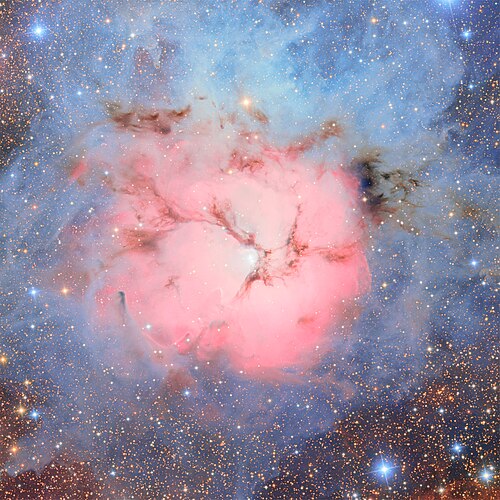
His son, John Herschel, later gave it the name “Trifid,” meaning “divided into three lobes,” after observing the distinctive dark lanes that appear to split the nebula into three sections.
A Stellar Nursery Revealed
The Trifid Nebula sits approximately 5,200 light-years from Earth and spans about 40 light-years across. It represents a fascinating combination of stellar phenomena: an emission nebula glowing red from ionized hydrogen gas, a blue reflection nebula where starlight scatters off dust particles, and dark nebula regions where dense dust blocks background light.
A Window into Cosmic Creation
Modern astronomical instruments have revealed the Trifid as an exceptionally active star-forming region. In 2005, NASA’s Spitzer Space Telescope made groundbreaking infrared observations that pierced through the nebula’s dusty veil, revealing 30 embryonic stars and 120 young stellar objects that had been previously hidden from optical telescopes.
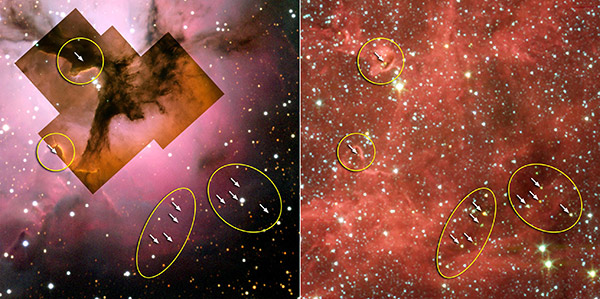
Credit: NASA/JPL-Caltech/NOAO/STScI
On the next clear summer evening, venture outside and turn your gaze toward Sagittarius. Even if you can only make out a faint smudge of light through binoculars, know that you’re looking at a stellar nursery where new suns are being born and the raw materials of future planets swirl in the darkness.
My Observation
| Date | July 27, 2025 |
| Time | 1:00 a.m. |
| Location | Tampa, FL |
| Magnification | ~15x |
| Scope | Seestar S50 |
| Exposure Time | 21 minutes |
| Seeing | Average |
| Transparency | Average |
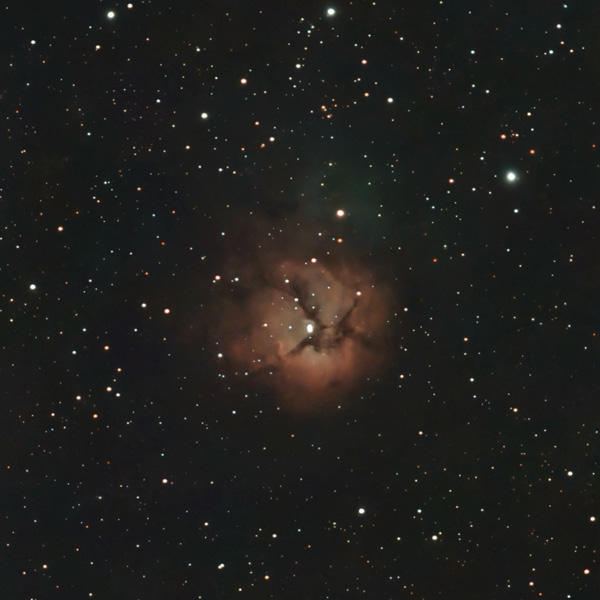
Instead of wrestling with my 8-inch SCT in Florida’s humid air, I let the Seestar capture the Trifid Nebula for me. The photo beautifully shows M20’s iconic dark dust lanes and its rosy hydrogen glow. A simple setup, but a stunning reminder of just how much beauty a small scope can reveal. I hope to get out under better conditions so I can sketch this wonderful sight.
Key Stats
| Constellation | Sagittarius |
| Best Viewing | Summer |
| Visual Magnitude | +6.3 |
| Absolute Magnitude | +1.7 |
| Distance from Earth | ~5,200 light-years |
| Diameter | 40-50 light-years |
| Apparent Size | 28 arcminutes × 28 arcminutes |
| Milky Way Location | Orion Spur |
| My Viewing Grade | A |
| Designations | M20, NGC 6514, h 1991, h 3718, GC 4355 |
Sources and Notes
NOIRLab. (2025, June 23). Trifid Nebula [Image]. NOIRLab. https://noirlab.edu/public/images/noirlab2521ah/
http://www.messier.seds.org/Mdes/dm020.html
Banner photo by Wayne McGraw. Seestar S50 image of 21 minutes, stacked



 The Garden Astronomer
One thought on “Messier 20 (NGC 6514): The Trifid Nebula in Sagittarius”