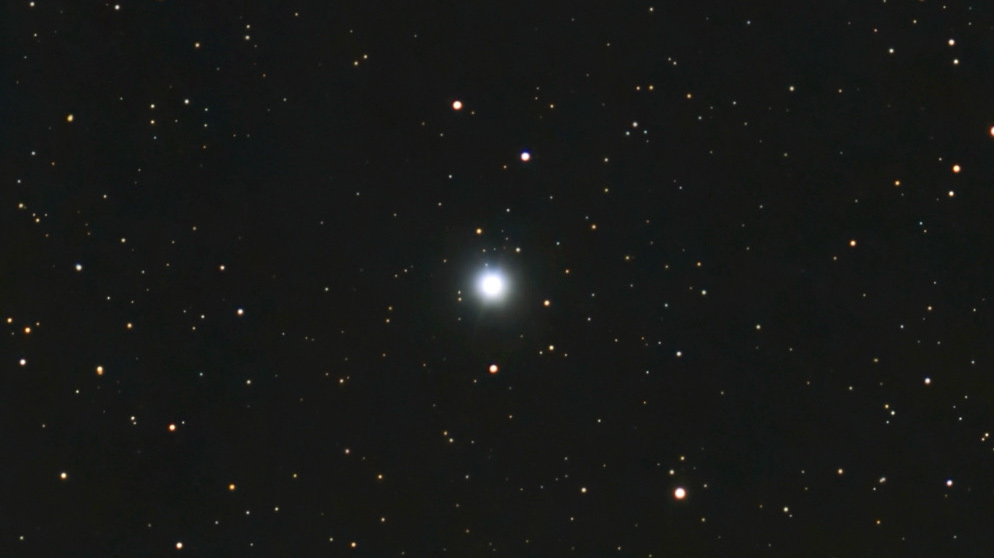
As you gaze up at the canopy of the winter night sky, a striking blue-white star draws your attention. Gomeisa sparkles vividly, not far from the more familiar Procyon in the constellation of Canis Minor. For me, Gomeisa stands out as one of the most stunning blue-white stars visible to the naked eye, and it is a personal favorite.
Hot, Fast, and Blue
Also known as Beta Canis Minoris, Gomeisa is a B-type star, giving it that striking blue-white hue that immediately marks it as a hot and energetic star. Located about 170 light-years from Earth, it shines at an apparent magnitude of 2.9, making it easily visible on a clear night. Its name comes from the Arabic al-ghumaisa, meaning “the bleary-eyed (woman),” a poetic nod from ancient stargazers.
Gomeisa is especially interesting because of its physical properties. Its surface temperature is over 11,000 Kelvin! This makes it more than twice as hot as our Sun. This intense heat gives Gomeisa its distinctive blue color and causes it to consume its nuclear fuel quickly. The star is also about three times as massive as the Sun and spins very rapidly, completing a full rotation in just a day. For comparison, the Sun takes 27 days to rotate once.
Beyond the Blue Glow
Gomeisa is also classified as a Gamma Cassiopeiae-type variable star, which means its brightness can fluctuate slightly due to material ejected from its equatorial regions, forming a disk around the star. Observing this subtle variation can be a rewarding challenge for amateur astronomers with precise instruments.
For stargazers, locating Gomeisa is straightforward. It sits just east of Procyon, the brighter star of Canis Minor. While yellow-white Procyon is the alpha star of the constellation, Gomeisa’s vivid blue tone offers a lovely contrast, making the small constellation a delightful target for both binoculars and small telescopes.
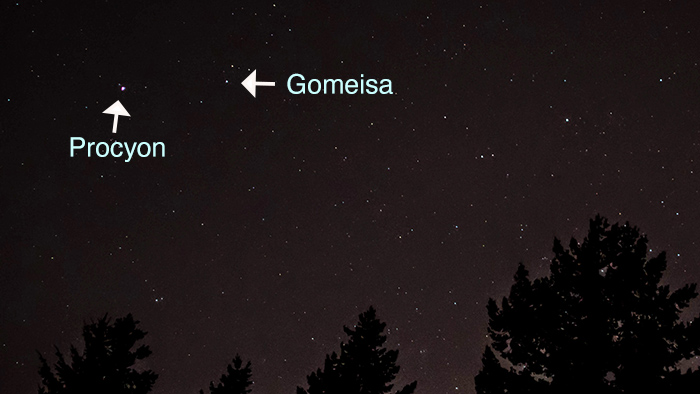
Each glance east of Procyon is a look 170 light-years back in time, inviting reflection on the vastness of space and our own place within it.
My Observations
| Date | February 22, 2024 |
| Time | 8:12 pm |
| Location | Seattle, WA |
| Magnification | 169x |
| Scope | Meade 8″ SCT |
| Eyepiece | 12mm |
| Seeing | Average |
| Transparency | Average |
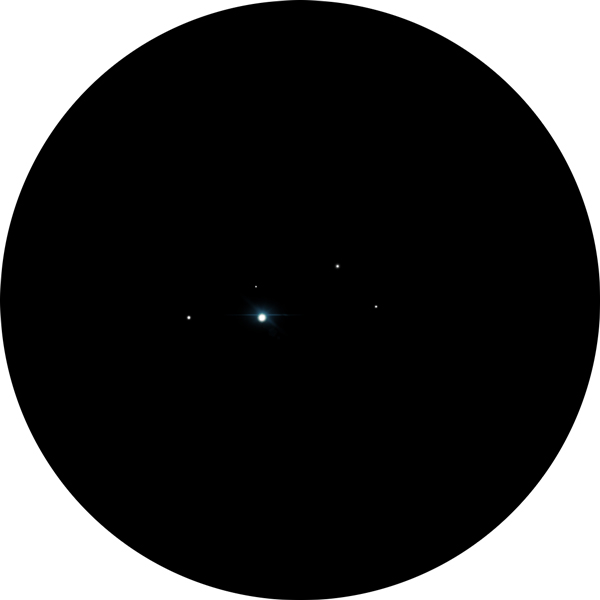
On this cold Seattle winter’s night, I revisit one of my favorite stars. Gomeisa glows in a way that always pulls at my heart. While it doesn’t have a bright double companion for the eye to catch, the surrounding stars in Canis Minor sparkle like a little cluster. Its soft blue reminds me of my younger sister’s eyes. Ashley had deep blue eyes. She, like this star, is unforgettable, even though she left us far too soon.
Key Stats
| Constellation | Canis Minor |
| Best Viewing | Winter |
| Visual Magnitude | +2.90 (variable) |
| Absolute Visual Magnitude | -.6 |
| Distance from Earth | ~162 light-years |
| My Viewing Grade | A |
| Designations | Beta Canis Minoris, β CMi, 3 Canis Minoris, HIP 36188, HR 2845, HD 58715 |
Sources and Notes
Zeta Ophiuchi: Embracing a Rejected Star. (2022). NASA Chandra X-ray Center. https://chandra.cfa.harvard.edu/photo/2022/zetaoph/
Zeta Ophiuchi. (n.d.). en.wikipedia.org/wiki/Zeta_Ophiuchi. https://en.wikipedia.org/wiki/Zeta_Ophiuchi
Kaler, J. B. (n.d.). gomeisa. STARS. Retrieved September 6, 2025, from http://stars.astro.illinois.edu/sow/gomeisa.html
Sketch by Wayne McGraw
 The Garden Astronomer