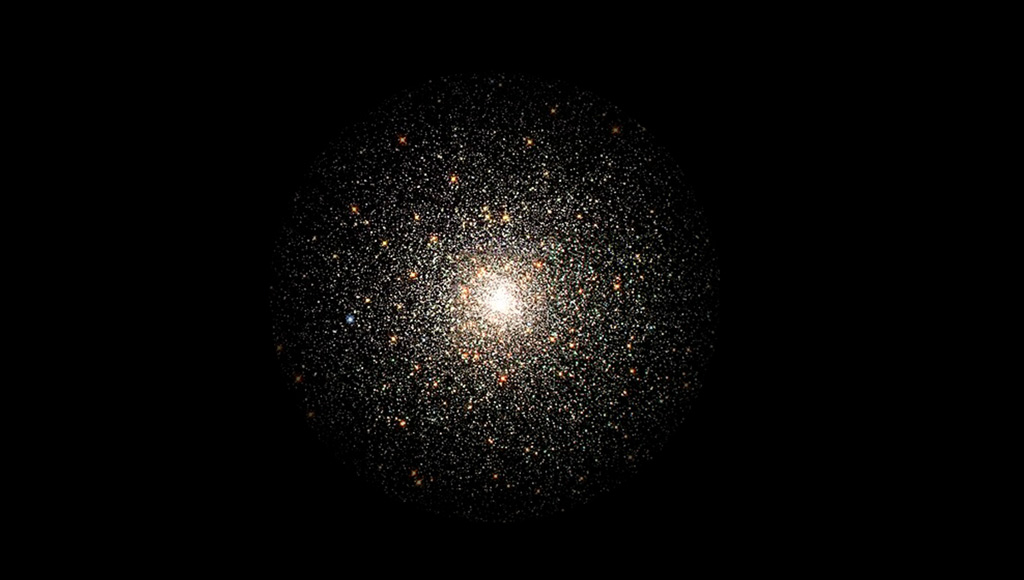
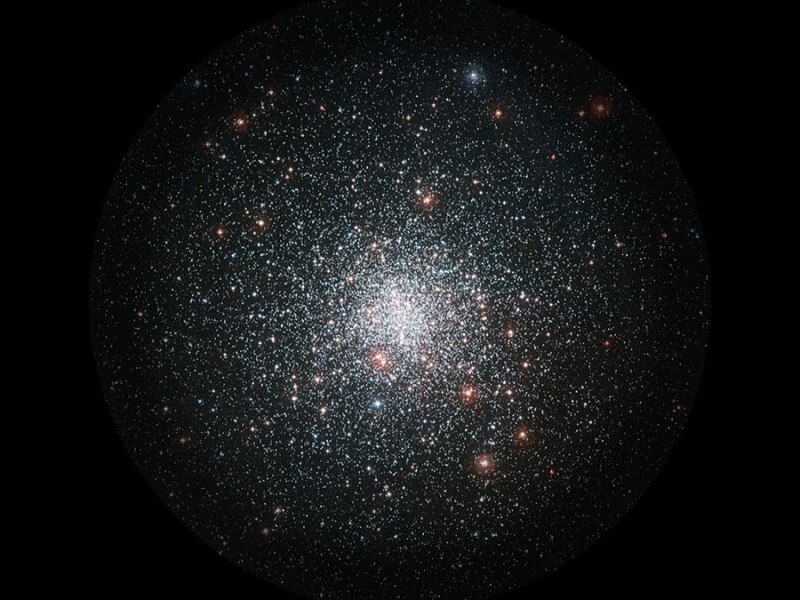
Tucked between the bright stars of Antares and Beta Scorpii in Scorpius lies Messier 80 (M80). Cataloged also as NGC 6093, this globular cluster is one of the most densely packed in our galaxy. It’s a glittering ball of ancient stars, around 500,000 of them, bound together in a gravitational dance nearly as old as the universe.
Why M80 Stands Out
What makes Messier 80 extraordinary is its incredible density. Globular clusters are already tightly packed, but M80 is among the densest of them all. At its heart, stars crowd so close together that their average separation is less than a light-year. That’s far closer than the several light-years that typically separate stars near our Sun.

NASA, The Hubble Heritage Team, STScI, Public Domain
The cluster is also famous for a dramatic event: in 1860, astronomers witnessed a nova erupting from one of its stars, briefly making the cluster shine brighter than ever before. On May 28, 1860, Norman Pogson described that he “was arrested by the startling appearance of a star of the 7.6 magnitude in the place which the nebula previously occupied.” Today, according to NASA, the Hubble Space Telescope allowed astronomers to pinpoint the hot, faint remnant of the white dwarf that produced the nova in M80.
Observing the Cluster
From a dark site, even binoculars may reveal M80 as a faint smudge. A telescope of 4 inches or more begins to resolve the cluster into a grainy patch of starlight. See more of my observations below. Also, if you’re viewing from southern latitudes, note that M80 will be higher in the sky, offering potentially clearer views.
Historically speaking, on the early morning hours of January 4, 1781, Charles Messier observed the cluster as a “nebula without star” with a “center brilliant, and it resembles the nucleus of a small Comet, surrounded with nebulosity.”
My Observations
| Date | September 13, 2025 |
| Time | 9:00 p.m. |
| Location | Tampa, FL |
| Magnification | 169x |
| Scope | Meade 8″ SCT |
| Eyepiece | 12mm |
| Seeing | Average |
| Transparency | Below Average |
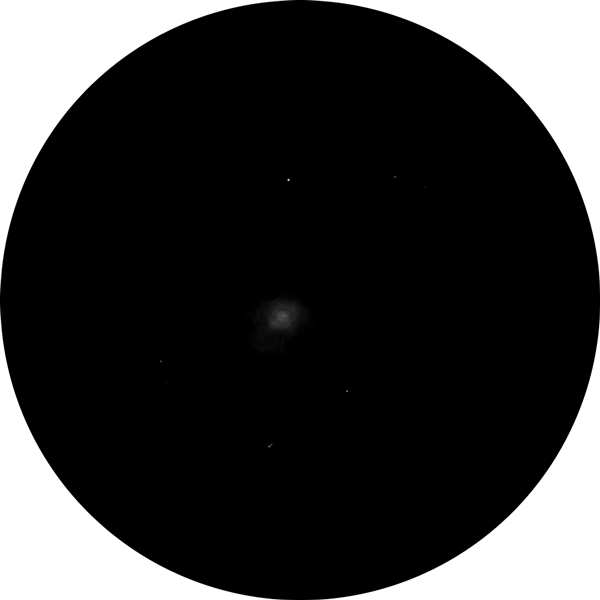
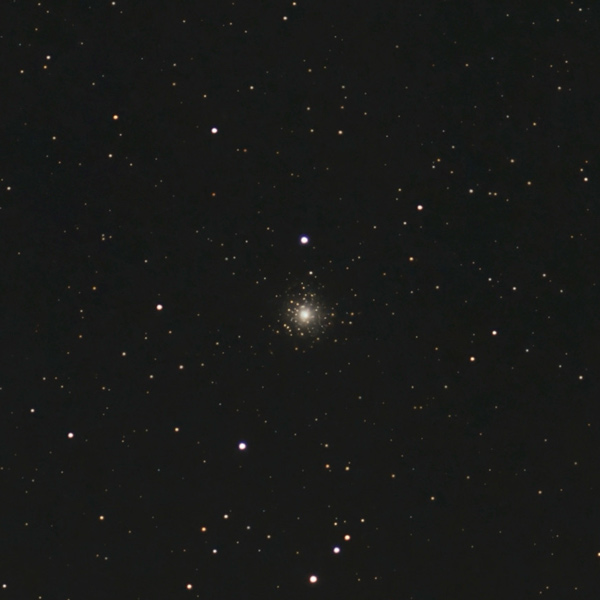
I’ve had the chance to see Messier 80 twice using two scopes. The sketch above was created in 2023 from Seattle, with M80 low in the southern skies against bright suburban skies. I was unable to pull out individual stars, unfortunately, due to the sky glow; however, I could make out the brighter, dense center. Then, on September 13, 2025, around 9p.m., I captured M80 a second time using the Seestar S50 from Tampa, Florida.
Key Stats
| Constellation | Scorpius |
| Best Viewing | Summer |
| Visual Magnitude | +7.3 |
| Absolute Magnitude | -8.5 |
| Distance from Earth | ~32,600 light-years |
| Diameter | ~93 light-years |
| Apparent Size | 10 arcmin |
| Milky Way Location | Orion Spur |
| My Viewing Grade | B- |
| Designations | M80, NGC 6093 |
Sources and Notes
SEDS. (n.d.). Messier Object 80 (M80). Retrieved September 14, 2025, from http://www.messier.seds.org/Mdes/dm080.html
Pogson, N. R. (1860). Remarkable changes observed in the cluster 80 Messier. Monthly Notices of the Royal Astronomical Society, 21(1), 32. https://doi.org/10.1093/mnras/21.1.32
Banner photo by Wayne McGraw. Seestar S50 image of 11 minutes, stacked
 The Garden Astronomer