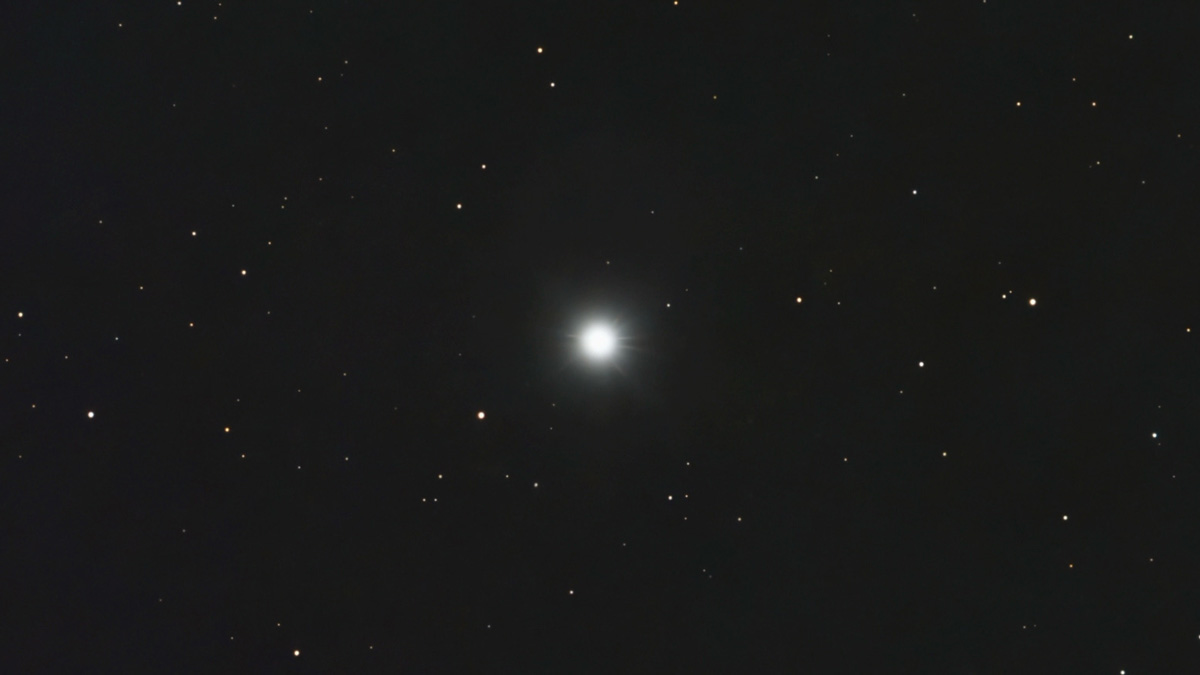
As autumn nights grow crisp and new constellations rise, Fomalhaut emerges in the southern sky. Known as the Lonely Star of Autumn, it shines with a bluish-white light, set apart from its peers in a quiet stretch of the deep southern heavens.
Where to Find It
Fomalhaut resides in the constellation Piscis Austrinus, the “Southern Fish.” The name itself comes from Arabic, meaning “mouth of the fish.” Scan low in the southern sky on October and November evenings; the lone bluish-white star you find is Fomalhaut. Unlike stars in constellations like Orion or Pegasus, Fomalhaut doesn’t have a cluster of bright stars around it. Instead, it floats alone, making it an easy standout once you know where to look. This fact made it a helpful navigational star for sailors.
A Star with a Planetary Disk
Astronomically, Fomalhaut is a fascinating object. Located about 25 light-years away, it’s a relatively close neighbor to our Sun. This star is a young A-type main-sequence star, burning hot and blue-white, and about twice as massive as the Sun.
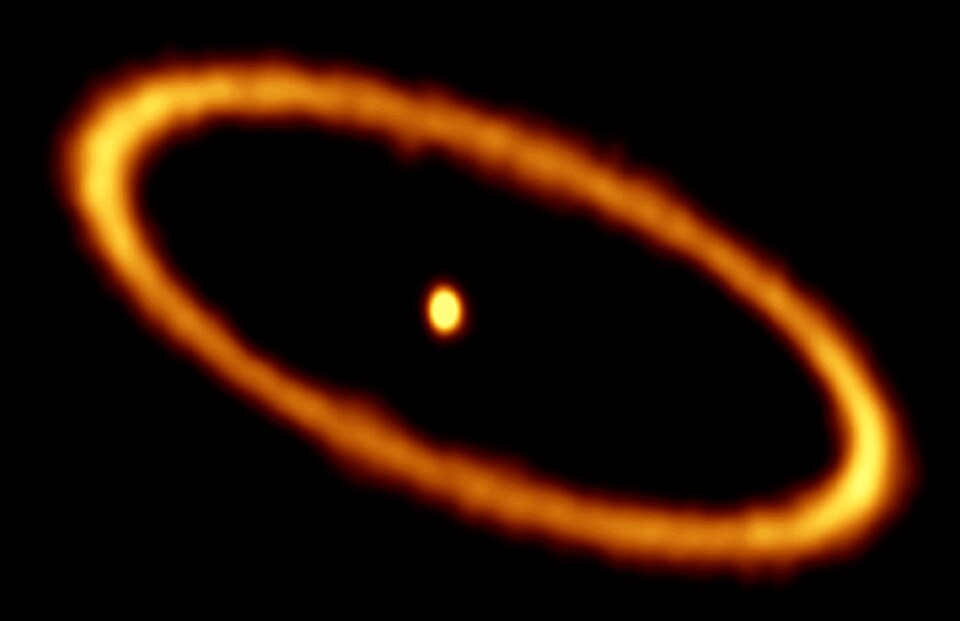
ALMA (ESO/NAOJ/NRAO)/L. Matrà/M. A. MacGregor | Creative Commons
Fomalhaut is especially interesting because of its debris disk, a wide ring of dust and ice that circles the star, similar to a larger version of our solar system’s Kuiper Belt. The Hubble Space Telescope showed that the disk has sharp edges, probably shaped by the gravity of unseen planets. In 2008, astronomers announced they had found a planet, Fomalhaut b. Later research raised questions about whether it was a lasting planet or just a temporary cloud of debris, but the system is still one of the most studied exoplanetary environments.
My Observations
| Date | September 19, 2025 |
| Time | 10:30 p.m. |
| Location | Tampa, FL |
| Binoculars | 25×70 |
| Eyepiece | 25x |
| Seeing | Average |
| Transparency | Average |
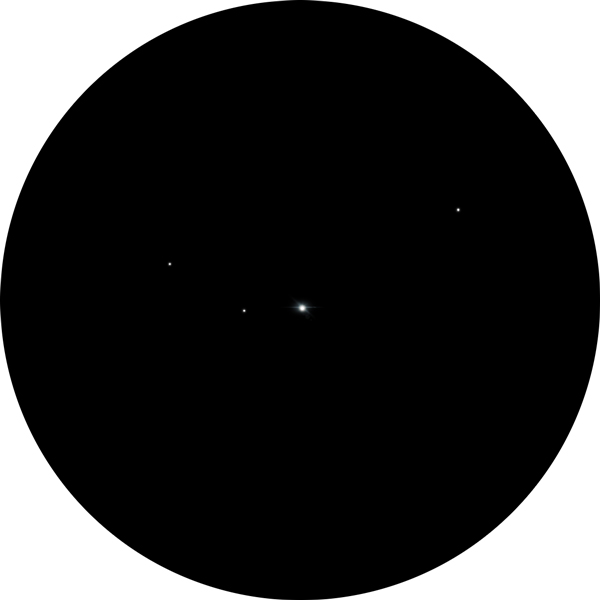
Back when I lived in Seattle, my southern horizon was hidden behind a wall of tall trees, and I never ventured to seek Fomalhaut, and I can’t recall seeing it from my Colorado locations, though I know it was visible. From my vantage point in Tampa, the view is different. From here, Fomalhaut climbs much higher in the sky, standing out as one of the few bright southern stars that can pierce through the hazy glow of the city lights.
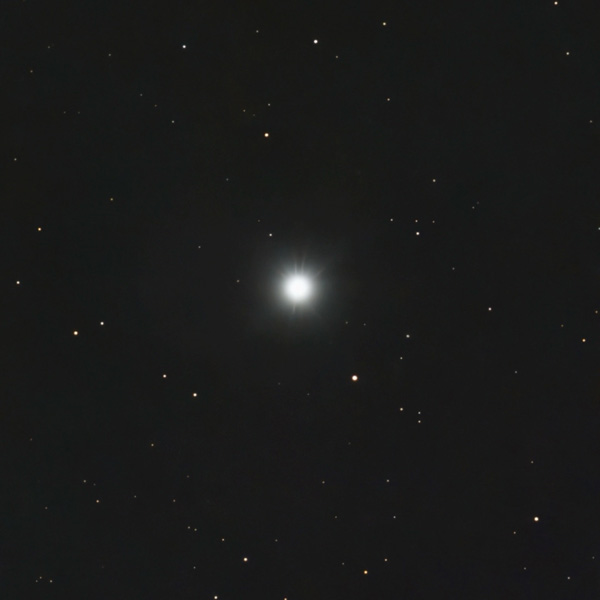
Armed with my binoculars, I finally catch sight of it tonight from my porch—sparkling with a delicate blue hue, almost solitary, with only a scattering of faint companions nearby. In this moment, I understand why sailors once used Fomalhaut as a navigational guide across open seas. Its isolation in the sky makes it unmistakable. I’ve turned my Seestar S50 on the star as well, revealing this point of light in all its quiet brilliance, framed by the stillness of space.
Key Stats
| Constellation | Piscis Austrinus |
| Best Viewing | Autumn |
| Visual Magnitude | +1.16 |
| Absolute Visual Magnitude | +1.72 |
| Distance from Earth | 25 ly |
| Milky Way Location | Orion Spur |
| My Viewing Grade | A |
| Designations | Alpha Piscis Austrini, α PsA, HR 8728, HD 216956, SAO 191524 |
Sources and Notes
Banner photo and sketch by Wayne McGraw
The Editors of Encyclopaedia Britannica (2025, September 13). Fomalhaut. Encyclopedia Britannica. https://www.britannica.com/place/Fomalhaut
Thayer, B. (Ed.). (n.d.). Piscis Australis. In R. H. Allen, Star names: Their lore and meaning. Retrieved September 20, 2025, from https://penelope.uchicago.edu/Thayer/E/Gazetteer/Topics/astronomy/_Texts/secondary/ALLSTA/Piscis_Australis%2A.html
 The Garden Astronomer
3 thoughts on “Fomalhaut: The Lonely Star of Autumn Skies”