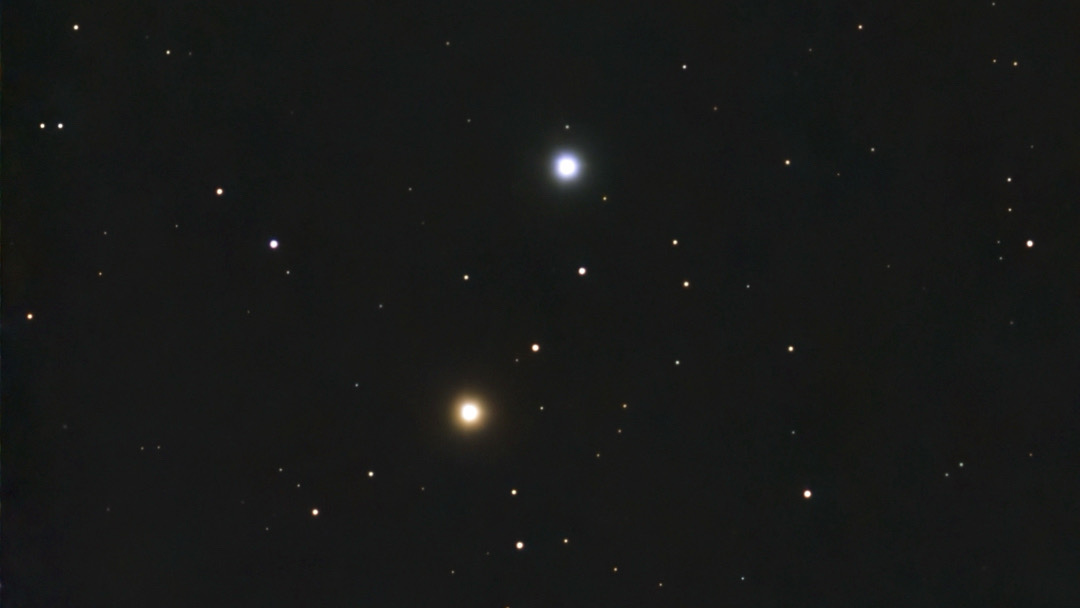
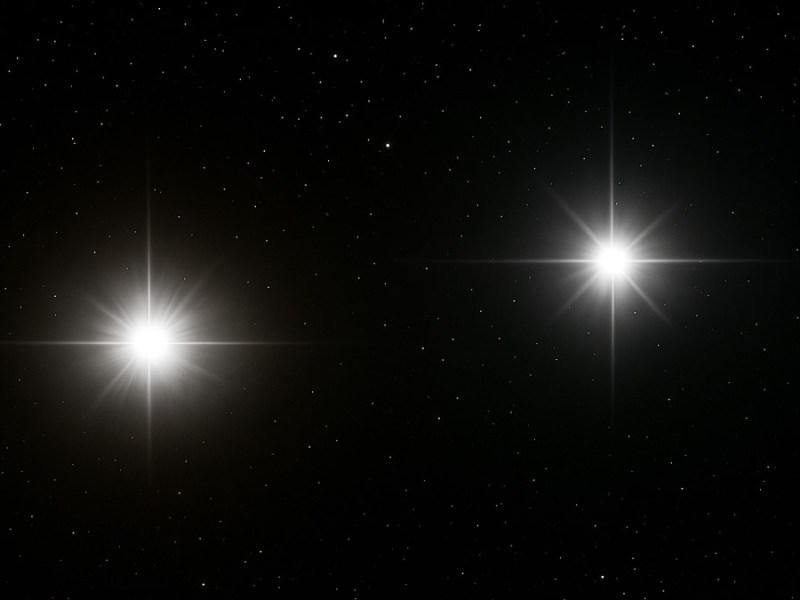
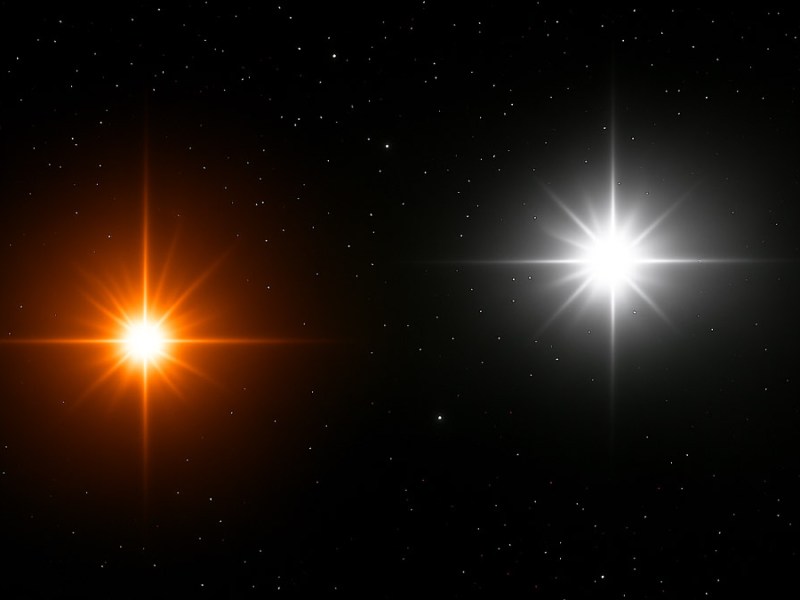
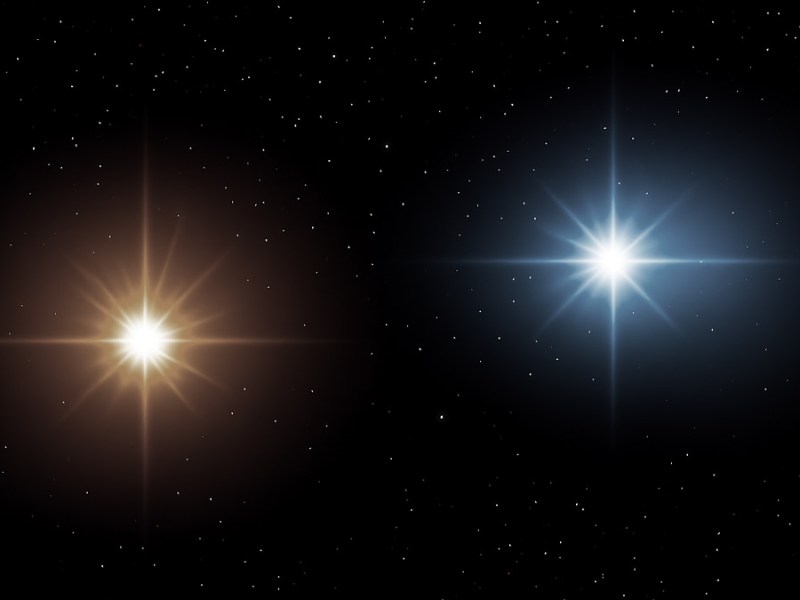
From spring through autumn, the kite-shaped constellation Boötes takes center stage in the night sky, rewarding backyard astronomers with a scattering of deep-sky objects and double stars. Among them is the wide visual pair Nu Boötis, featuring the orange-hued Nu¹ Boötis and the blue Nu² Boötis. They make for an easy, must-see target and beautiful gift from the herdsman.
A Great Pair to View with Binoculars
Much like the visual pair Mu Scorpii, Nu Boötis creates a pleasing view in both binoculars and telescopes. First, there is Nu¹ Boötis, a striking orange star classified as a K4 giant, which shines at magnitude +5.01. According to astronomer Jim Kaler, this star is about 88 times larger than our Sun and lies roughly 838 light-years away.
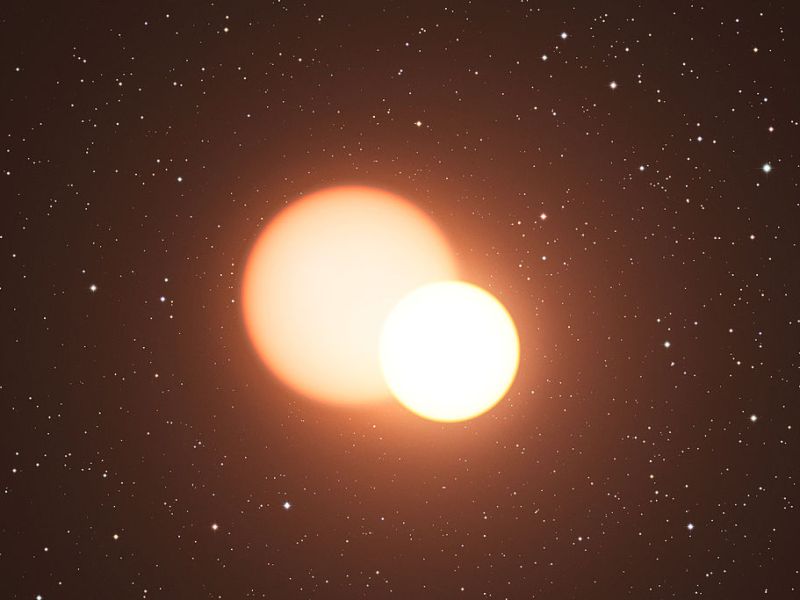
Nearby shines Nu² Boötis with its blue hue at a distance of 388 light-years away and at a magnitude of +4.98. Nu² is especially intriguing because it is a true binary star system: two A-type main-sequence stars orbiting one another. Our backyard telescopes are unable to split the tight binary, so we are left with the impression of a single, blue-tinted point of light.
A Beautiful Pair but Stellar Strangers
It’s tempting to think of Nu¹ and Nu² Boötis as a stellar sibling pair, but in truth, they are strangers. Their distances—838 light-years vs. 388 light-years—are too different for them to be gravitationally bound. They only appear close together because of our line of sight. Still, it’s a happy coincidence, giving backyard astronomers a double star with vivid and memorable color contrast.
My Observations
| Date | September 19, 2025 |
| Time | 8:50 p.m. |
| Location | Tampa, FL |
| Magnification | 15x |
| Binoculars | 15×70 |
| Seeing | Average |
| Transparency | Average |
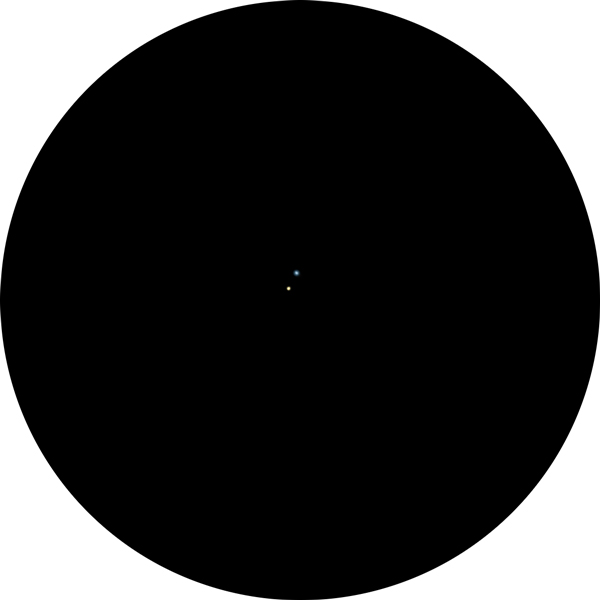
On this clear September evening, as Boötes dips beneath the western horizon, I catch sight of Nu Boötis in what feels like a farewell to summer. Through my binoculars, the pair reveals itself in simple beauty: Nu¹ glowing with its warm orange hue beside the cool blue of Nu². The contrast is striking, especially against the backdrop of a sky slowly giving way to autumn’s constellations.
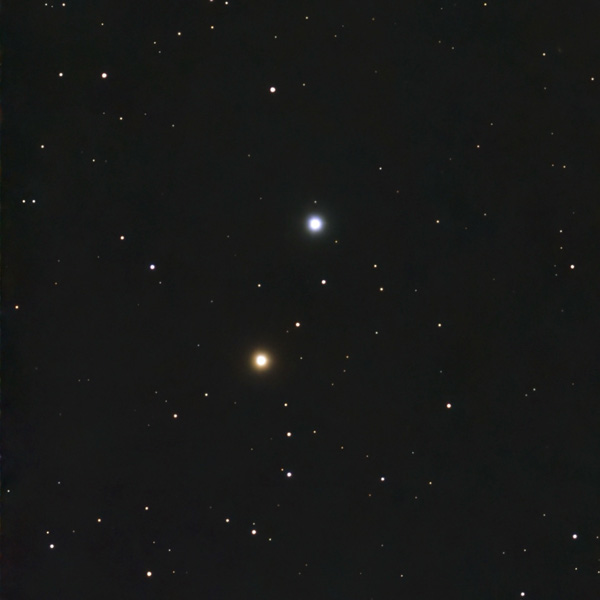
Four minutes of 10-second exposures stacked under Bortle 7-8 suburban skies outside Tampa, Florida.
Not wanting the moment to pass too quickly, I turn my Seestar S50 toward the pair. The little scope captures their colors with impressive clarity, enhancing the contrast that already stands out in my binoculars. It feels like a fitting sendoff, watching the herdsman bow out for the season while leaving behind this colorful gem as a parting gift.
Key Stats
| Constellation | Boötes |
| Best Viewing | Spring — Early Autumn |
| Visual Magnitude | +5.02 (Nu¹) | +4.98 (Nu²) |
| Separation | 10 arcminutes |
| Distance | Nu¹ ≈ 840 ly | Nu² ≈ 400 ly |
| My Viewing Grade | A+ |
| Designations | Nu¹ Boötis (ν¹ Boo, 27 Boötis) | Nu² Boötis (ν² Boo, 28 Boötis) |
Sources and Notes
Banner photo and sketch by Wayne McGraw
Stars. (n.d.). Nu Boötis (ν Boo). University of Illinois. Retrieved September 21, 2025, from http://stars.astro.illinois.edu/sow/nuboo.html

 The Garden Astronomer