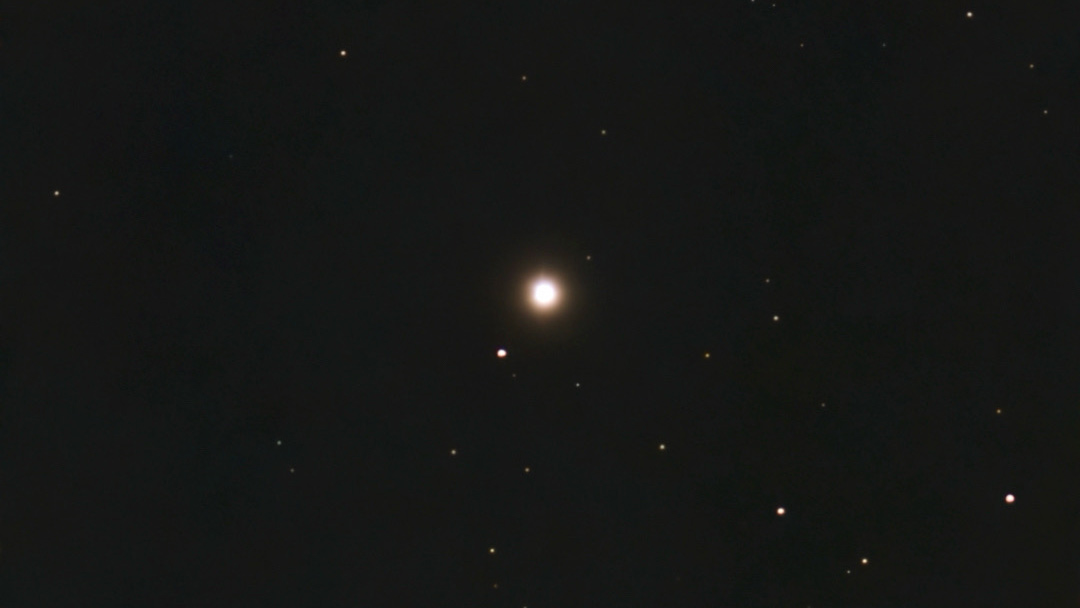
Ankaa, or Alpha Phoenicis, isn’t a star that demands attention. It doesn’t shine with the brilliance of Sirius or throb like Betelgeuse, yet as the brightest star in the southern constellation Phoenix, it still captures interest. For those of us in the Northern Hemisphere, spotting it requires traveling below 30° latitude—places like southern Texas or Florida—where, in October and November, it glows low along the southern horizon.
With an apparent magnitude of +2.4, Ankaa shines with a warm orange hue. Classified as a K0 giant, it has evolved beyond its youthful hydrogen-burning phase, expanding and cooling into a mature, steady glow. Its surface temperature hovers around 4,500 K, which is cooler than our sun, but its larger size makes it roughly 80 times more luminous. Sitting about 85 light-years away, the light reaching us tonight began its journey in the mid-20th century, a quiet testament to the vast scale of the cosmos.

Image is courtesy of the History of Science Department at the University of Oklahoma.
Public Domain in the United States
Historically speaking, Ankaa was recognized in multiple star catalogs, including Bayer’s Uranometria (1603), where it received the designation Alpha Phoenicis for being the constellation’s brightest star. Its name, “Ankaa,” directly connects it to the mythical Phoenix, a symbol of rebirth and renewal, which seems fitting for a star that has evolved beyond its main-sequence stage.
My Observations
| Date | September 19, 2025 |
| Time | 11:30 p.m. |
| Location | Tampa, FL |
| Binoculars | 25×70 |
| Eyepiece | 25x |
| Seeing | Average |
| Transparency | Average |

Back when I lived farther north, Phoenix was always hidden below the horizon, and I never had the chance to look for Ankaa. Even during visits to darker skies in the Rockies, it stayed too far south to rise into view. But now, from Florida, the sky opens differently. On autumn evenings, Ankaa climbs just high enough above the southern horizon to reveal itself, quietly shining among the faint stars that shape the Phoenix.
From my backyard, I sweep the area with binoculars, and there it is with its warm glow, brighter than its neighbors, and easy to pick out once found. Unlike the famous northern stars, Ankaa feels like a secret jewel of the southern sky, visible only if you’re far enough south and patient enough to search for it.
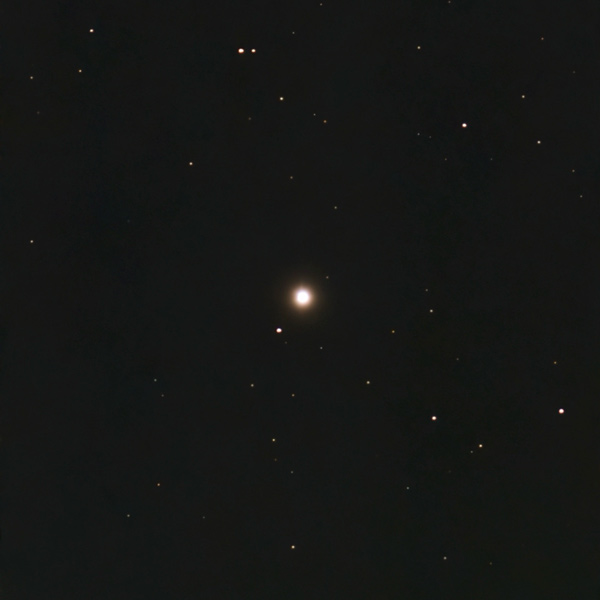
Two-minute exposure stacked.
I turn my Seestar S50 toward it, capturing the solitary point of light. Though it looks modest compared to grand clusters and nebulae, I can’t help but admire its role: the heart of a constellation that many in the north never see, a reminder of how shifting your place on Earth changes the entire canvas of the heavens.
Key Stats
| Constellation | Phoenix |
| Best Viewing | Autumn (Spring in S. Hemipshere) |
| Visual Magnitude | +2.4 |
| Absolute Visual Magnitude | +0.28 |
| Distance from Earth | ~ 80 light-years |
| Milky Way Location | Orion Spur |
| My Viewing Grade | B |
| Designations | Alpha Phoenicis, α Phe, HR 99, HD 2261, SAO 215093, HIP 2081, Alp Phe, CRU 9004 |
Sources and Notes
Banner photo and sketch by Wayne McGraw
Wikipedia contributors. (n.d.). Alpha Phoenicis. Wikipedia. Retrieved September 22, 2025, from https://en.wikipedia.org/wiki/Alpha_Phoenicis
The Huntington Library, Art Museum, and Botanical Gardens. (n.d.). Uranometria. Retrieved September 22, 2025, from https://www.huntington.org/uranometria
 The Garden Astronomer
One thought on “Ankaa: The Ember in Phoenix”