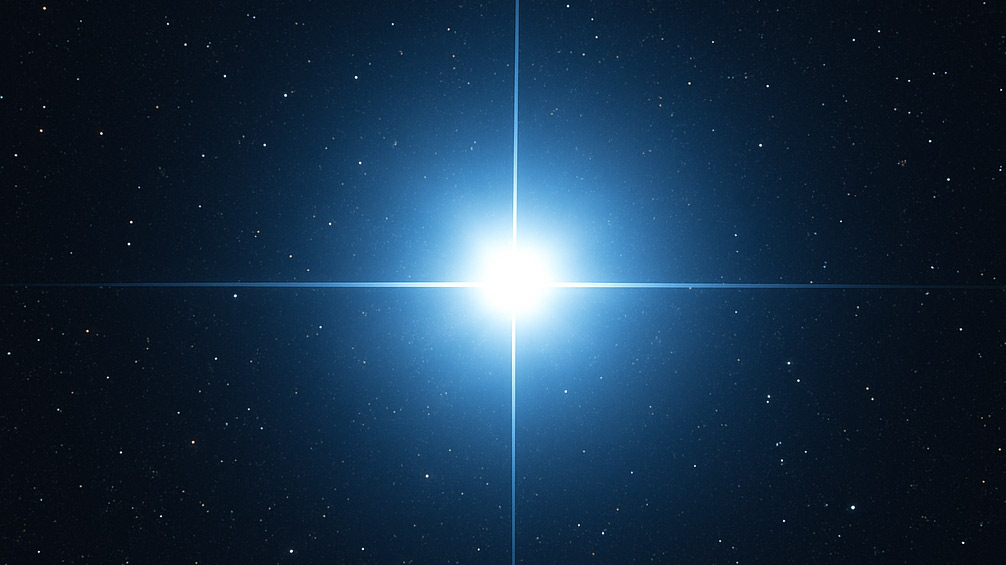
I spent some time recently observing Altair, and even though it’s a familiar star to most of us, it still has a way of standing out. It sits right in the middle of Aquila, the Eagle, and if you’ve ever looked up on a summer night and spotted a bright star almost overhead, there’s a good chance you were looking at it. It lies only about 16.7 light-years away, which practically makes it a next-door neighbor by stellar standards.
A Key Part of the Summer Triangle
Altair, also known as Alpha Aquilae, makes up one corner of the Summer Triangle, along with Vega and Deneb. What’s easy to forget is that Altair is much closer than the other two.

Public Domain: NASA
Altair’s Fast Spin
There are plenty of bright stars out there, but Altair has a pretty wild claim to fame as it spins incredibly fast. Our Sun takes about 25 days to rotate once. Altair does the same thing in roughly 9 or 10 hours. It’s spinning so quickly that it’s actually squashed at the poles and bulged at the equator. According to NASA, astronomers first recognized this phenomenon in the 1960s and subsequently employed interferometry to image the star.

NASA/Center for High Angular Resolution Astronomy, Zina Deretsky
A Variable Star in a Multiple-Star System
Altair is classified as an A-type main-sequence star. This indicates it is a hot, white star that is still fusing hydrogen in its core, a good contrast to Antares, which I recently wrote about.
It is also a Delta Scuti-type variable star, meaning its brightness fluctuates slightly over short periods. These variations are subtle, with a magnitude difference of only about 0.03, and occur over a period of roughly 7.7 hours. To the naked eye, these changes are imperceptible, but precise instruments can detect them.
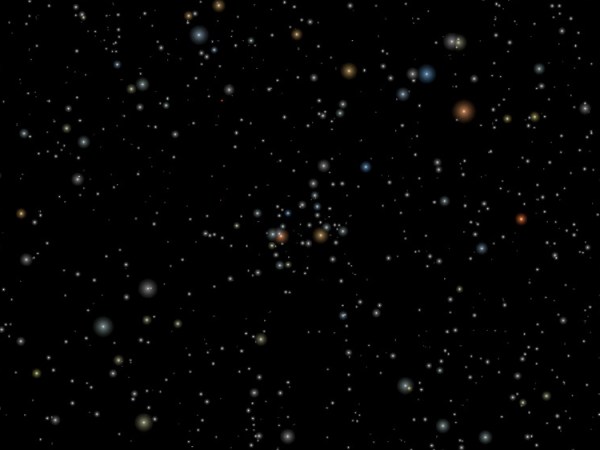
Beyond these characteristics, Altair has six companion stars, which are line of sight and not gravitationally bound.
| Companion | Angular Distance from Altair | Position Angle | Apparent Magnitude |
| B | 195.8″ | 286° | 9.8 |
| C | 186.4″ | 110° | 10.3 |
| D | 26.8″ | 105° | 11.9 |
| E | 157.3″ | 354° | 11.0 |
| F | 292.4″ | 48° | 10.3 |
| G | 185.1″ | 121° | 13.0 |
I was able to sketch several of them below.
My Observation
| Date | July 29, 2022 |
| Time | 11:08 p.m. |
| Location | Seattle, WA |
| Magnification | 85x |
| Scope | Meade 8″ SCT |
| Eyepiece | 24mm |
| Seeing | Good |
| Transparency | Good |
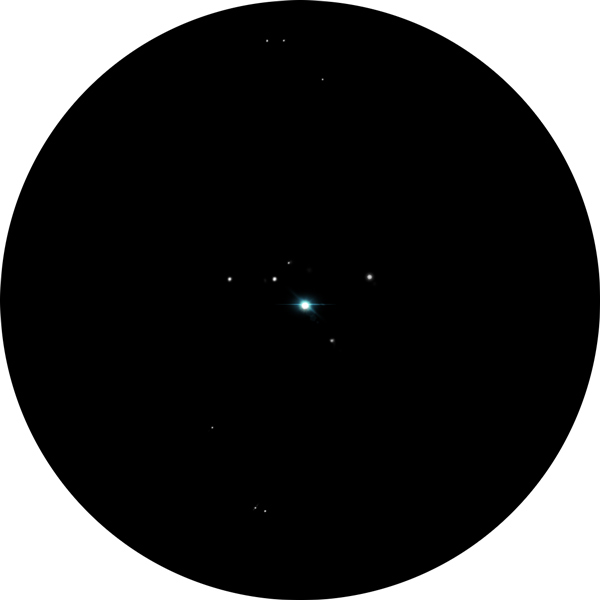
Some stars have a warmer tint or a bit of flicker, but Altair is crisp and white, almost sharp. Knowing how fast it’s rotating adds a fun layer to the view. It doesn’t look like chaos, but it’s moving at a pace that would tear most stars apart. The companion stars provide a nice view through the eyepiece.

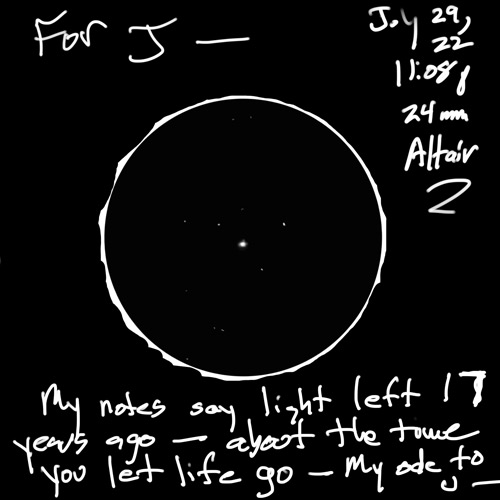
As I sketch Altair, I think about how its light began its journey around the same time my close friend John Bove passed away. I can’t help but remember those formative years we shared—our families and friends woven together through small, fleeting moments that quietly shape a lifetime. Now, with my own daughter preparing to leave for college, I think of his family and how he never got the chance to watch the many sunrises, sunsets, and stars climb into the crisp Colorado skies.
The light of Altair, traveling across all those years to reach my eyes tonight, feels like a messenger from that time—a gentle whisper from the past, reminding me that what once was still lingers, still matters. John’s life and faith burned brightly, touching everyone around him. And like the light of a distant star, his influence continues to travel, carrying warmth and illumination long after the source itself has vanished from sight. Each summer, when Altair rises once more into the firmament, I will think of him. This one is for you, buddy.
Key Stats
| Constellation | Aquila |
| Best Viewing | Summer |
| Visual Magnitude | 0.95 |
| Distance from Earth | 16.73 ly |
| Milky Way Location | Orion Spur |
| My Viewing Grade | A |
| Designations | Alp Aql, 53 Aquilae, SAO 125122, HD 187642, HIP 97649, HR 7557, GC 27470, STFB 10 |
Sources and Notes
Troche, K. (2025, August 15). Summer Triangle Corner: Altair. NASA Science. Retrieved from https://science.nasa.gov/solar-system/skywatching/night-sky-network/summer-triangle-corner-altair/
Lawrence, P. (2022, May 10). A guide to star Altair. BBC Sky at Night Magazine. Retrieved from https://www.skyatnightmagazine.com/advice/altair
Stelle Doppie. (n.d.), from https://www.stelledoppie.it/index2.php?iddoppia=83989
Sketch by Wayne McGraw
 The Garden Astronomer