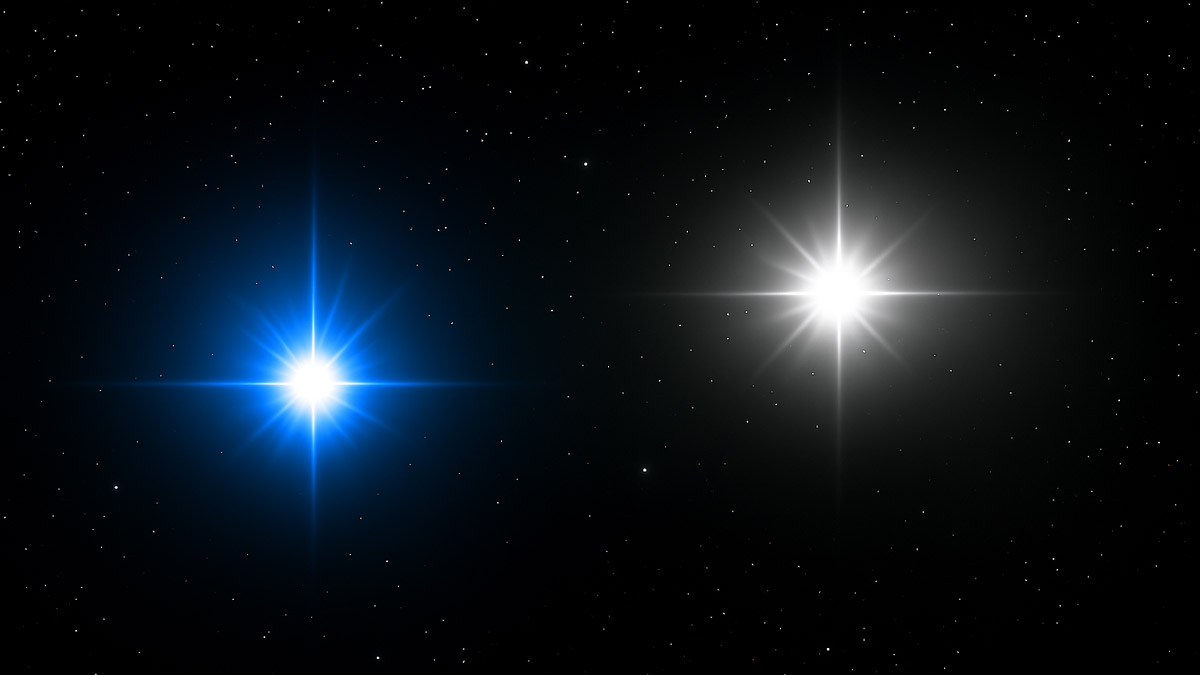
Canis Major is home to several notable double stars, making it a nice hunting ground for anyone who enjoys stellar pairs. One of these is 145 Canis Majoris, often referred to as the “Winter Albireo.” Against this backdrop of stellar treasures, Struve 3116 (STF 3116) adds depth to the constellation’s catalog of double star delights and deserves a place on any observer’s winter list.
Struve 3116 is a tight double star, ideal for observers who enjoy a challenge. The pair sits just 3.9 arcseconds apart, which means you’ll want a telescope of at least 4–6 inches (100–150 mm) in aperture to reliably split them under steady skies.
The primary star shines at magnitude 5.55 and is classified as a B1V blue-white star. Its companion, however, is far more delicate. At magnitude 9.7 and classified as a B9V blue-white star, it clings very close to the primary’s glare. Because of the tight separation and stark magnitude difference, good seeing conditions are essential.
According to Stelle Doppie, astronomers remain uncertain whether the two stars are gravitationally bound, and the pair lies at an estimated distance of about 1,102 light-years from Earth. Of additional interest, the system also includes a third companion at roughly magnitude 11.56, separated by 56.3 arcseconds.
My Observations
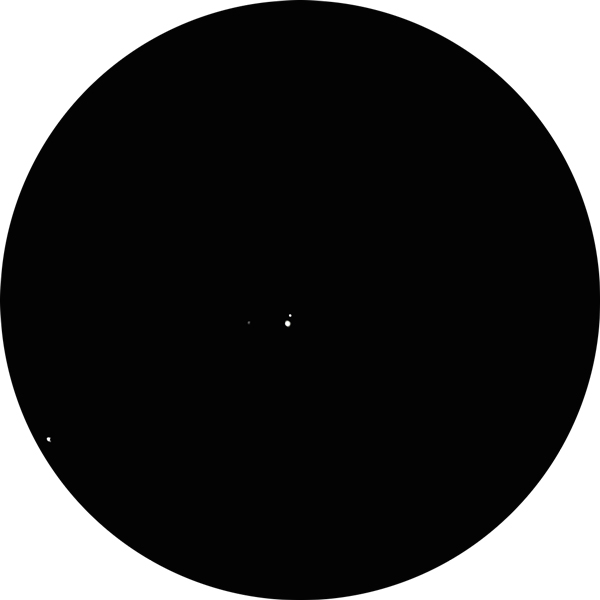
Through the telescope, Struve 3116 presents itself as a delicate pair. The primary shines predominantly white, with just the slightest suggestion of blue in its glow. At first, using a 12mm eyepiece, the secondary is difficult to perceive—its light seems to melt into the brilliance of the primary.
But when I switch to the 8mm eyepiece, a faint pinprick of light appears pressed right up against the main star. The companion is small and subtle, but once seen, it holds steady in the field.
| Date | February 22, 2024 |
| Time | 8:38 p.m. |
| Location | Seattle, WA |
| Magnification | 256x |
| Scope | Meade 8″ SCT |
| Eyepiece | 8mm |
| Seeing | Above Average |
| Transparency | Above Average |
Key Stats
| Constellation | Canis Major |
| Best Viewing | Winter / Spring |
| Visual Magnitude | +5.5 | +9.7 |
| Distance from Earth | 1,102 ly |
| Separation | 3.9″ |
| Position Angle | 22.7° |
| Milky Way Location | Orion Spur |
| My Viewing Grade | B+ |
| Designations | SAO 151401, HD 44458, HIP 30214, HR 2284, FR CMa, GC 8186, BD-11 1460 |
Sources and Notes
Sketch by Wayne McGraw
 The Garden Astronomer