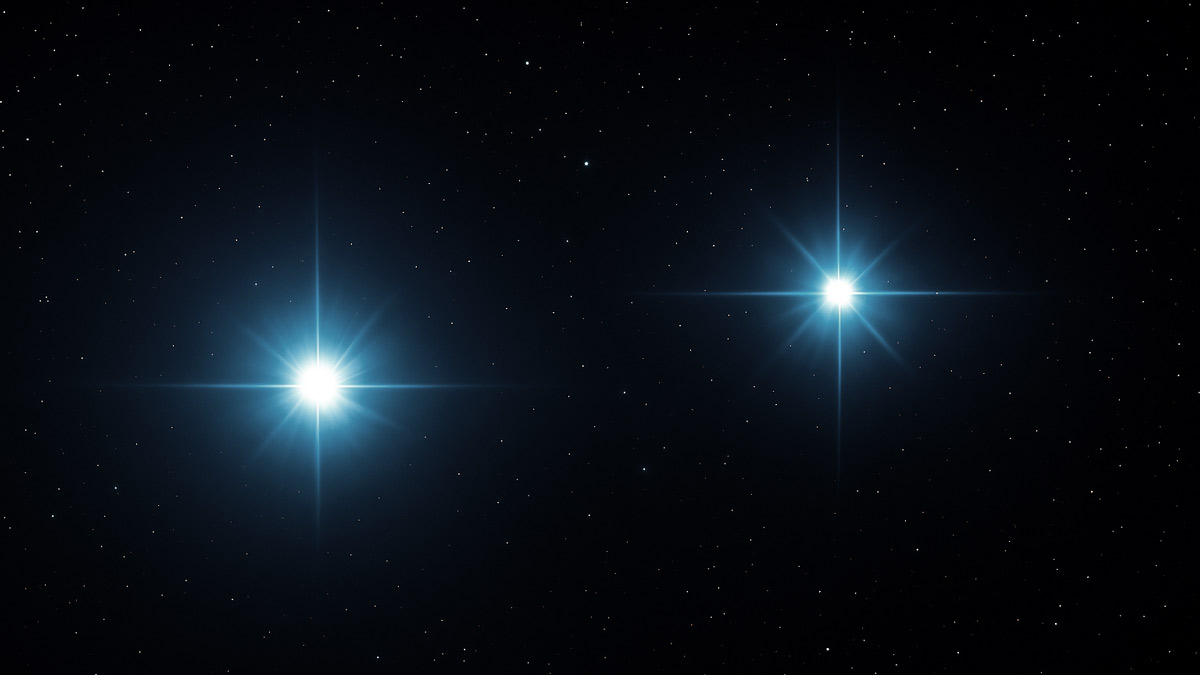
While Taurus is best known for Aldebaran and the sprawling Hyades and Pleiades clusters, it also hides quieter treasures among its horns. One such delight is the double star Struve 730, also known as STF 730. It’s a pairing that offers both challenge and charm to the patient observer.
In his insightful analysis, John Nanson writes about how this unassuming pair of stars actually passed through the eyepieces of all the major figures in double star astronomy, including William Herschel and his son John Herschel, James South, and F.G.W. Struve. The story begins with William Herschel, who appears to have confused this pair with the star 117 Tauri. That error wasn’t caught until 1821, when John Herschel and James South went searching for 117 Tauri and found that it was a single star.
Properties of STF 730
STF 730 is made up of two B7-type stars. These stars are hot, blue-white suns with surface temperatures in the ballpark of 12,000 to 13,000 Kelvin. They burn their fuel quickly and brightly, often several times more massive than our Sun and far more luminous.
The primary in this pair shines at magnitude 6.06, while the secondary trails just slightly behind at 6.44. With such close magnitudes, the two stars have a pleasing visual balance in the eyepiece as neither one overwhelms the other. Their separation is only 9.7 arcseconds, which makes for a fairly tight double and a satisfying challenge to split cleanly, especially under less-than-perfect seeing.
What makes STF 730 even more interesting is its distance. At roughly 2,992 light-years away, it’s more distant than most of the double stars I typically observe. Many of my usual targets are a few dozen to a few hundred light-years away—occasionally stretching into the low thousands—but this one sits well beyond the familiar neighborhood.
According to Stelle Doppie, there’s also mention of a third component in the system, listed at about magnitude 7.3. However, that companion lies a mere 0.1 arcseconds from the primary, which puts it beyond the reach of backyard telescopes.
My Observations
| Date | January 23, 2023 |
| Time | 8:03 p.m. |
| Location | Seattle, WA |
| Magnification | 169x |
| Scope | Meade 8″ SCT |
| Eyepiece | 12mm |
| Seeing | Above Average |
| Transparency | Above Average |
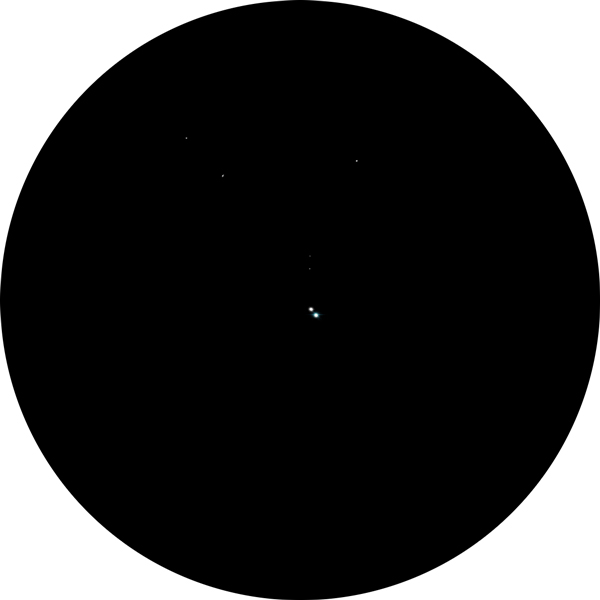
It’s a frigid January night as the new year begins, and I steady my breath to keep from fogging the eyepiece. Through the telescope, Struve 730 comes into view. Two nearly equal points of light rest close together in the darkness. The split is clean and satisfying, the pair offering just enough contrast to admire their individuality.
The primary, only slightly brighter, carries a darker or faintly blue cast as if tinted by the cold itself, while the secondary presents a clean white glow beside it. In the stillness of the night, this view is a quiet reward for braving the frozen air.
Key Stats
| Constellation | Taurus |
| Best Viewing | Winter |
| Visual Magnitude | +6.0 | +6.4 |
| Separation | 9.68″ |
| Position Angle | 141° |
| Spectral Class | B7 & B7 |
| Milky Way Location | Orion Spur |
| My Viewing Grade | B |
| Designations | STF 730, SAO 94630, HD 36408, HIP 25950, HR 1847, GC 6843 |
Sources and Notes
Sketch by Wayne McGraw
 The Garden Astronomer