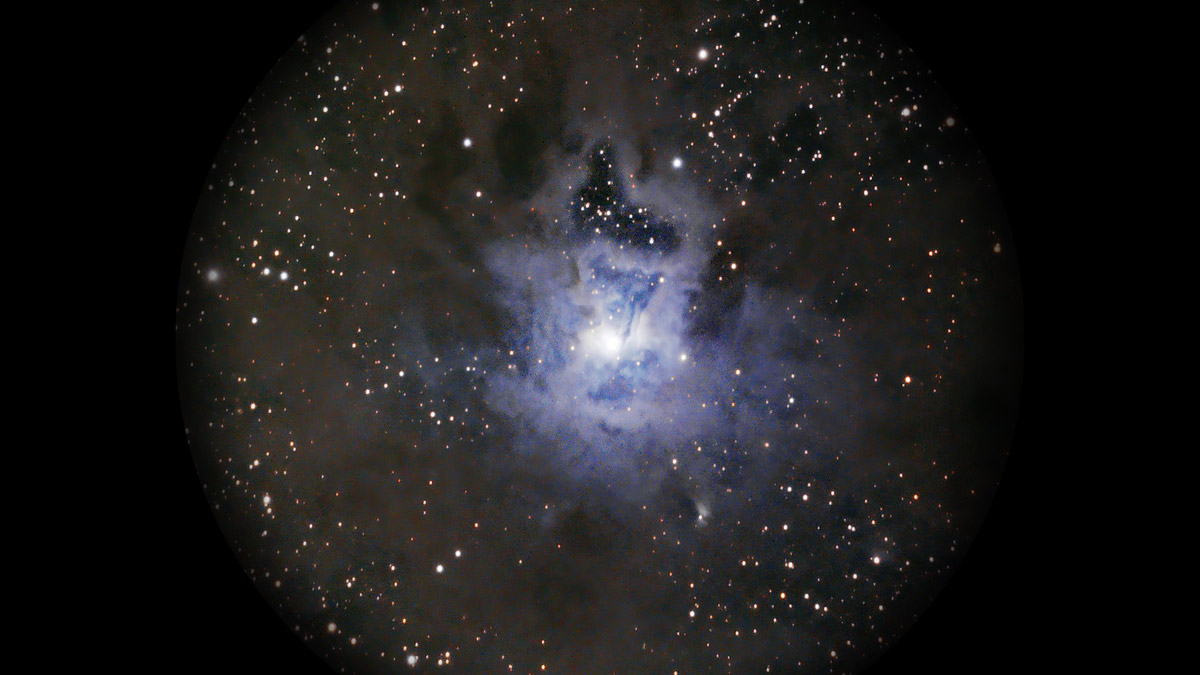
The beautiful Iris Nebula, also known as NGC 7023 or Caldwell 4, is a reflection nebula in the constellation Cepheus, which is best viewed in autumn. William Herschel first viewed the Iris Nebula on October 18, 1794.
A bright central star illuminates the nebula’s dark filaments of gas and dust, creating a predominantly blue-colored glowing celestial flower. According to NASA, the dust particles diffuse the light coming from the central star, “giving the nebula a second-hand glow that’s typically bluish (like our sky).” Of interest to astronomers, the color red is also visible, indicating the presence of other chemical compounds in this cosmic region.
The Iris shines at a magnitude of +6.8, lies 1,300 light-years away, and spans approximately 6 light-years. While its subtle reflective light struggles to break through light-polluted skies (see my observation below), astrophotographers cherish this gorgeous target.
The Iris Nebula reminds us that light doesn’t always come from fire. Sometimes it comes from reflection, from the quiet interplay of light and matter. And beyond science, it’s simply a work of art. A flower blooming in the dark, lit by a single star, billions of miles from everything we know.
My Observations
| Date | September 19, 2022 |
| Time | 9:10 p.m. |
| Location | Seattle, WA |
| Magnification | 145x |
| Scope | Meade 8″ SCT |
| Eyepiece | 14mm |
| Seeing | Average |
| Transparency | Average |
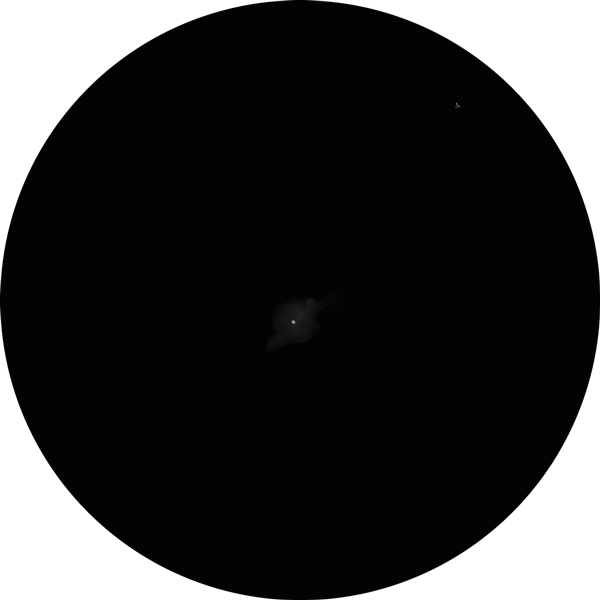
At first, I was feeling uncertain if I had landed on the Iris Nebula. I could only see a star in the center of the eyepiece. However, as I nudged the scope, I noticed a faint haze around the star move. The haze is like a breath on a glass on a frigid day and is elongated, not circular. There is no distinguishable color.
Also observed on October 13, 2025, from Tampa, Florida
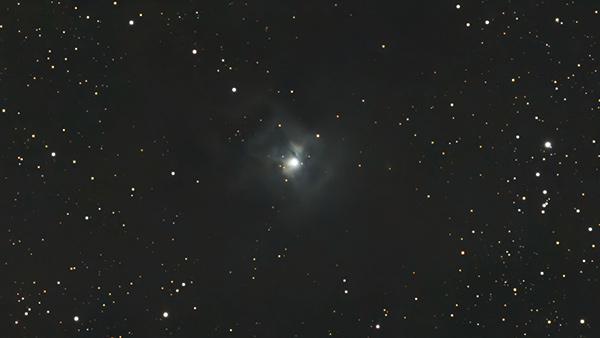
On this October evening, the skies are clear and moonless. For the last hour, I’ve waited for the Iris Nebula to clear the roofline. Now at 11pm, the nebula is in sight, so I let the Seestar S50 fire up.
Key Stats
| Constellation | Cepheus |
| Best Viewing | Autumn |
| Visual Magnitude | +7.9 |
| Absolute Magnitude | -.93 |
| Distance from Earth | 1,400 ly |
| Diameter | 6 ly |
| Apparent Size | 18 x 18 arcmin |
| Milky Way Location | Orion Spur |
| My Viewing Grade | B |
| Designations | Caldwell 4, LBN 487, C 4, Collinder 427 |
Sources and Notes
The banner photo of NGC 7023 provided by the author Hewholooks. This file is licensed under the Creative Commons Attribution-Share Alike 3.0 Unported license.
NASA. (2024, May 9). Caldwell 4 (The Iris Nebula). NASA. https://science.nasa.gov/mission/hubble/science/explore-the-night-sky/hubble-caldwell-catalog/caldwell-4/
 The Garden Astronomer
