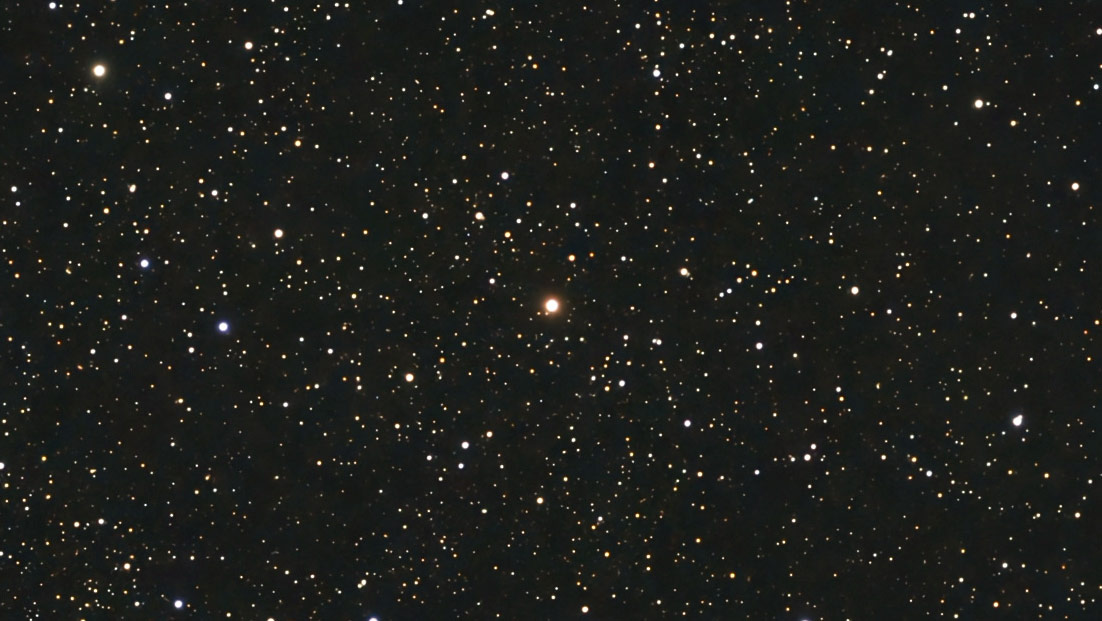
If the night sky could speak, Chi Cygni (χ Cygni) would be a dramatic storyteller among the rich stars in the constellation Cygnus, the Swan. This star is not just a point of light. It’s a cosmic heartbeat changing before our eyes.
Chi Cygni is a Mira-type variable star, meaning its brightness fluctuates over time. Unlike our steady Sun, Mira variables expand and contract in cycles, causing their light to fluctuate.
For Chi Cygni, this pulsation is particularly pronounced: it can range from an apparent magnitude of about 3.3 at its brightest—visible to the naked eye—to around 14 at its faintest, over a period of 408 days. That’s a dramatic swing, making it one of the more striking variable stars in the northern sky.
The star is an M-type red giant. Its orange hue is unmistakable, giving amateur astronomers a warm, glowing beacon to track over months. It has exhausted the hydrogen in its core and is fusing heavier elements in shells around the core. This is one of the final chapters before stars like this shed their outer layers and form planetary nebulae, like the Ring or Helix nebula.

For history buffs: Back in 1686, the German astronomer Gottfried Kirch was scanning the sky for a nova in Vulpecula when something peculiar caught his eye—or rather, didn’t. The star labeled Chi Cygni on Johann Bayer’s Uranometria atlas was gone.
Kirch made note of the mystery. Then, on October 19th of that same year, he noticed the star returned, glowing faintly at fifth magnitude. That moment marked the discovery of Chi Cygni’s variability, only the second known pulsating star after Mira.
I suggest reading Dr. Kristin Laresen’s article for the American Association of Variable Star Observers (AAVSO), as she provides a comprehensive overview of Chi Cygni, its history, and its unique spectral type.
My Observations
| Date | October 16, 2025 |
| Time | 10:30 p.m. |
| Location | Tampa, FL |
| Scope | Seestar S50 |
| Exposure | 2 Minutes |
| Seeing | Above Average |
| Transparency | Above Average |
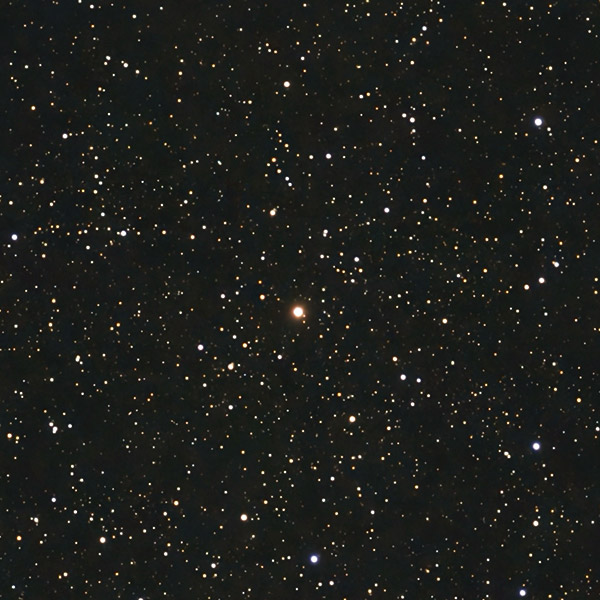
Tonight, I spent the evening photographing several regions around Cygnus. As I did, Chi Cygni surfaced in my mind. I remembered reading about this remarkable star in my youth, captivated by the idea of a sun that brightened and faded like a heartbeat in the heavens.
With better equipment and a deeper patience born of time, I’m thrilled to finally capture an image of Chi Cygni and to follow its slow pulse across the months ahead—a reunion with an old celestial friend I once only knew through the pages of a book. A few months ago, in August 2025, observers noted that the star hit max brightness and is now fading again.
Key Stats
| Constellation | Cygnus |
| Best Viewing | Summer — Autumn |
| Visual Magnitude | Mira Variable: +3.3 to +14.2 |
| Distance from Earth | ~ 550 – 590 Light Years |
| Milky Way Location | Orion Spur |
| My Viewing Grade | B+ |
| Designations | HD 187796, HIP 97629, HR 7564, SAO 68943, BD +32° 3593, |
Sources and Notes
Center for Astrophysics: Harvard & Smithsonian. (2020, August 18). Close photos of a dying star show our sun’s fate. https://www.cfa.harvard.edu/news/close-photos-dying-star-show-our-suns-fate
American Association of Variable Star Observers. (n.d.). Chi Cygni. AAVSO. https://www.aavso.org/vsots_khicyg
Images by Wayne McGraw
 The Garden Astronomer