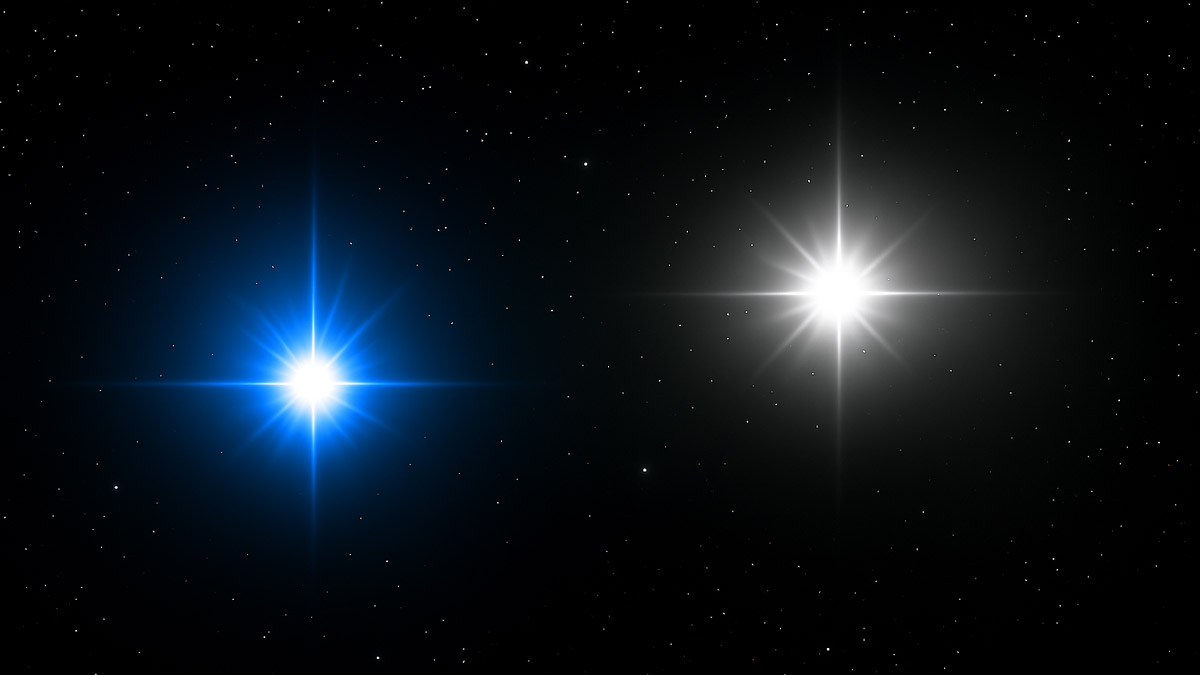
Struve 331 is a pretty binary star system located in the Perseus constellation. Autumn brings the best nights to view the pair overhead. It was, in fact, in the fall when famed astronomer William Herschel first recorded the binary on September 14, 1781.1
The brighter primary star, Struve 331 A, is a blue-white main-sequence star with a spectral type of B75. Some observers see the star as simply white in color, while others have reported a white star with tinges of blue to yellow. Meanwhile, its dimmer companion, Struve 331 B, is slightly fainter and has a spectral type of B9V. Most observers see this secondary star as blue or blue-green in color.
Interestingly, both Struve 331 A & B live within the same spectral type family as B stars, but their close proximity of 11.9 arcseconds apart makes for a nice contrast of white to blue colors. See my observations below for more.
Most backyard observers with moderate-sized telescopes should have no problem splitting this lovely pair.
My Observations
| Date | November 23, 2023 |
| Time | 10:25 p.m. |
| Location | Seattle, WA |
| Magnification | 169x |
| Scope | Meade 8″ SCT |
| Eyepiece | 12mm |
| Seeing | Above Average |
| Transparency | Above Average |

My telescope points straight up as I capture Struve 331 in the eyepiece this Thanksgiving night. Across the way, a large family sits around a large fire pit in their backyard. The fire blazes some 3 feet high, keeping them warm on this near-freezing evening as kids play around the fire and adults engage in rich conversations. It’s like I have company with me. I enjoy it, but I have noticed the cold, humid air trapping the plumes of smoke from their fire within the lower areas of my yard. In fact, the smoke looks like heavy fog swirling around the nearby amber streetlight.
I turn my attention back to Struve 331. The flickering white primary shines with an icy blue secondary nearby. Sissy Haas reports the two stars as lemon-white with a dusty blue-green hue. I tend to agree with her observation. As you stare at this pair, they are enchanting for some reason. Maybe it’s the flicker of the yellow-white against the blue-green smaller star. It’s somewhat like the “fire” one sees in diamonds. For me, the stars capture the feeling of a crisp, cold night. And, for me in this moment, it’s like they are reflecting the light of the distant fire across the way.
Key Stats
| Constellation | Perseus |
| Best Viewing | Autumn |
| Visual Magnitude | +5.2 | +6.2 |
| Separation | 11.9″ |
| Position Angle | 85° |
| Spectral Class | B7V & B9V |
| Milky Way Location | Orion Spur |
| My Viewing Grade | A- |
| Designations | SAO 23763, HIP 14043, HD 18537, HR 890 |
Sources and Notes
1 William Herschel’s double star catalog. (n.d.). https://www.handprint.com/ASTRO/Herschel_All.html
Sketch by Wayne McGraw
 The Garden Astronomer