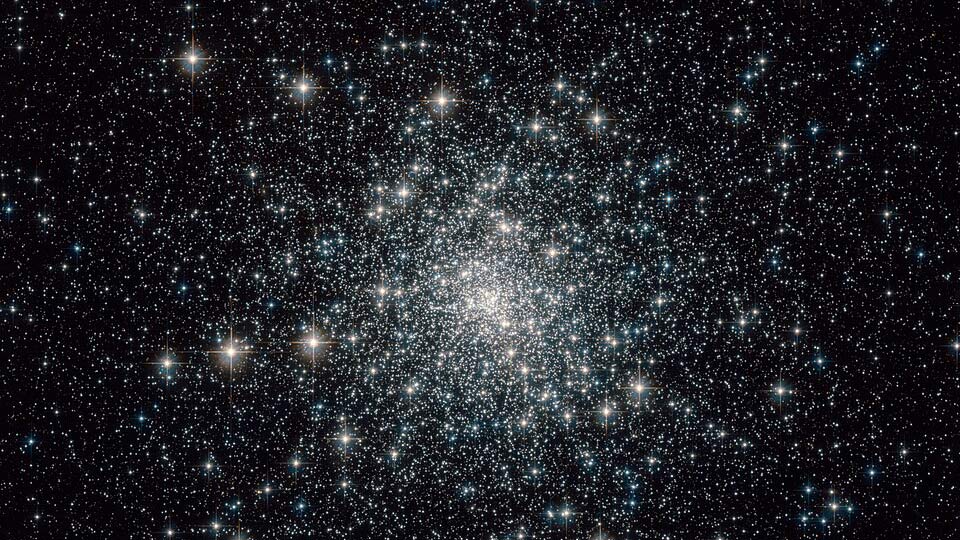
High in the southern sky, within the constellation Capricornus, lies the globular cluster Messier 30. This ancient stellar city, about 28,000 light-years from Earth, contains hundreds of thousands of stars tightly packed into a relatively small space.
On this site, I often refer to globular clusters as a “chandelier of stars,” but when I gaze at M30, I can’t help but appreciate its other nickname: the Jellyfish Cluster. The beautiful lines of stars radiating from its core resemble delicate tentacles, giving the cluster an almost living quality.
A Dense Core and a Violent Past
The “tentacles” of M30’s jellyfish appearance aren’t just a beautiful illusion; they hint at the cluster’s turbulent internal life. Those graceful streams of stars are shaped, in part, by the dense gravitational core at its center, a telltale sign of a dramatic process known as core collapse.
Over billions of years, gravity pulled the cluster’s stars inward, packing them tightly together in the center. In other words, the outer stars haven’t fallen in yet, but some are being stretched into long streams by the core’s pull, forming the “tentacles” you see.
Also, collisions and close encounters among the stars are common, making M30 a hotspot for exotic objects like blue stragglers, which are unusually young-looking stars formed when two older stars merge. An article by Simon Portegies Zwart on arXiv discusses the proposed origins of the blue stragglers in Messier 30.
From up north, M30 can be a bit shy, barely peeking over the horizon. But if you head a little south, it will meet you in the sky. For anyone who loves chasing the stars, seeing it up close makes every mile of the journey worthwhile.
My Observations
| Date | October 23, 2025 |
| Time | 9:30 p.m. |
| Location | Seattle, WA |
| Magnification | 127x |
| Scope | Meade 8″ SCT |
| Eyepiece | 16mm |
| Seeing | Above Average |
| Transparency | Above Average |
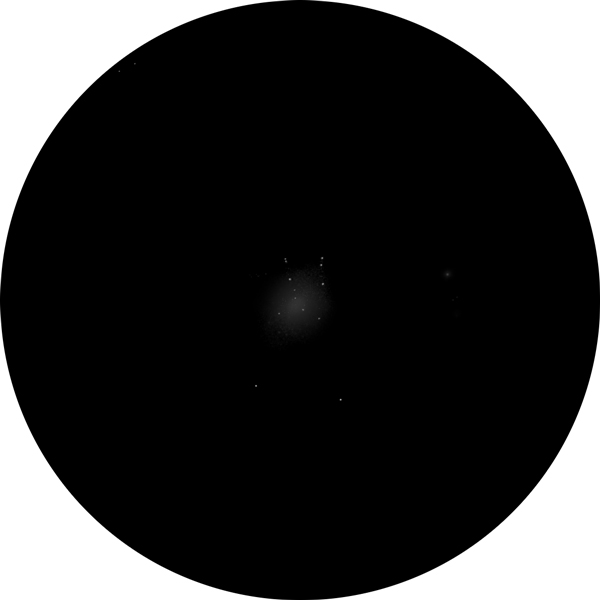
Peering at M30 from the brighter skies of Tampa, I was struck by how the core manages to punch through the city glow. Using averted vision, I could make out a few of the brightest stars stretching along its delicate tentacles, subtle hints of the cluster’s intricate structure that make it feel almost alive.
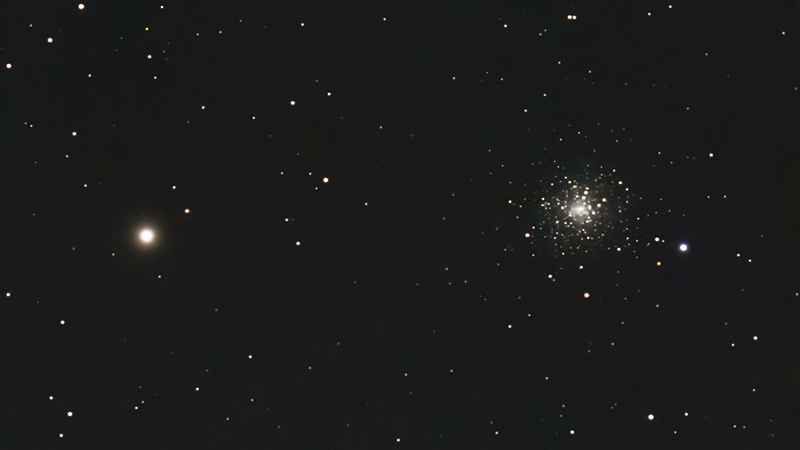
Seestar S50 photo of Messier, October 23, 2025, at 9:20 p.m.
Thankfully, I also have the Seestar aimed at M30 tonight, taking advantage of the moonless and transparent skies. I’ve decided to position the cluster on the right across from 41 Capricorni (41 Cap), which shines at magnitude 5. 41 Cap is a good guidepost when steering the telescope to find M30.
Key Stats
| Constellation | Capricornus |
| Best Viewing | Late Summer-Early Autumn |
| Visual Magnitude | +7.7 |
| Distance from Earth | ~28,000 light-years |
| Diameter | ~90,000 light-years |
| Apparent Size | 12 arcminutes |
| Milky Way Location | Orion Spur |
| My Viewing Grade | B |
| Other Designations | M30, NGC 7099, GCl 122 |
Historical Observations
Charles Messier’s observation on August 3, 1764.
“In the night of August 3 to 4, 1764, I have discovered a nebula below the great tail of Capricornus, & very near the star of sixth magnitude, the 41st of that constellation, according to Flamsteed: one sees that nebula with difficulty in an ordinary [non-achromatic] refractor of 3 feet [FL]; it is round, & I have not seen any star: having examined it with a good Gregorian telescope which magnifies 104 times, it could have a diameter of 2 minutes of arc. I have compared the center with the star Zeta Capricorni, & I have determined its position in right ascension as 321d 46′ 18″, & its declination as 24d 19′ 4″ south. This nebula is marked in the chart of the famous Comet of Halley which I observed at its return in 1759.”
For more historic descriptions, visit: http://www.messier.seds.org/Mdes/dm030.html
Sources and Notes
Banner image from NASA/ESA. Public Domain. NASA. (2024, September 16). ACS image of Messier 30 [Image]. Science@NASA. https://science.nasa.gov/image-detail/acs-image-of-messier-30/
Portegies Zwart, S. (2018). The origin of the two populations of blue stragglers in M30 (arXiv:1811.00058) [Preprint]. arXiv. https://arxiv.org/abs/1811.00058
Sketch and Seestar image by Wayne McGraw
 The Garden Astronomer