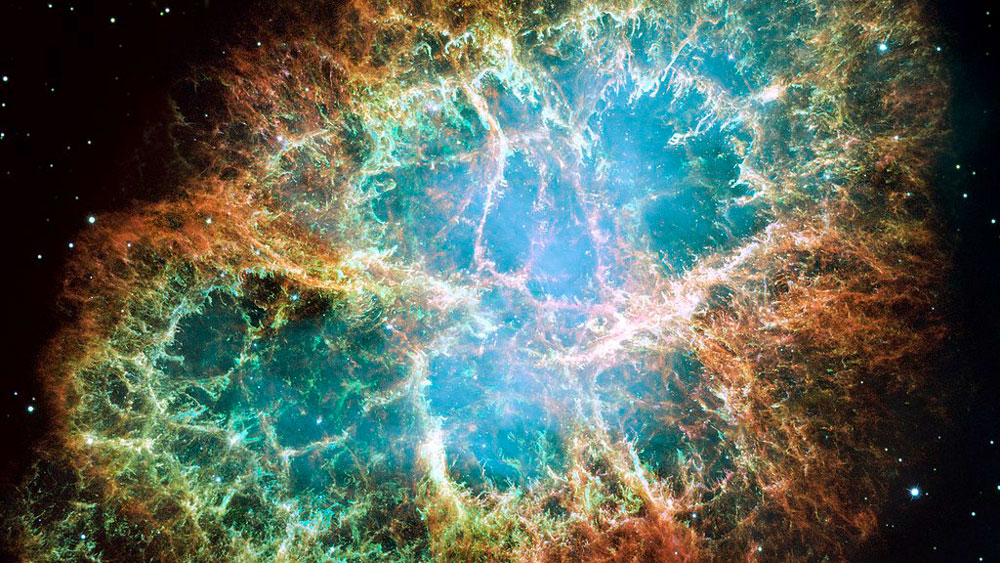
Messier 1 is a supernova remnant in the constellation Taurus, best viewed during the winter months.
On July 4, 1054, Chinese astronomers recorded a new “guest star” blazing in the sky. For nearly a month, it shone so brightly it was visible during the day. After reaching a brilliance greater than Venus, it gradually faded over the course of a year until it vanished completely.
Today, we know that those ancient astronomers were witnessing a supernova—the explosive death of a star. Messier 1, also known as the Crab Nebula, is the glowing remnant of that stellar explosion. While astrophotographers capture it in spectacular detail, backyard observers see it as a faint object that can be challenging to spot, especially from suburban skies.
You might be wondering why the title of this page borrows a lyric from the Oasis song Champagne Supernova. True story: I owned their album, and every time I listened, Messier 1 came to mind. That mental image has stuck with me over the years. Noel Gallagher has said he doesn’t know what the lyrics mean, and many speculate the song reflects drug addiction. For me, though, it will always evoke the awe-inspiring sight of a star exploding long ago.
My Observations
| Date | January 15, 2021 |
| Time | 10:11 p.m. |
| Location | Seattle, WA |
| Magnification | 92x |
| Scope | Meade 8″ SCT |
| Eyepiece | 22mm |
| Seeing | Average |
| Transparency | Average |

While tonight is moonless, a faint mist blows past the streetlamp every 15 minutes or so and then clears. The viewing is unpredictable. As I center the scope on M1, I don’t notice anything. Using averted vision, I gently move the scope from left to right. With each move back and forth, I finally notice a ghostly blob. This is an elusive target. I leave wanting more, and I plan to return on a better night.
Observation on March 19, 2025, at 10:49 p.m. from Tampa, Florida
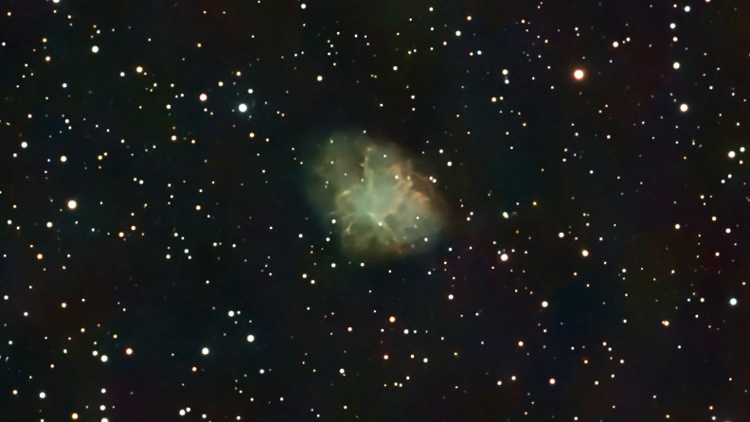
Key Stats
| Constellation | Taurus |
| Best Viewing | Winter |
| Visual Magnitude | +8.39 |
| Absolute Magnitude | -3.00 |
| Distance from Earth | 6,200 ly |
| Diameter | 10.8 ly |
| Apparent Size | 6 x 4 arcmin |
| Milky Way Location | Orion Spur |
| My Viewing Grade | C |
| Designations | Crab Nebula, Supernova, Taurus A, M1 |
Historical Observations
August 28, 1758, observation by Charles Messier
“The Comet of 1758, on August 28, 1758, was between the horns of Taurus, I discovered above the southern horn, & little distant from the star Zeta of that constellation, a whitish light, elongated in the form of the light of a candle, which didn’t contain any star. This light was of almost the same as that of the Comet which I observed at that time; yet it was a bit more vivid, more white & a bit more elongated than that of the Comet which to me had always appeared almost round in its coma, without the appearance of a tail or beard.”1
Sources and Notes
Banner photo top of page: NASA, ESA, J. Hester and A. Loll (Arizona State University)
1Charles Messier Observations: SEDS Messier Database
Lewis, B. (2023, August 25). Crab Nebula: Everything you need to know. Space.com. https://www.space.com/16989-crab-nebula-m1.html
Sketch by Wayne McGraw
 The Garden Astronomer
One thought on “Messier 1 (NGC 1952): A Champagne Supernova in the Sky”