
Messier 2 (M2) is a dazzling gem of the night sky, shining at a magnitude of 6.5. That’s bright enough that, under truly dark skies, you might just glimpse it with your naked eye. In most suburban settings, you’ll need a good pair of binoculars or a telescope to truly appreciate it. Look closely, and M2 appears as a delicate patch of light, like a faint wisp of glowing smoke hovering in the darkness.
This ancient globular cluster lies in the constellation Aquarius and reaches its peak visibility in the crisp autumn months of October and November. What looks like a simple smudge is actually home to a staggering 150,000 stars, stretching across 175 light-years.
According to NASA, the first person to record this cosmic wonder was Jean-Dominique Maraldi in 1746, while he was diligently hunting for comets. Imagine peering through his telescope centuries ago and glimpsing the same shimmering cluster that continues to captivate stargazers today.
My Observations
| Date | October 11, 2021 |
| Time | 8:06 p.m. |
| Location | Seattle, WA |
| Magnification | 127x |
| Scope | Meade 8″ SCT |
| Eyepiece | 16mm |
| Seeing | Average |
| Transparency | Average |
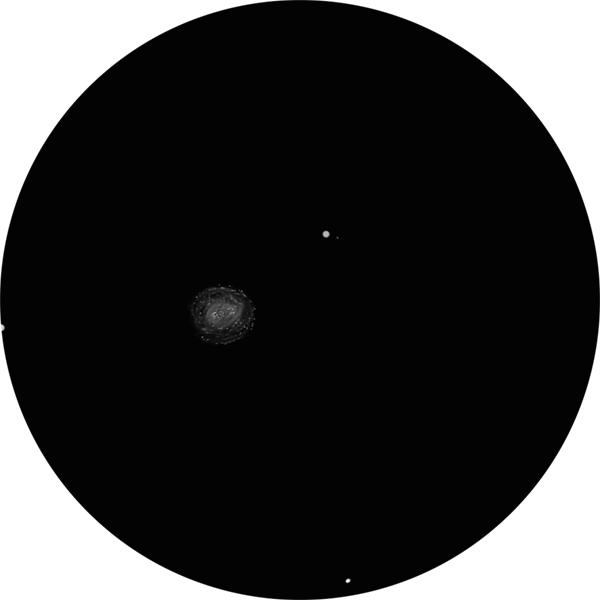
I’m looking at M2 with a half-moon up tonight. I believe that’s why the globular appears a little washed up in the eyepiece. It’s fairly faint, and I can only see a few individual stars with averted vision. It looks more like a nebula in the eyepiece on this evening.
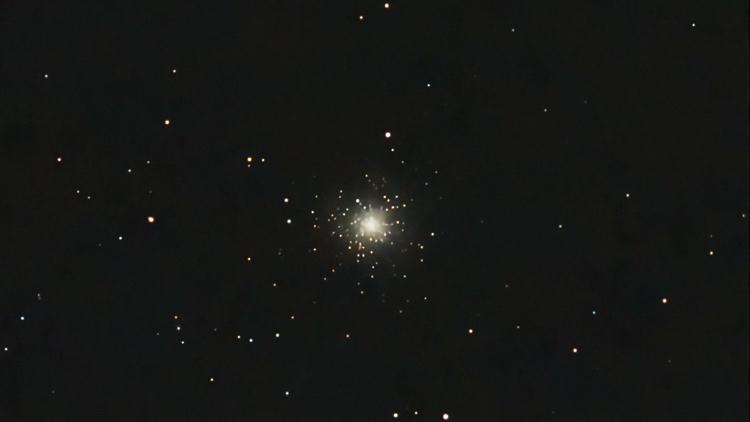
Observation on November 21, 2024, at 8:35 p.m. from Tampa, FL
Key Stats
| Constellation | Aquarius |
| Best Viewing | Autumn |
| Visual Magnitude | +6.5 |
| Absolute Magnitude | -8.4 |
| Distance from Earth | 37,000 ly |
| Diameter | 175 ly |
| Apparent Size | 16 arcmin |
| Milky Way Location | Below center |
| My Viewing Grade | B |
| Designations | Messier 2, M 2, NGC 7089 |
Historical Observations
Maraldi’s observation on September 11, 1746
“On September 11 I have observed another one [nebulous star, besides M15] for which the right ascension is 320d 7′ 19″ [21h 20m 29s], & the declination 1d 55′ 38″ south, very near to the parallel where the Comet should be. This one is round, well terminated and brighter in the center, about 4′ or 5′ in extent and not a single star around it to a pretty large distance; none can be seen in the whole field of the telescope. This appears very singular to me, for most of the stars one calls nebulous are surrounded by many stars, making one think that the whiteness found there is an effect of the light of a mass of stars too small to be seen in the largest telescopes. I took, at first, this nebula for the comet.”1
Charles Messier observation on September 11, 1760
“Nebula without star in the head of Aquarius, its center is brilliant, & the light surrounding it is round; it resembles the beautiful nebula which is situated between the head & the bow of Sagittarius [M22], it is seen very well with a telescope of 2 feet…“
Sources and Notes
The banner photo of M2 is attributed to ESA / Hubble and is licensed under the Creative Commons Attribution 4.0 International license.
1Historical observation from messier.seds.org.
Sketch by Wayne McGraw
 The Garden Astronomer
2 thoughts on “Messier 2 (NGC 7089): One of the Largest Globular Clusters in the Sky”