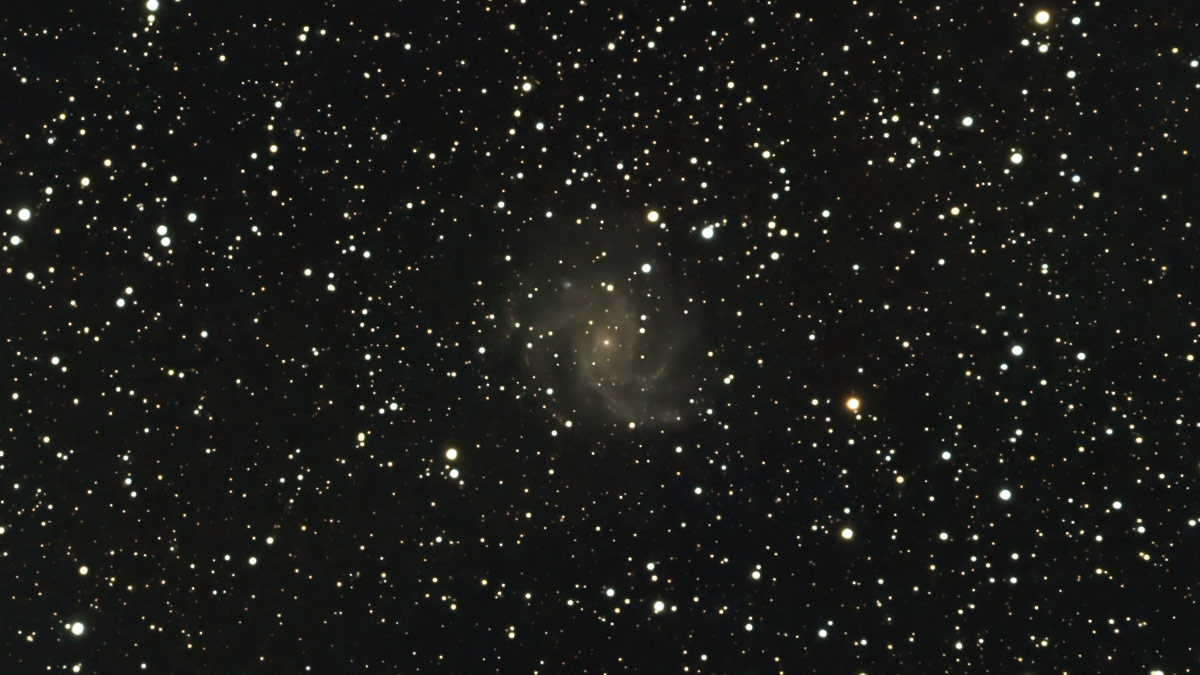
Hidden in the constellation Cepheus lies NGC 6946, a galaxy that has captured the attention of astronomers since William Hershel discovered it on September 9, 1798, using his 40-foot telescope. Nicknamed the Fireworks Galaxy, this pretty spiral is a cosmic spectacle both visually and scientifically.
A Hotbed of Young Stars and Supernovae
The Fireworks Galaxy lies about 22 million light-years from Earth and spans roughly 40,000 light-years. Because it’s tilted nearly face-on to our line of sight, we can admire its full spiral design.
Rich in gas and dust, the galaxy is a vibrant hub of star formation, where the spiral arms shimmer with countless young, blue stars. Dark dust lanes thread through these bright regions, adding depth and texture to its already dynamic appearance.
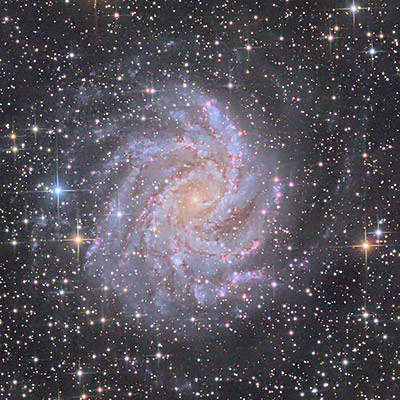
Photo by Andrei Gusan | Creative Commons 1.0 License
What truly earns NGC 6946 its nickname is its extraordinary supernova activity. Over the last century, astronomers have observed 10 supernovae. This is an unusually high number for a galaxy of its size. These explosive stellar deaths have offered a wealth of insight into how stars live and die.
Viewing the Galaxy
NGC 6946 is relatively faint in visible light, requiring dark skies and moderately powerful telescopes to appreciate its beauty. Its location near the Milky Way’s plane adds another layer of challenge, as intervening dust from our own galaxy slightly dims its light. Yet, for those who take the time to observe it, NGC 6946 presents a rewarding experience.
My Observations
| Date | December 16, 2023 |
| Time | 9:00 p.m. |
| Location | Seattle, WA |
| Magnification | 169x |
| Scope | Meade 8″ SCT |
| Eyepiece | 12mm |
| Seeing | Above Average |
| Transparency | Above Average |
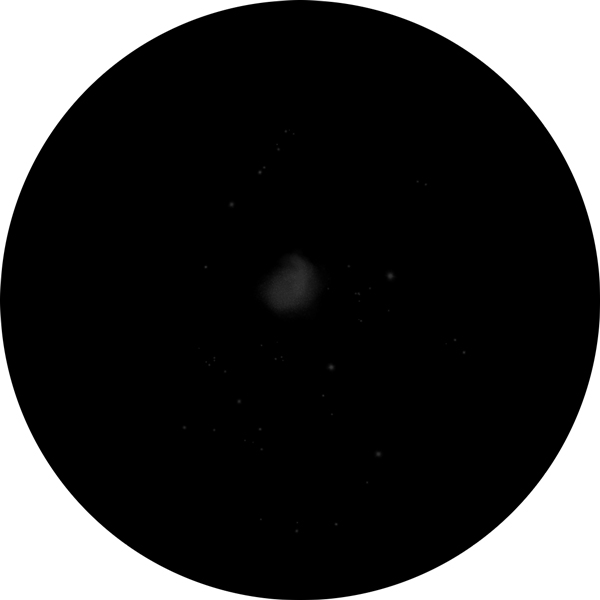
While looking through my observing logbooks from 2020–2021, I came across the beginnings of a sketch of the Fireworks Galaxy. It must have been an exceptionally transparent night in Seattle, as I haven’t been able to glimpse its faint spiral structure since then. Its low surface brightness makes it difficult to observe under suburban skies.
I remember the galaxy appearing slightly elongated with a gentle hook at one end, likely hinting at a few of its brighter arms. As my sketch shows, I couldn’t resolve the individual spirals, only the soft suggestion of form. One day, I hope to revisit this galaxy from a truly dark-sky site and see its delicate details more clearly.
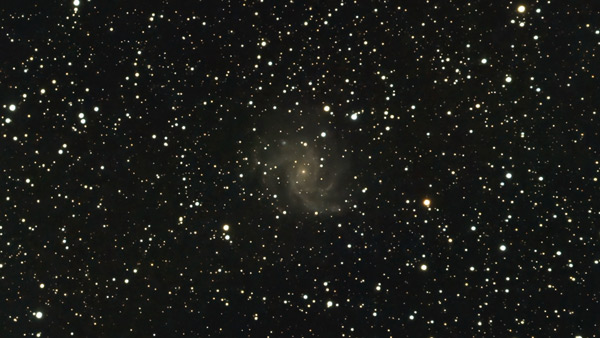
Observation on October 21, 2025, at 11:30 p.m. from Tampa, FL
Key Stats
| Constellation | Cepheus / Cygnus border |
| Best Viewing | Autumn |
| Visual Magnitude | +9.6 |
| Absolute Magnitude | –20.7 (approximate) |
| Distance from Earth | ~22 million light-years |
| Diameter | ~40,000 light-years |
| Apparent Size | 11.5 × 9.8 arcmin |
| My Viewing Grade | B- |
| Designations | Caldwell 12 (C12), UGC 11597, PGC 65001 |
Sources
NOIRLab. (n.d.). NOAO image of NGC 6946. Retrieved October 29, 2025, from https://noirlab.edu/public/images/noao-ngc6946/
Sketch and Seestar photo by Wayne McGraw
 The Garden Astronomer