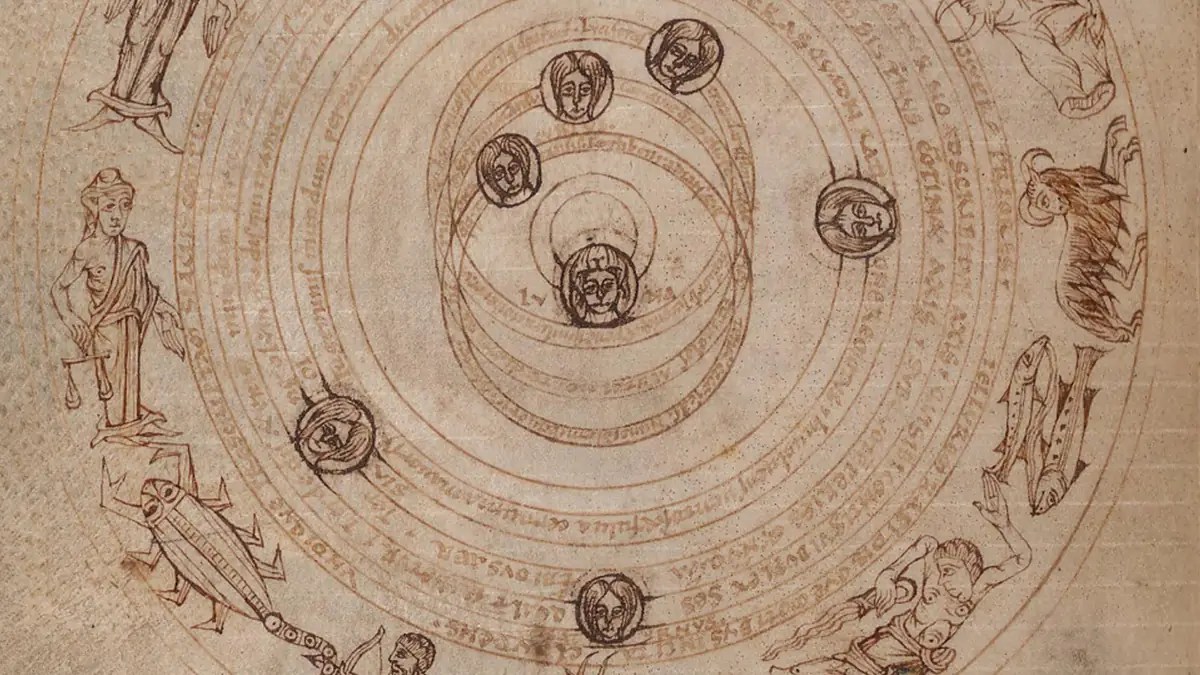
When I was young, my dad owned Astronomy by Professor John Charles Dunkin, a classic textbook first published in 1926. I was captivated by the pages about the planets and their distinctive symbols: a circle with a dot for the Sun, a crescent for the Moon, and others that resembled ancient hieroglyphs. I didn’t know what they meant, but I loved them.
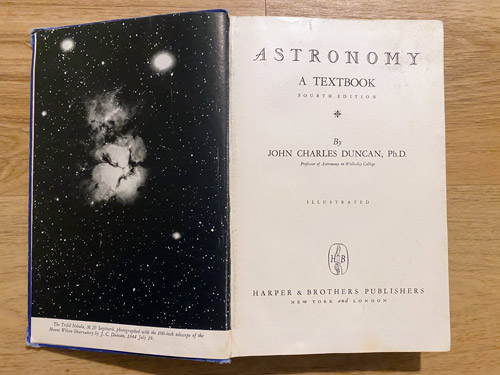
I’d trace them on the page and see them again on star charts. Uranus and Neptune were the most mysterious, and I often imagined what they might look like through a telescope. And don’t get me started on Pluto. That distant world, now a minor planet, seemed so far into the firmament that I’d never glimpse its dim light… until I did earlier this year.
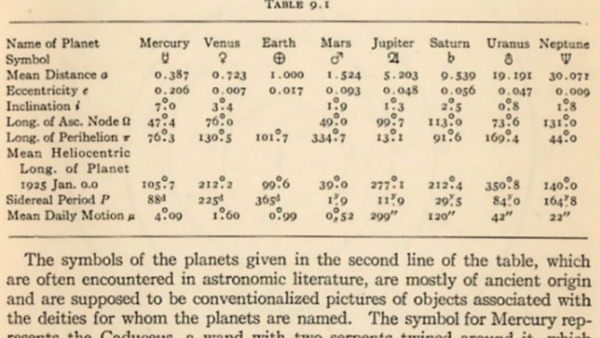
Fascinated by these symbols for as long as I can remember, I decided to learn more and share a high-level summary of each. I suggest that readers who wish to delve deeper review the sources listed at the bottom of this article. Clear skies!
The Sun

The Sun’s symbol (☉), a circle with a central dot—called the Circled Dot or Circumpunct—is one of the most ancient and universally recognized astronomical and alchemical symbols. To ancient thinkers, the circle represented perfection and eternity, while the dot symbolized the divine spirit or consciousness. In alchemy, the Sun was associated with gold, celebrated for its purity, radiance, and incorruptibility.
The Moon — The Crescent of Reflection

The Moon’s crescent shape (☽) is as familiar as the night sky itself. In ancient symbolism, it represented change, cycles, and reflection, embodying the rhythms of life and the passage of time. Alchemists associated the Moon with silver, valuing it as a softer, purer counterpart to the Sun’s gold. Its symbol captures both the Moon’s gentle illumination and its influence over tides, reminding us of the subtle forces that shape our world.
While I don’t appreciate the Moon’s bright glow washing out darker night skies, I never pass up a chance for a closer look. Its craters, mountains, and seas are endlessly fascinating, and lunar eclipses add a whole new layer of wonder, captured in some photos I took in March 2025.
Mercury — The Messenger’s Wand

The symbol for Mercury (☿) combines a circle, a small crescent, and a cross, making it a stylized version of Hermes’ caduceus, the winged staff. Sometime after the 11th century, the cross was added to lend the symbol a Christian association. In alchemy, Mercury (the element) represented the “spirit” that could unite all other substances, reflecting the planet’s quicksilver nature.
I first spotted Mercury in 2018, and it was a great moment with my wife and daughter. In an article about that evening, I share a curious historical tidbit linking Mercury to none other than Ted Bundy, a reminder of how astronomy can unexpectedly intersect with the wider world.
Venus — The Mirror of Beauty

The symbol of Venus (♀) is a circle above a cross, representing a hand mirror—a fitting emblem for the goddess of love and beauty. In the case of Venus, the cross was added later to Christianize the ancient symbol. Alchemically, it corresponded to copper, admired for its luster and warmth. It’s fascinating that this same symbol still represents the female gender, showing how deeply ancient astronomy continues to shape our cultural language.
I’ve admired Venus as the evening star for years, but it was during a quiet walk with my family in the early months of the COVID pandemic that I caught it shining above my garden. That simple, luminous moment inspired me to start this website, which I share on the About page.
Earth — Our Home

The symbol of Earth (⊕), a circle bisected by a vertical and horizontal line, represents the world divided into four parts, echoing the ancient idea of the four rivers or “corners” of the Earth. It’s a fitting emblem for our planet, the stage of life and human experience. Over time, the cross at its center also took on Christian associations, linking earthly existence to divine order.
Mars — The Spear and Shield

The symbol of Mars (♂) is a circle with an arrow pointing outward and upward—a simplified depiction of the god’s shield and spear. It came to represent iron, strength, and masculine energy. Where Venus embodies harmony, Mars stands for action.
I’ve long enjoyed observing Mars through various telescopes, but in recent years, I began trying to capture its icy poles through the scope. How great it is that familiar planets can reveal new wonders when you take a closer look.
Jupiter — The Thunderbolt or Eagle’s Staff

The symbol of Jupiter (♃) resembles a stylized “4,” but it originally represented the god’s lightning bolt or eagle’s staff. Its most widely accepted origin traces back to the Greek letter Zeta, the first letter of Zeus, Jupiter’s Greek counterpart. The horizontal cross-stroke was later added to indicate that the letter was an abbreviation. Over time, the design evolved into the more familiar shape. In alchemy, Jupiter corresponded to tin, a versatile and useful metal.
I’ve observed Jupiter through various telescopes for years, and what keeps me coming back is its constant variety. The four Galilean moons shift their positions daily, and even a modest telescope reveals subtle cloud changes and storms that evolve from one night to the next. In a full article, I share why Jupiter’s colorful, ever-changing atmosphere makes every viewing session a new adventure.
Saturn — The Scythe of Time

The symbol of Saturn (♄) resembles an “h” with a crossbar, representing the scythe or sickle of the god Saturn (Cronos), who ruled over time and harvest. Appropriately, alchemists associated it with lead, the heaviest and slowest of the seven classical metals. Saturn’s slow movement across the sky made it a natural emblem of patience, endurance, and the long arc of time.
I’ve had the pleasure of showing Saturn to family and friends over the years. Saturn never disappoints. Viewers are invariably struck by its beauty, just as I was as a child when I first saw those rings and became hooked on amateur astronomy. Season after season, I never miss the chance to pay a visit to the golden planet. You can check out my observations on this site.
Uranus — The Awakener

Soon after Uranus was discovered in 1781, two symbols were created. One symbol, ⛢, designed by the German astronomer Johann Gottfried Köhler and refined by Johann Elert Bode, helped popularize the planet. This design represented both Uranus and the recently discovered metal platinum, combining the traditional alchemical symbols for iron (Mars) and gold (the Sun) to reflect platinum’s blend of iron’s strength and gold’s nobility. A second symbol, ♅, was proposed in 1784 by French astronomer Joseph Jérôme Lefrançois de Lalande: a globe topped with an “H” in honor of William Herschel, who discovered Uranus.
I first spotted Uranus on November 6, 2020, and the moment was unforgettable. After years of searching from my backyard, I finally glimpsed the turquoise ice giant on a crisp, late-autumn night, a long-anticipated item checked off my astronomical bucket list. I recount that thrilling discovery and share tips for finding Uranus for yourself, even when it seems just out of reach.
Neptune — The Trident of the Sea

Neptune’s symbol (♆) is unmistakable: a trident, the weapon of the Roman god of the sea. Discovered in 1846, Neptune was named for its deep-blue color and oceanic mystery. The glyph, with its central prong pointing upward, evokes both the god’s power and the planet’s lofty place in the sky. In alchemy, Neptune’s influence was later associated with the metal mercury, reflecting fluidity and change, traits fitting for a planet so distant, mysterious, and ever-moving.
I first glimpsed Neptune on October 8, 2021, fulfilling a decades-long dream to see every planet in our solar system with my own eyes. That quiet, icy-blue point of light felt especially poignant coming just after the 175th anniversary of Neptune’s discovery. I share the story of that night, the thrill of spotting this elusive planet, and why moments like these make astronomy so deeply rewarding.
Pluto — The Hidden World

The symbol for Pluto (♇) joins the letters “P” and “L,” honoring Percival Lowell, whose observatory inspired its discovery in 1930. Though reclassified as a dwarf planet, Pluto still commands fascination. It stands for the unseen and the enduring, a small world of ice and shadow that reminds us how even the faintest points of light can carry great meaning.
On August 27, 2025, after thunderstorms finally cleared over Tampa, I set up my Seestar S50 for a routine night of astrophotography and captured Pluto for the very first time. I share the excitement of that moment, tips for spotting this distant world, and why even tiny points of light in the sky can inspire immense wonder.
Invitations to Stories Left to Tell
While modern astronomy has largely traded symbols for data tables and computer plots, these little emblems remain part of our heritage. They connect us to a time when astronomy was not just science, but a divine drama written across the heavens, with every planet a character.
For me, those curious shapes in my dad’s old astronomy book were invitations. And even now, I’m reminded that the heavens still have stories left to tell.
Sources for more information
Helmenstine, A. M., Ph.D. (2024, August 9). Alchemy Symbols and Meanings. ThoughtCo. Retrieved November 1, 2025, from https://www.thoughtco.com/alchemy-symbols-and-meanings-4065063
Maunder, A. S. D. (1934, August). The origin of the symbols of the planets. The Observatory, 57(723), 238–247. Retrieved from https://adsabs.harvard.edu/full/1934Obs….57..238M
NASA Science. (n.d.). Solar system symbols. Retrieved November 1, 2025, from https://science.nasa.gov/resource/solar-system-symbols/
Wikipedia. (n.d.). Planetary symbols. In Wikipedia. Retrieved November 1, 2025, from https://en.wikipedia.org/wiki/Planetary_symbols



 The Garden Astronomer