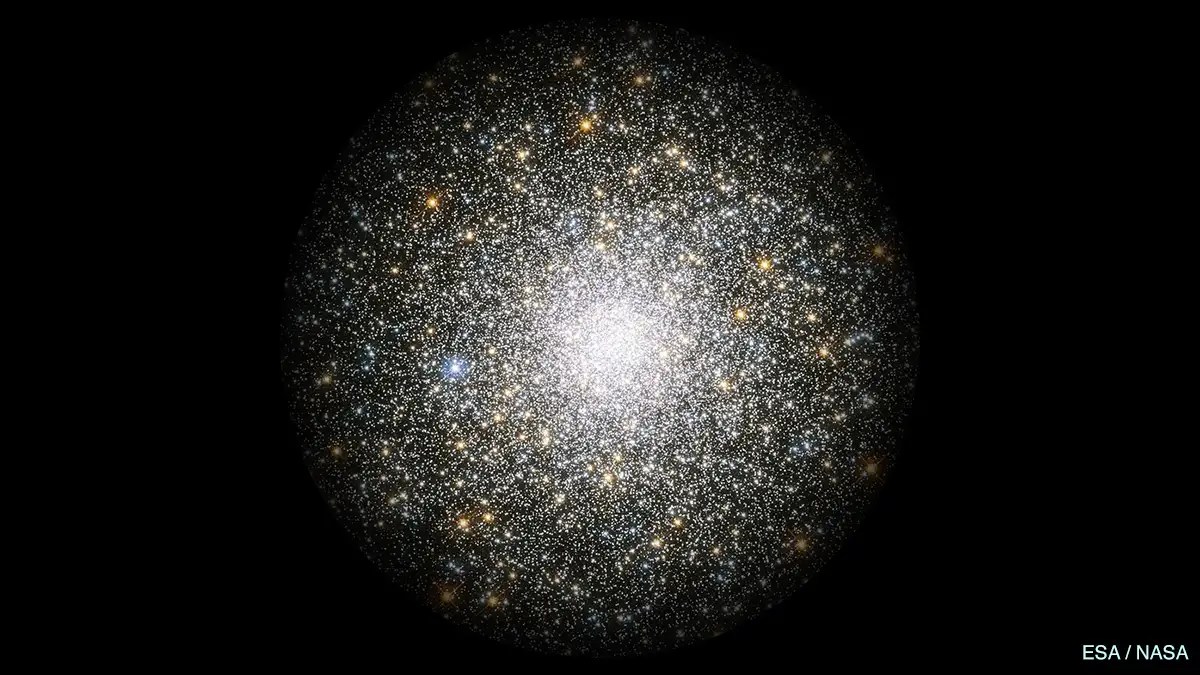
If the Milky Way were a metropolis, Messier 75 would be its most crowded suburb during rush hour. This cluster in the outer core of our galaxy isn’t just crowded; it’s one of the most densely packed collections of stars in our galactic neighborhood.
From about 67,500 light-years away in the constellation Sagittarius, M75 glows like a cosmic lantern. It’s small, faint, and easily overlooked through a backyard telescope. But zoom in with Hubble, and you’ll see more than 400,000 stars jammed into a sphere.

A Compact Ancient, Glittering Relic
Discovered in 1780 by Pierre Méchain and later added to Charles Messier’s famous catalog, M75 is classified as a Class I globular cluster, the tightest rating on the scale astronomers use to measure stellar concentration. That means stars in its core are so densely packed that if you lived there, the night sky would never get dark.
Moreover, studies of its orbit and chemical composition suggest that it may be a cosmic immigrant, a remnant of a smaller galaxy that the Milky Way has consumed. Think of it as a historical artifact from a time when galaxies were colliding and merging, reshaping the early universe. Read Rod Pommier’s article in Astronomy for more on this perspective.
My Observations
| Date | November 1, 2025 |
| Time | 9:45 p.m. |
| Location | Tampa, FL |
| Magnification | 169x |
| Scope | Meade 8″ SCT |
| Eyepiece | 12mm |
| Seeing | Average |
| Transparency | Above Average |
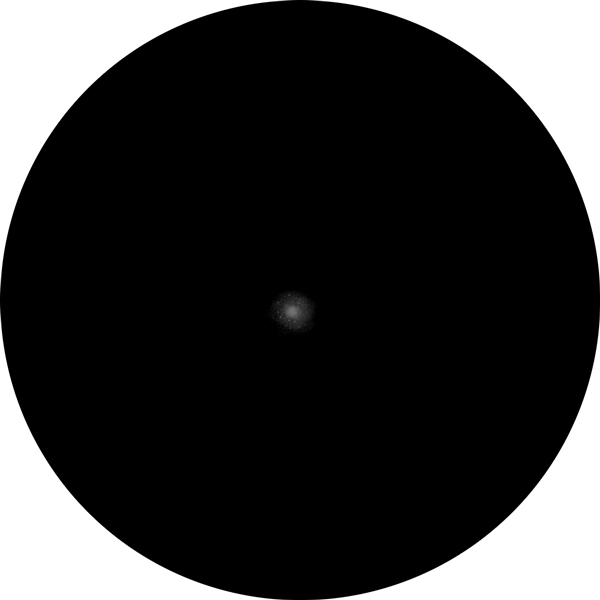
Last night, I retrieved my 8-inch Meade SCT from its long storage. I powered it up under a half-moon sky from my new observing spot. It felt wonderful to be back at the eyepiece of this telescope.
I’m still working through its calibration, and tonight it decided to have a mind of its own, missing every Go-To target by a wide margin! So I went old-school, sweeping back and forth across the southern sky, letting instinct and patience take over. After a few careful slews, the soft circular patch of Messier 75 slid into view.
The globular cluster appeared as a faint, fuzzy ball, its edges melting into the background. I couldn’t resolve any individual stars, but the core glowed with a subtle brightness. It wasn’t a perfect view, yet in that quiet moment, it didn’t matter. I was home again behind the eyepiece, rediscovering the sky one faint glow at a time.
Key Stats
| Constellation | Sagittarius |
| Best Viewing | Summer (June–August) |
| Visual Magnitude | +8.5 |
| Absolute Magnitude | −8.6 |
| Distance from Earth | 67,500 light-years |
| Diameter | ≈ 134 light-years (sources differ) |
| Apparent Size | 6.8 arcmin |
| Milky Way Location | Outer halo (∼14,700 ly beyond Galactic center) |
| My Viewing Grade | B- |
| Designations | M 75, NGC 6864, GCl 116 |
Historical Observations
Discovered by Pierre Méchain on August 27, 1780.
Nebula without star, between Sagittarius & the head of Capricorn; seen by M. Méchain on August 27 & 28, 1780. M. Messier looked for it on the following October 5, & on October 18, compared it with the star 4 Capricorni, of sixth magnitude, according to Flamsteed: it seemed to M. Messier to be composed of nothing but very small stars, containing nebulosity: M. Méchain reported it as a nebula without stars. M. Messier saw it on October 5; but the Moon being above the horizon, & it was not until the 18th of the same month that he was able to judge about its form & determine its position.
Historical descriptions, such as Méchain’s, are enjoyable and insightful. You can read more on Messier 75 at messier.seds.org.
Sources and Notes
Hartmut Frommert & Christine Kron. (2005, October 21). Messier 75. SEDS Messier. http://www.messier.seds.org/Mdes/dm075.html
NASA. (n.d.). Messier 75. NASA Science: Hubble Space Telescope. Retrieved November 2, 2025, from https://science.nasa.gov/mission/hubble/science/explore-the-night-sky/hubble-messier-catalog/messier-75
Pommier, R. (2024, August 9). Survivors from the Milky Way’s birth. Astronomy. https://www.astronomy.com/science/survivors-from-the-milky-ways-birth/
Sketch by Wayne McGraw
 The Garden Astronomer