
There’s a place in the Cygnus the Swan where a curved shell of light glows like breath on glass. Astronomers refer to it as NGC 6888 or Caldwell 27. To the rest of us, it’s the Crescent Nebula, a luminous deep-sky beauty suspended five thousand light-years from Earth.
The Fire Within: A Wolf-Rayet Star
William Herschel first observed the emission nebula on September 15, 1792. According to Russell Deeks for BBC Sky at Night, Herschel described a double star with a “faint, milky ray joining to it.”
At this emission nebula’s “milky ray” heart lies a star known as WR 136, a Wolf–Rayet star nearing its end. These are rare, massive, and short-lived suns that live fast and burn with a ferocity most stars never know. WR 136 is at least twenty times the mass of our Sun, and it’s shedding its outer layers in fierce, storming winds.
Shaping the Crescent
As that expelled material collides with older clouds thrown off long ago, shockwaves ripple through the surrounding gas, shaping the nebula. What forms is not a gentle bow of light, but a sculpture of motion, waves of glowing gas folding in on themselves, rising, falling, reshaping like surf against the unseen shore of space.
My Observations
| Date | November 1, 2025 |
| Time | 10:45 p.m. |
| Location | Tampa, FL |
| Magnification | 85x |
| Scope | Meade 8″ SCT |
| Eyepiece | 24mm |
| Seeing | Above Average |
| Transparency | Average |
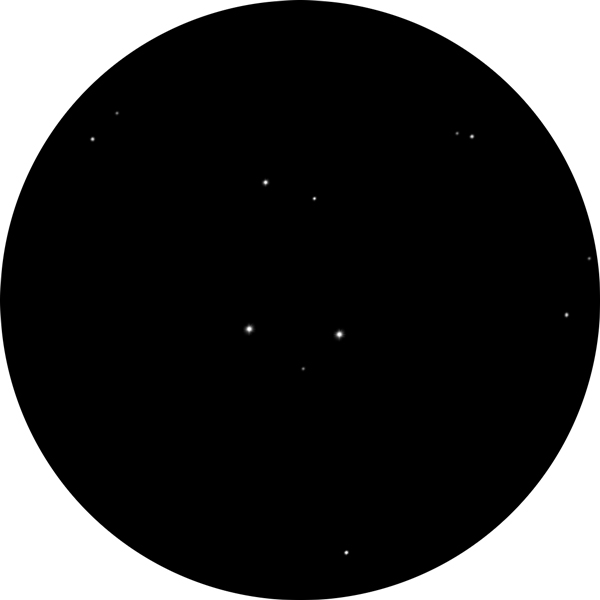

Unfortunately, the light pollution from nearby Tampa washes out any nebulosity of NGC 6888, making it impossible to see the Crescent Nebula itself, so I fired up the Seestar to get a 45-minute image. Still, the four familiar bright stars of the field shine clearly in the Meade, and their steady glow transports me back to my first observation of this region in Seattle a few years ago.
First observation on August 22, 2020, at 10:09 p.m. from Seattle, WA: Even when using a light pollution filter, NGC 6888 is tough to make out during this session. I can only confirm I’m seeing the nebula due to the bright parallelogram “pattern” of the stars. Additionally, using peripheral vision, it appears that there is some nebulosity surrounding the top two stars. I didn’t have any luck with my UHC filter, but my OIII brought out very faint nebulosity around the top two stars.
Key Stats
| Constellation | Cygnus |
| Best Viewing | Summer / Autumn |
| Visual Magnitude | +7.4 |
| Absolute Magnitude | -.93 |
| Distance from Earth | 4,700 ly |
| Diameter | 25 light-years |
| Apparent Size | 20 x 10 arcmin |
| Milky Way Location | Orion Spur |
| My Viewing Grade | B |
| Designations | NGC 6888, Sharpless 105, Caldwell 27, LBN 203 |
Sources and Notes
Banner photo by Patrick Hsieh. Licensed under the Creative Commons Attribution-Share Alike 4.0 International.
Deeks, R. (2024, August 12). The Crescent Nebula is a cosmic cloud glowing as it’s blasted by radiation from a rare type of star. BBC Sky at Night Magazine. https://www.skyatnightmagazine.com/astrophotography/nebulae/crescent-nebula
Wikipedia contributors. (n.d.). Crescent Nebula. In Wikipedia. Retrieved November 6, 2025, from https://en.wikipedia.org/wiki/Crescent_Nebula
 The Garden Astronomer