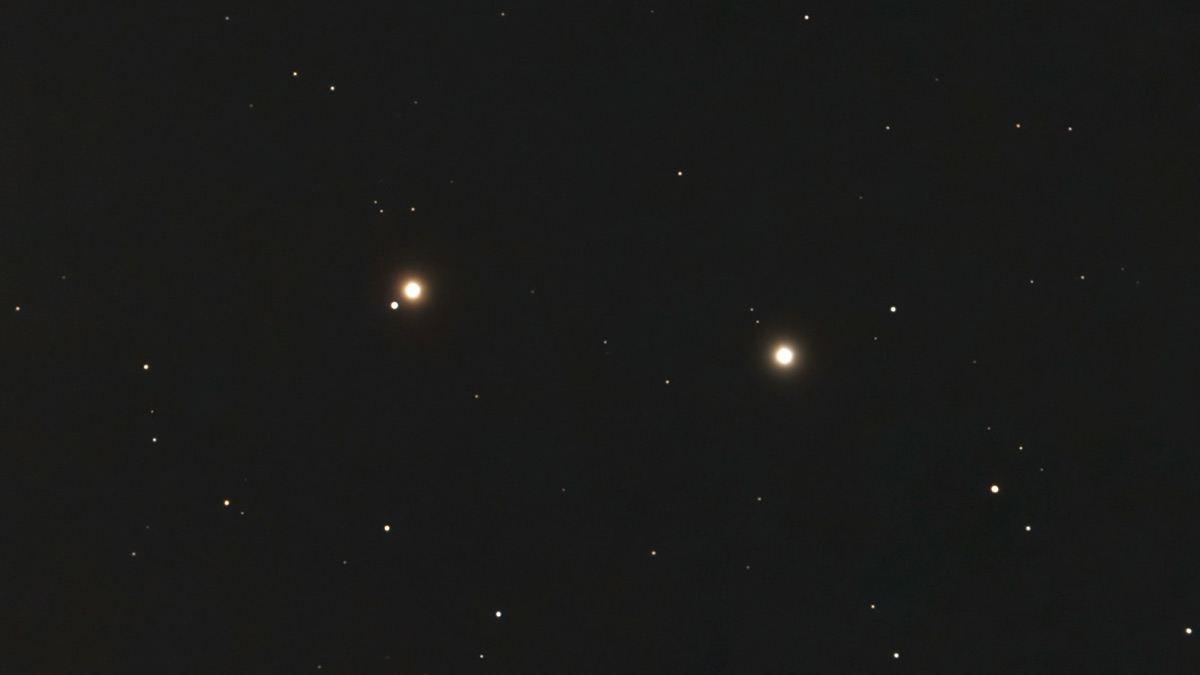
When you point your telescope toward the southern constellation Grus (the Crane), you’ll find a delightful surprise: two stars that appear close together in the sky, known as Delta¹ Gruis (δ¹ Gru) and Delta² Gruis (δ² Gru). Separated by a little over 15 arcminutes, they sit just over half the apparent width of the full Moon apart, forming a pleasing naked-eye pair created purely by line-of-sight coincidence.
Delta¹ Gruis: A Yellow Giant
Delta¹ Gruis is a yellow giant star classified as spectral type G7. Located approximately 309 light-years from Earth, this evolved star has exhausted the hydrogen in its core and expanded to become a giant. Its visual magnitude hovers around 4.0 and is visible to the naked eye under reasonably dark skies. Also, Delta¹ Gruis is accompanied by a much fainter star of magnitude 12.8, located about 5.6 arcseconds away. At present, it remains unclear whether this nearby star is a true gravitationally bound companion or merely an optical alignment
Delta2 Gruis: A Red Giant
Delta² Gruis is the more distant of the pair, lying roughly 356 light-years away. This red giant star, classified as spectral type M4.5, is cooler and more evolved than its optical companion. Shining at magnitude 4.1, it’s actually the brighter of the two stars despite being farther away, thanks to its larger size and luminosity. According to Stelledoppie, the star has a magnitude 9.7 visual companion 60 arcseconds away.
Viewing the pair
The Delta Gruis pair offers a pleasant view for amateur astronomers, especially in the Southern Hemisphere, where Grus rides high in the sky during spring and summer. For observers in the Northern Hemisphere, it’s best seen from lower latitudes, where you can look low toward the southern horizon in late summer through autumn to catch the Crane walking along the horizon. Through even a small telescope or good binoculars, you’ll easily resolve both stars.
My Observations
| Date | October 16, 2025 |
| Time | 9:15 p.m. |
| Location | Tampa, FL |
| Scope | Seestar S50 |
| Exposure | 3 Minutes |
| Seeing | Above Average |
| Transparency | Above Average |
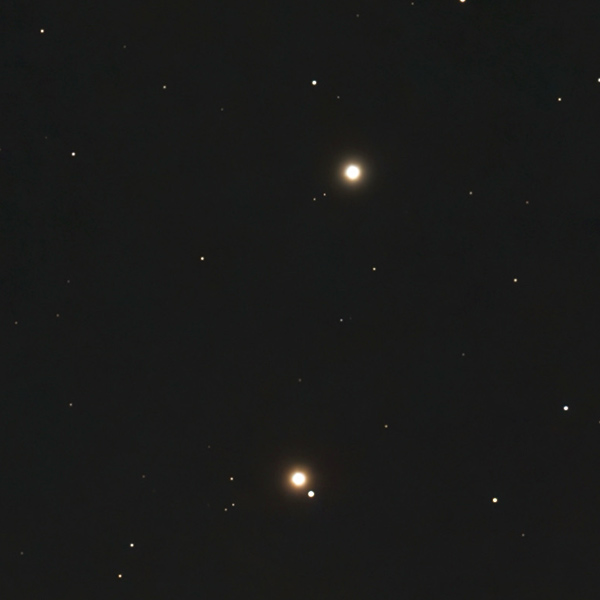
From the Tampa area, I’m taking advantage of the lower latitude to catch southern constellations I could never reach from Seattle. It was exciting to finally see the stars of Grus and Phoenix (Ankaa) hovering low on the horizon, using Fomalhaut as my guidepost. Once Delta¹ and Delta² popped into view through my binoculars, I decided to image the pair with the Seestar S50, which captured this pretty optical duo up close.
Key Stats
| Constellation | Grus |
| Best Viewing | Late Summer — Autumn |
| Visual Magnitude | +3.97 (Delta¹) | +4.11 (Delta²) |
| Distance | Delta¹ ≈ 309 ly | Delta² ≈ 356 ly |
| My Viewing Grade | A |
| Designations | Delta¹ Gruis (δ¹ Gru, HD 213009, SAO 231154, Del1 Gru) | Delta² Gruis (δ² Gru, HD 213080, SAO 231161) |
Sources and Notes
Kaler, J. B. (n.d.). Delta ¹ Gruis. STARS: Portraits of Stars and Their Constellations. Retrieved November 7, 2025, from http://stars.astro.illinois.edu/sow/deltagru.html
Stelle Doppie. (n.d.). Stelle Doppie – Double star database. Retrieved November 7, 2025, from https://www.stelledoppie.it/index2.php?iddoppia=99923
Photos: Wayne McGraw
 The Garden Astronomer