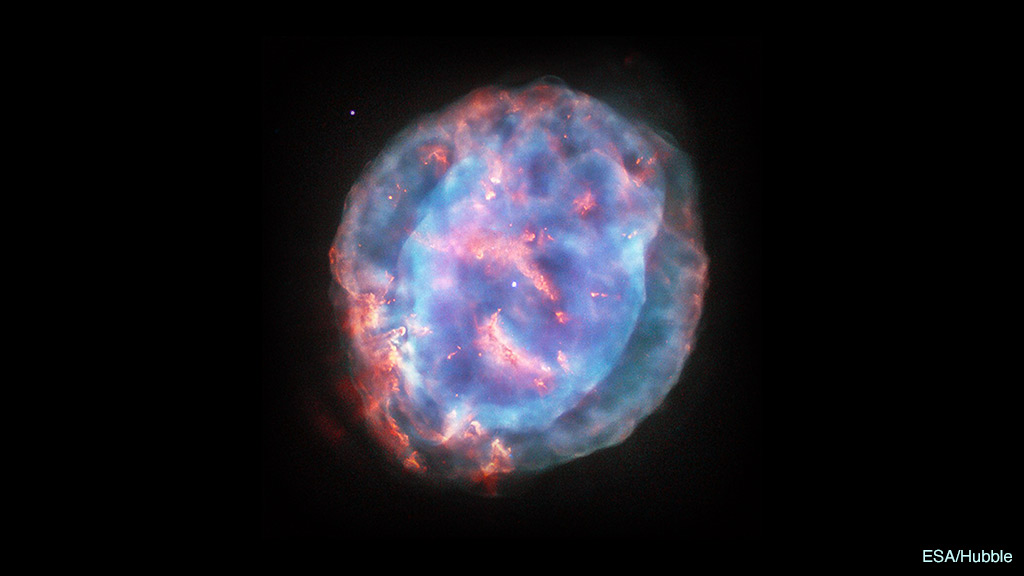
When William Herschel swept his telescope across Sagittarius on August 4, 1787, he stumbled upon something small but unusually bright. Little did he know, he had discovered what would later be named the Little Gem Nebula.
A Star’s Final Breath Frozen in Time
NGC 6818 sits about 6,000 light-years from us. In the eyepiece, it looks like a faint bead floating in a dense field of stars. That glow comes from a Sun-like star in its final act. After running out of fuel, it shed its outer layers, exposing its blistering-hot core. That exposed core now lights up the cast-off gas, creating a vivid blue-green bubble in space.
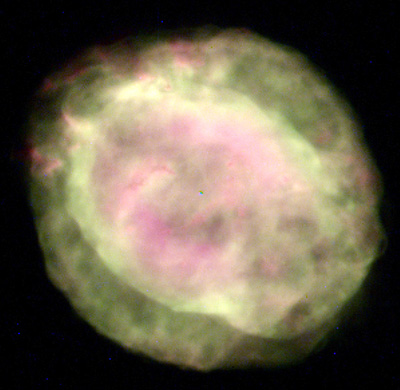
Hubble images show filaments, knots, and arcs that reveal the chaos that shaped it. Fast winds crash into older, slower gas, creating hollows and shock fronts. Some scientists think a hidden companion star may have helped shape the nebula’s uneven edges.
So next time you scan the stars in summer—or autumn if you’re farther south—pause on Sagittarius and seek out the Little Gem. Even through a modest telescope, you’ll glimpse the final, radiant moments of a distant star, frozen in a jewel-like bubble of light. It’s a reminder of the beauty and impermanence written across the cosmos.
My Observation
| Date | November 13, 2025 |
| Time | 8:00 p.m. |
| Location | Seattle, WA |
| Magnification | 127x |
| Scope | Meade 8″ SCT |
| Eyepiece | 16mm |
| Seeing | Average |
| Transparency | Average |

It still amazes me that I can peer down into Sagittarius on a mid-November night—especially with that soft dome of skyglow rising from Tampa to my south. As the telescope finishes its slew, a faint, fuzzy dot pops out against the sharper stars in the 20mm eyepiece. I switch to the 16mm, then the 12mm, but the 16mm feels just right.
The nebula displays a beautiful green-blue disk, with a brighter turquoise center that gradually fades into a deeper blue at its edges. Beyond that, I can’t tease out much detail. This has quickly become one of my favorite planetary nebulae. It announces itself immediately in the eyepiece, bright and confident, almost as if it’s glad I stopped by.
Key Stats
| Constellation | Sagittarius |
| Best Viewing | Summer |
| Visual Magnitude | +10 |
| Distance from Earth | 6,000 light-years |
| Diameter | 0.5 light-year across |
| Apparent Size | 15″ × 22″ |
| My Viewing Grade | B+ |
| Designations | NGC 6818, PK 25-17.1, PN G025.8-17.9, “Little Gem Nebula” |
Sources and Notes
NASA Hubble Mission Team. (2015, August 7). Hubble finds a little gem. NASA. Retrieved November 13, 2025, from https://science.nasa.gov/missions/hubble/hubble-finds-a-little-gem/
Wikipedia contributors. (n.d.). NGC 6818. In Wikipedia. Retrieved November 13, 2025, from https://en.wikipedia.org/wiki/NGC_6818



 The Garden Astronomer