
I promise I’m not trying to farm clicks with a wild comparison. As I look at NGC 6883, I see the spaceship from the classic game Asteroids shooting bullets, but more on that in a minute.
A Small and Mighty Cluster
The constellation Cygnus is packed with bright stars and glowing nebulae, and inside that busy stretch of the Milky Way sits NGC 6883. It is an open cluster approximately 4,500 light-years away, composed of a few dozen young stars that are moving together through space. It is easy to miss because the surrounding star field is so crowded, but that is part of what makes it interesting.
Through a telescope, NGC 6883 reveals a few brighter stars that anchor the group, with dimmer members scattered around them. Perhaps it’s just my Gen-Xer coming out, but through a 12mm eyepiece, the shape almost resembles the little triangular spaceship from the game Asteroids, firing across the starry screen. Once you see it, you cannot unsee it.
Part of a Bigger Stellar Family
NGC 6883 may look small at first, but it’s really part of a much larger stellar family, together with UBC 103, a nearby open cluster identified in recent Gaia surveys. A 2023 study in Astronomy & Astrophysics found stars moving together at similar distances stretching as far as 40 arcminutes to the north, northeast, and south of NGC 6883.
This small cluster, first identified by John Herschel in 1828, may not be a showstopper, but it rewards those who slow down and look closely.
My Observations
| Date | November 14, 2022 |
| Time | 9:40 p.m. |
| Location | Seattle, WA |
| Magnification | 169x |
| Scope | Meade 8″ SCT |
| Eyepiece | 12mm |
| Seeing | Average |
| Transparency | Average |
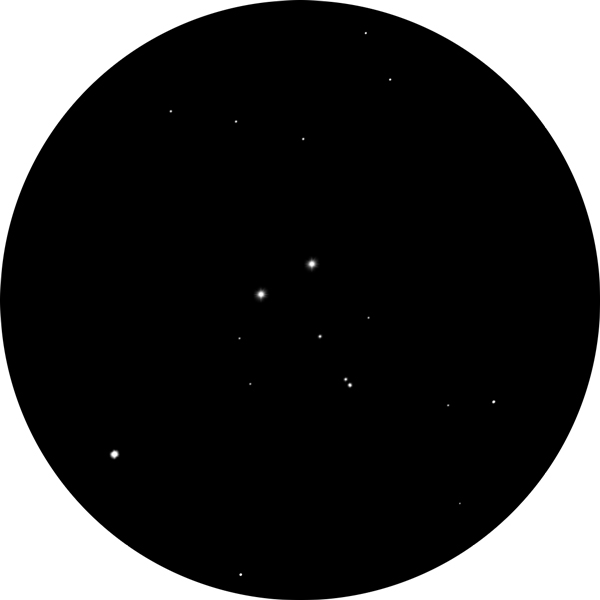
Through my 12 mm eyepiece, NGC 6883 looks like a mini Asteroids game in the sky. Tampa’s suburban glow dims the view, but even with city lights, the cluster’s charm shines through. Tiny yet lively, it reminds me that the universe has a sense of order, chaos, and a hint of nostalgia all rolled into one backyard view.
Key Stats
| Constellation | Cygnus |
| Best Viewing | Summer |
| Visual Magnitude | +8.0 |
| Absolute Magnitude | -2.70 |
| Distance from Earth | 4,500 ly |
| Milky Way Location | Orion Spur |
| My Viewing Grade | B+ |
Sources
Negueruela, I., and de Burgos, A. (2023). Gaia colour‑magnitude diagrams of young open clusters: Identification in the UBC catalogue and a comparison of manual and automated analysis. Astronomy & Astrophysics, 675, A19. https://doi.org/10.1051/0004-6361/202244933
Sketch by Wayne McGraw
 The Garden Astronomer