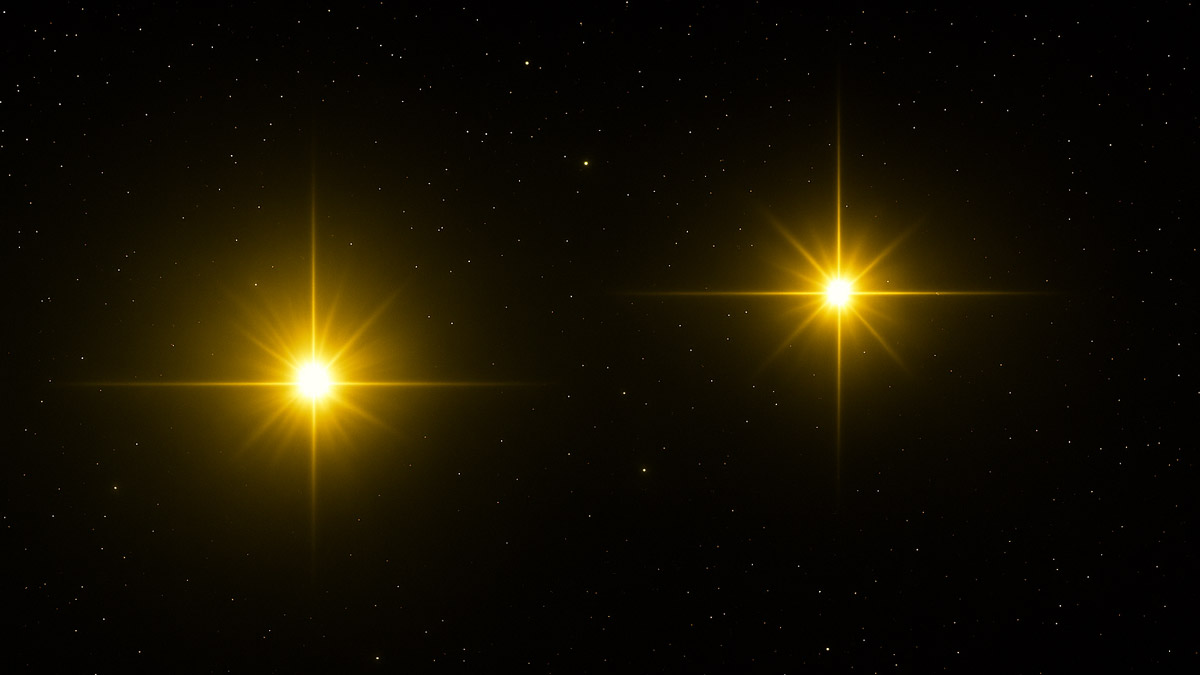
When you gaze up at the constellation Aquarius, you’re looking at a region of space filled with good deep-sky objects, like Messier 2, the Helix Nebula, and the Saturn Nebula. Joining them is 91 Aquarii, more properly known as Psi¹ Aquarii (ψ¹ Aquarii). It isn’t just a double star. It’s a multi-star system complete with a giant star, a binary star pair, and an exoplanet.
The Star at the Center: Psi1 Aquarii A
The main star of the show is Psi1 Aquarii A at a magnitude of +4.23. It’s an orange giant (spectral type K1 III). This means it has left its main-sequence life, having burned through the hydrogen in its core. It has since expanded dramatically, all while having a cooler surface temperature that gives it a distinct orange hue.
A Binary Orbiting Psi1 Aquarii A
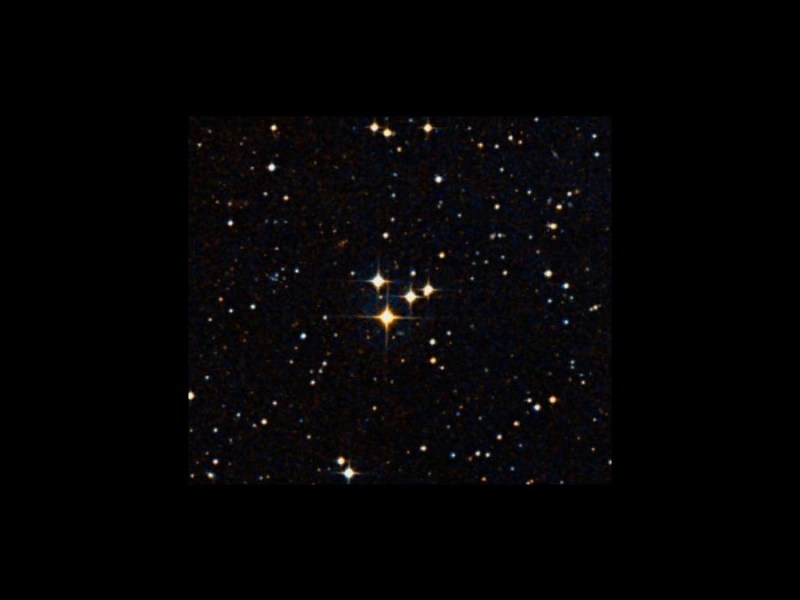
At 49 arcseconds away, two smaller, dimmer stars at magnitude +9.88 are gravitationally bound together in a tight little orbit of their own, known as Psi1 Aquarii B & C. According to Stelle Doppie, B &C are separated by .2 arcseconds, and the duo orbits the primary star Psi1 Aquarii A.
The System’s Hidden Secret: An Exoplanet
Astronomers discovered another member in 2003. Orbiting the primary star is a massive exoplanet designated 91 Aquarii Ab.
This isn’t a small, rocky world. It’s a gas giant estimated to be around 3 times the mass of Jupiter. It orbits its host star, the orange giant, in a surprisingly tight, nearly circular orbit that takes about 181 days to complete, placing it slightly closer to its star than Venus is to our Sun.
My Observations
| Date | November 14, 2025 |
| Time | 9:30 p.m. |
| Location | Seattle, WA |
| Magnification | 169x |
| Scope | Meade 8″ SCT |
| Eyepiece | 12mm |
| Seeing | Average |
| Transparency | Average |
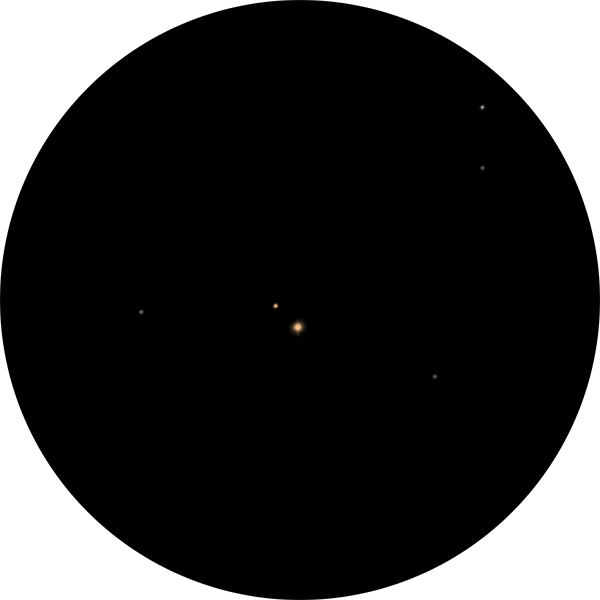
Through my 8-inch SCT with a 12mm eyepiece, 91 Aquarii appears with a steady, warm orange hue. The companion is faint but seems to share that same color. A few dim stars drift in the field, though I cannot tell if they belong to the system. Stelle Doppie lists six companions.
Key Stats
| Constellation | Aquarius |
| Best Viewing | Autumn |
| Visual Magnitude | +4.2 | +9.8 |
| Separation | 49″ |
| Position Angle | 311° |
| Milky Way Location | Orion Spur |
| My Viewing Grade | B |
| Designations | 91 Aqr A, Psi-1 Aquarii A, ψ1 Aqr A, ψ1 Aquarii A, HD 219449 A, HIP 114855 A, Gliese 893.2 A, GJ 893.2 A, GJ 9815 A, BD-09 6156 A, WDS J23159-0905 A |
Sources and Notes
Stelledoppie. (n.d.). Doppie: 103241. Retrieved November 16, 2025, from https://www.stelledoppie.it/index2.php?iddoppia=103241
Mitchell, D. S., Trifonov, T., Reffert, S., & Fischer, D. A. (2013). Precise radial velocities of giant stars. V. A brown dwarf and a planet orbiting the K giant stars τ Geminorum and 91 Aquarii. Astronomy & Astrophysics, 555, A87. https://doi.org/10.1051/0004-6361/201321714
Sketch by Wayne McGraw

 The Garden Astronomer