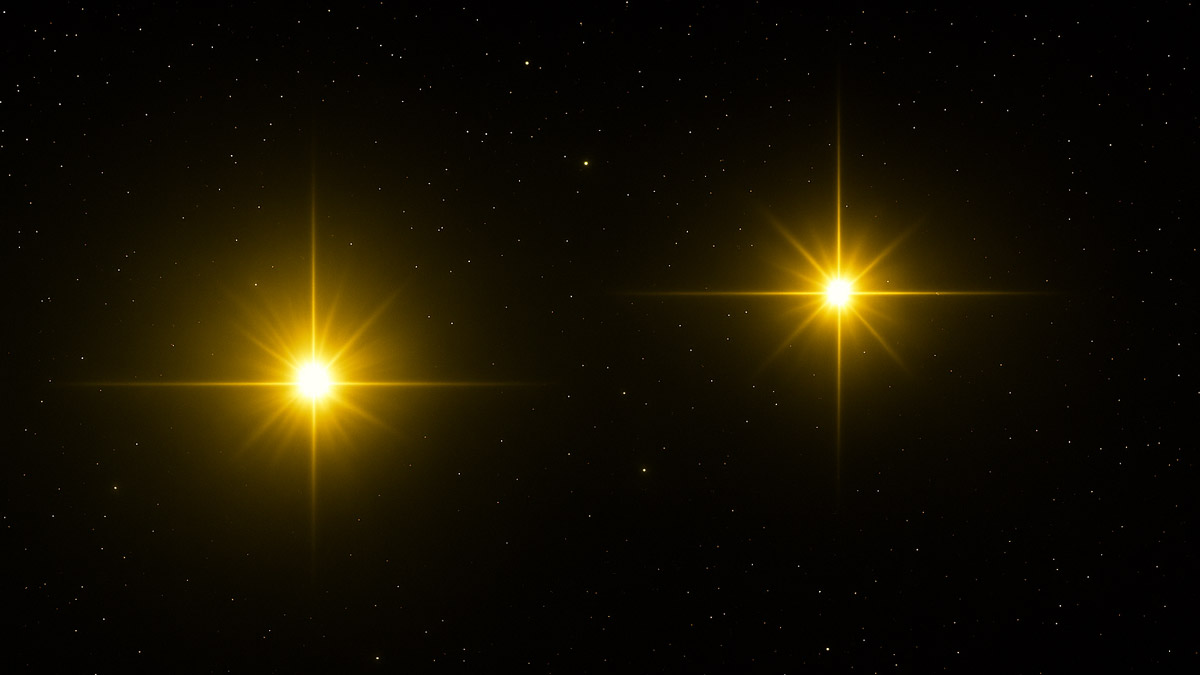
As the evening descends in autumn, the Water Bearer brings with it a rich collection of deep-sky objects, including Messier 2, the Helix Nebula, and the Saturn Nebula. Among them shines 94 Aquarii. Often called a double star, it is actually a triple star system, consisting of a bright inner binary pair orbited by a dimmer companion.
The Primary Star: 94 Aquarii A
94 Aquarii A shines at magnitude 5.19. This subgiant star, of spectral type G8.5 IV, has a mass about 1.22 times that of the Sun. Its surface temperature ranges from roughly 5,300 to 5,500 K, giving it a soft, warm yellowish tone. Only .18 arcseconds away is another star, orbiting it every 6.32 years. The separation between the two is too small, so we can’t see this smaller star visually.
The Companion Star: 94 Aquarii B
The dimmer outer component, B, lies 12.25 arcseconds away at magnitude 6.97. It is a main-sequence star of type K2 V, making it a relatively easy split for small telescopes. The system’s stars also display higher metallicity than the Sun, hinting that they formed in a region rich in heavy elements.
Exploring 94 Aquarii reminds us that even stars that seem ordinary at first glance can hold surprising complexity. It’s a worthy target when navigating the skies of Aquarius.
My Observations
| Date | November 14, 2025 |
| Time | 8:10 p.m. |
| Location | Seattle, WA |
| Magnification | 169x |
| Scope | Meade 8″ SCT |
| Eyepiece | 12mm |
| Seeing | Average |
| Transparency | Average |
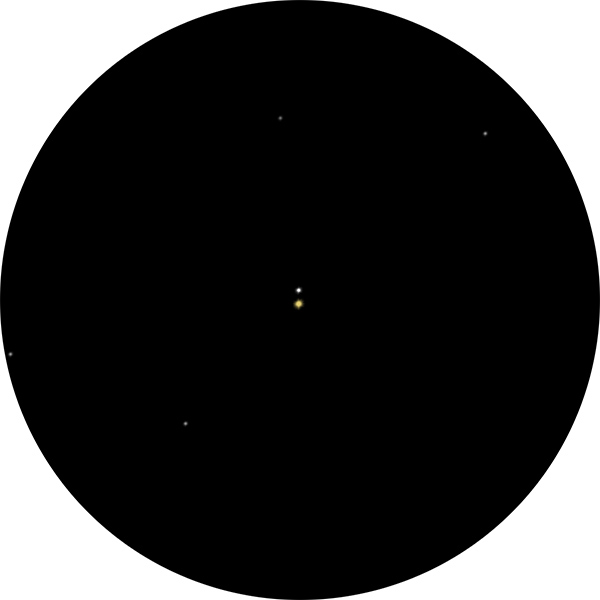
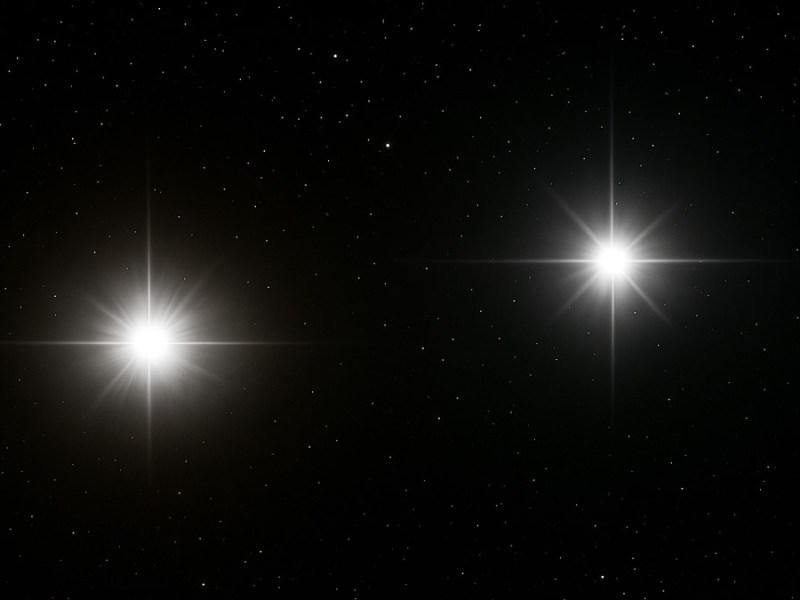
The primary star of 94 Aquarii stands out with a steady orange-yellow glow. The secondary appears gray at first glance, but the longer I stare, the more a faint bluish tint seems to emerge, as if its color shifts with each moment of concentration. It is subtle.
I am not alone in the uncertainty, either. Other observers have reported a variety of hues in the companion, ranging from bronze to violet to grary. That mix of impressions is part of the charm of observing this system, reminding me that sometimes the sky invites us not just to look, but to linger.
Key Stats
| Constellation | Aquarius |
| Best Viewing | Autumn |
| Visual Magnitude | +5.27 | +6.97 |
| Separation | 12.25″ |
| Position Angle | 353° |
| Distance | 68.9 light years |
| Milky Way Location | Orion Spur |
| My Viewing Grade | B |
| Designations | 94 Aqr, Struve 2998, STF 2998, SAO 165625, HIP 115126, HD 219834, HR 8866, GC 32461 |
Sources and Notes
Stelle Doppie. (n.d.). WDS 23191‑1328 STF 2998 AB (94 Aqr). Retrieved November 16, 2025, from https://www.stelledoppie.it/index2.php?iddoppia=103434
Sketch by Wayne McGraw

 The Garden Astronomer