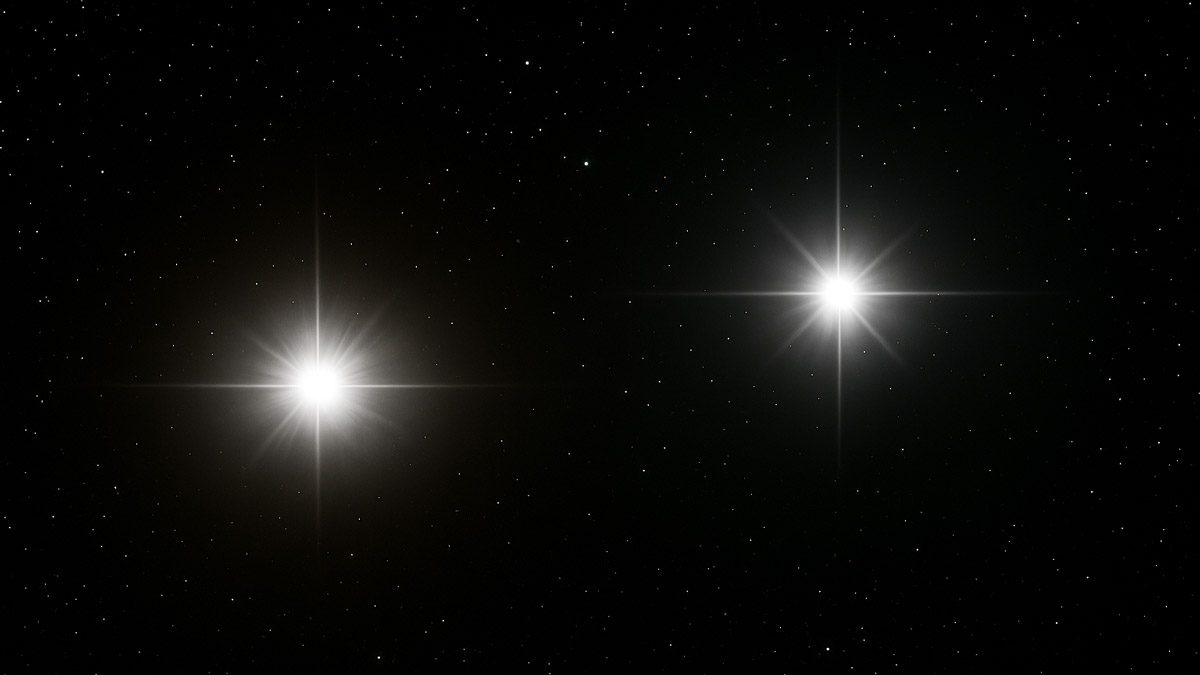
Positioned in southern skies, Cetus, the Sea Monster, is a sprawling constellation best viewed in late autumn. Among its double stars, including one of my personal favorites, 66 Ceti, is the intriguing pair WNO 1.
There is not a great deal of published material on WNO 1, but Bob Argyle offers some valuable insight through the Webb Deep Sky Society. He explains that the United States Naval Observatory in Washington has been measuring the positions of stars for more than 150 years. Along the way, their astronomers sometimes discover new double stars, which are then added to the Washington Double Star Catalog (WDS) under the designation WNO.
At the top of that list is WNO 1, the first pair recognized in this series. The primary star, a moderately bright F-type, shines around magnitude 6.6, while the companion glows more faintly at about 8.9. Stelle Doppie lists it as 9.2. Despite their brightness differences, they make a charming duo.
Argyle also notes that since its discovery in 1876, this pair has shown very little motion. The current separation is roughly 5.4 arcseconds, and according to Stelle Doppie, the two stars appear to be a true binary.
So the next time you are exploring the Sea Monster, take a moment to visit this quaint double, the very first entry in the Washington list!
My Observations
| Date | November 14, 2025 |
| Time | 8:42 p.m. |
| Location | Tampa, FL |
| Magnification | 169x |
| Scope | Meade 8″ SCT |
| Eyepiece | 12mm |
| Seeing | Average |
| Transparency | Average |

On this moonless November night with good seeing, I have been enjoying a peaceful tour through the sprawling constellation of Cetus. I sought out WNO 1 after reading about it in Agnes Clarke’s Observing Double Stars, and it proved to be a pleasant and subtle target.
Through my 12 mm eyepiece, the primary and its companion both appear cleanly white, with no hint of additional color. The secondary star is dim enough that I needed to steady the scope to hold it clearly in view, but once seen, the unequal pair presents a delicate and satisfying contrast against the quiet backdrop of the Sea Monster.
Key Stats
| Constellation | Cetus |
| Best Viewing | Late Autumn |
| Visual Magnitude | +6.6 | +8.9 |
| Separation | 5.4″ |
| Position Angle | 7° |
| Distance | 240 light-years |
| My Viewing Grade | B |
| Designations | SAO 166651, HD 5156, HIP 4164, |
Sources and Notes
Argyle, B. (2023). Double Star of the Month Archive 2023. Webb Deep-Sky Society. https://www.webbdeepsky.com/double-stars/2023/
Stelle Doppie. (n.d.). Double star database — record ID 3515. Retrieved [Month Day, Year], from https://www.stelledoppie.it/index2.php?iddoppia=3515
Sketch by Wayne McGraw
 The Garden Astronomer