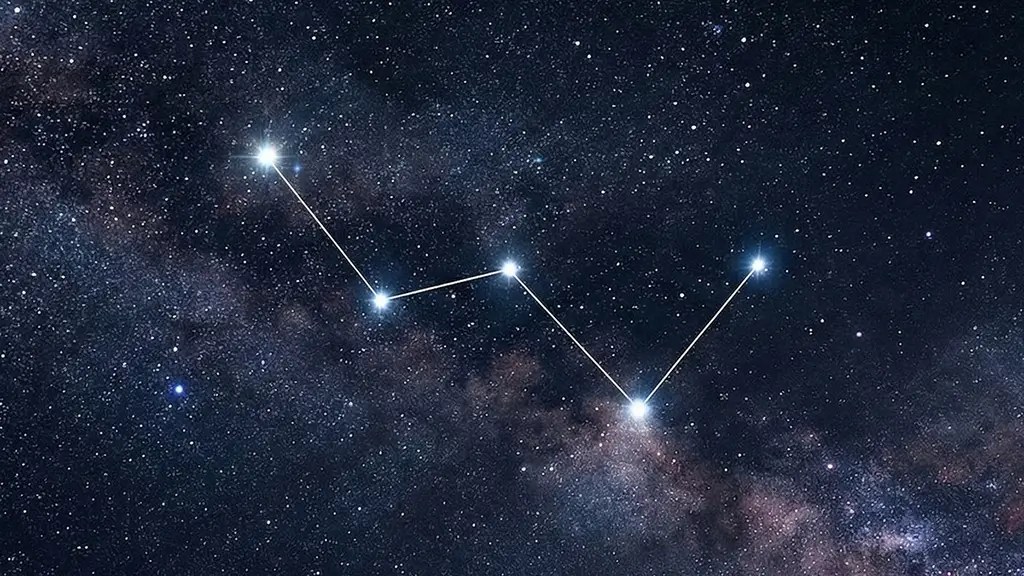
The backyard becomes a quiet outpost at the edge of evening. Darkness stretches across the yard as nearby porch lights vanish one by one. And above the roofline, half of Cassiopeia edges into view.
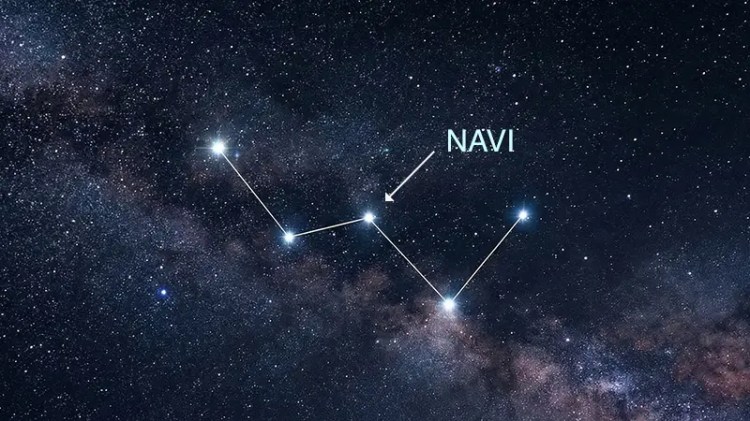
And there it is — Navi, my favorite star, known on charts as Gamma Cassiopeiae. Pinned to the center of the Queen’s celestial “W,” the star’s silver-blue light carries the same hue as a summer lightning bolt.
“That light left more than five centuries ago,” I whisper to myself, peering through the scope.
The Aztec and Inca Empires flourished, the Ming Dynasty ruled, and a young Leonardo da Vinci first picked up his brush and pencil, honing the skills that would one day make him legendary.
High above in that cathedral of night, Navi spins at nearly one million miles per hour. Its equator bulges and flickers with uncontainable energy, flinging matter outward into a swirling disk of gas that makes the star brighten and fade over time. How I wish I could step up to the firmament and witness this force!
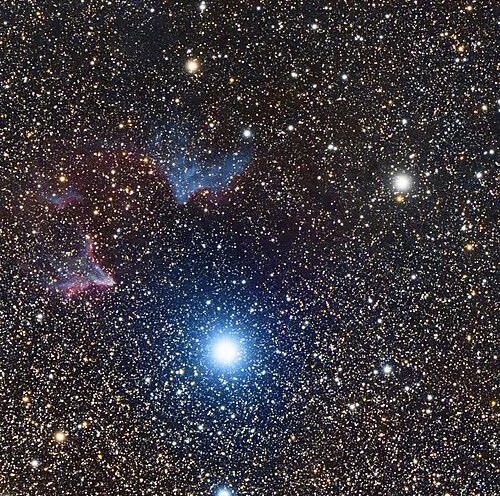
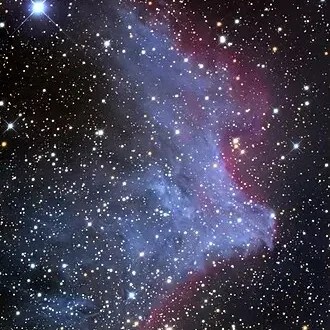
IC 63: The Ghost of Cassiopiea
Beneath a frosty Heidelberg sky on December 30, 1893, the German astronomer Max Wolf discovered the ethereal wisps of nebulae near Navi, in the region Sh 2-185. Those faint patches, now known as IC 69 and IC 53, are clouds of ionized gas shaped by the fierce stellar winds of this restless star.

From our view on Earth, IC 63 sits just behind Navi, with its nearest edge about 7.5 light-years away. The star itself sculpts and illuminates this ghostly nebula. IC 63 glows red at the tip where its hydrogen gas is excited by the star’s intense ultraviolet radiation. Meanwhile, the soft blue light comes from Navi’s starlight scattering off tiny dust particles.
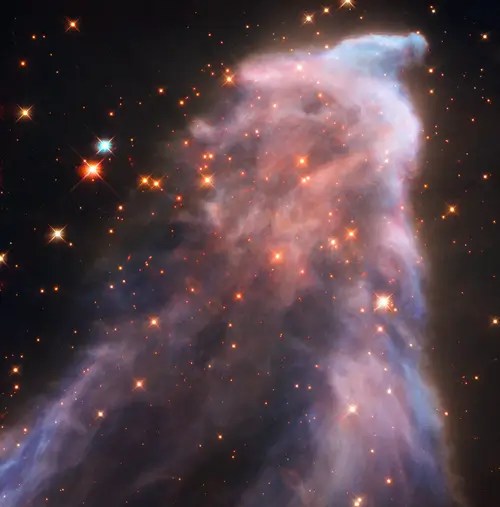
Acknowledgment: H. Arab (University of Strasbourg)
Nearby lies the related nebula IC 59, also discovered by Wolf that same night. It appears dimmer and less red, casting a beautiful blue of Navi’s starlight. Astronomers note that the nebulae are slowly evaporating under the star’s relentless radiation.
Navi: Gus Grissom’s Navigational Star
Gamma Cassiopeiae earned its nickname from astronaut Gus Grissom, whose full name was Virgil Ivan “Gus” Grissom.

It so happens that “Navi” is his middle name spelled backward, and he slipped a playful twist into NASA’s navigational star charts. According toEric Jones, Gamma Cassiopeiae became Navi for Grissom; Gamma Velorum became Regor for Roger B. Chaffee; and Iota Ursae Majoris became Dnoces for Ed White II.
After the tragic Apollo 1 fire took the lives of the three astronauts, NASA kept the star names as a quiet tribute to the crew. You can see them on the Apollo 11 star charts and on the Apollo 12 flight list.
My Observations
Tonight, I observe Navi through my telescope while using the Seestar S50 to image the Ghost Nebula. Due to light-polluted skies, I’m unable to see the faint nebula in the 8-inch scope.
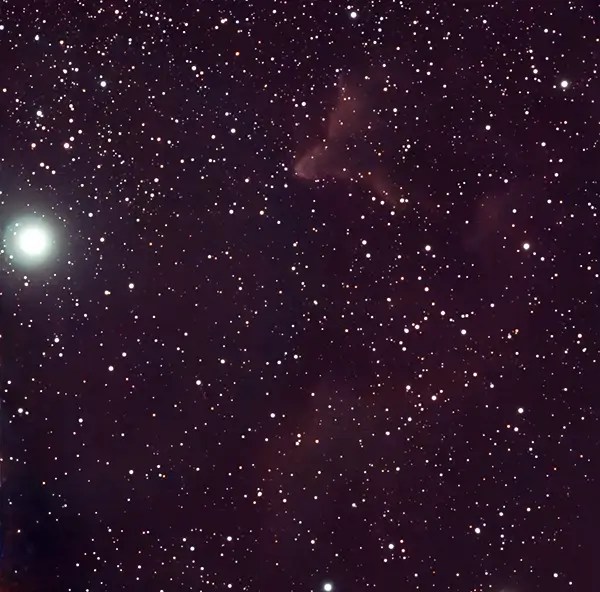
I’ve often visited the star over the years. For me, it has a unique beauty, and I’m always taken aback knowing it’s spinning in place while centuries vanish below it. It has been a silent witness to empires, artists, and astronauts. In a world where moments pass and things disappear, Navi continues to shine.
Key Stats
| Constellation | Cassiopeia |
| Best Viewing | Autumn |
| Visual Magnitude | 2.47 – 3.03 (variable) |
| Absolute Visual Magnitude | -3.41 |
| Distance from Earth | ~550 light-years |
| Milky Way Location | Orion Spur |
| My Viewing Grade | A |
| Designations | SAO 21247, α Cas (Gamma Cas), HIP 32549, HR 264, HD 5394, 18 Cas, GC 792, Navi |
Sources and Notes
NASA. (n.d.). IC 63 Ghost Nebula. NASA Science. Retrieved November 24, 2025, from https://science.nasa.gov/asset/hubble/ic-63-ghost-nebula/
Sh 2‑185. (n.d.). In Wikipedia. Retrieved November 24, 2025, from https://en.wikipedia.org/wiki/Sh_2-185
The Editors of Encyclopaedia Britannica. (2025, September 29). Max Wolf. In Encyclopaedia Britannica. Retrieved November 24, 2025, from https://www.britannica.com/biography/Max-Wolf
Seestar S50 image by Wayne McGraw
 The Garden Astronomer