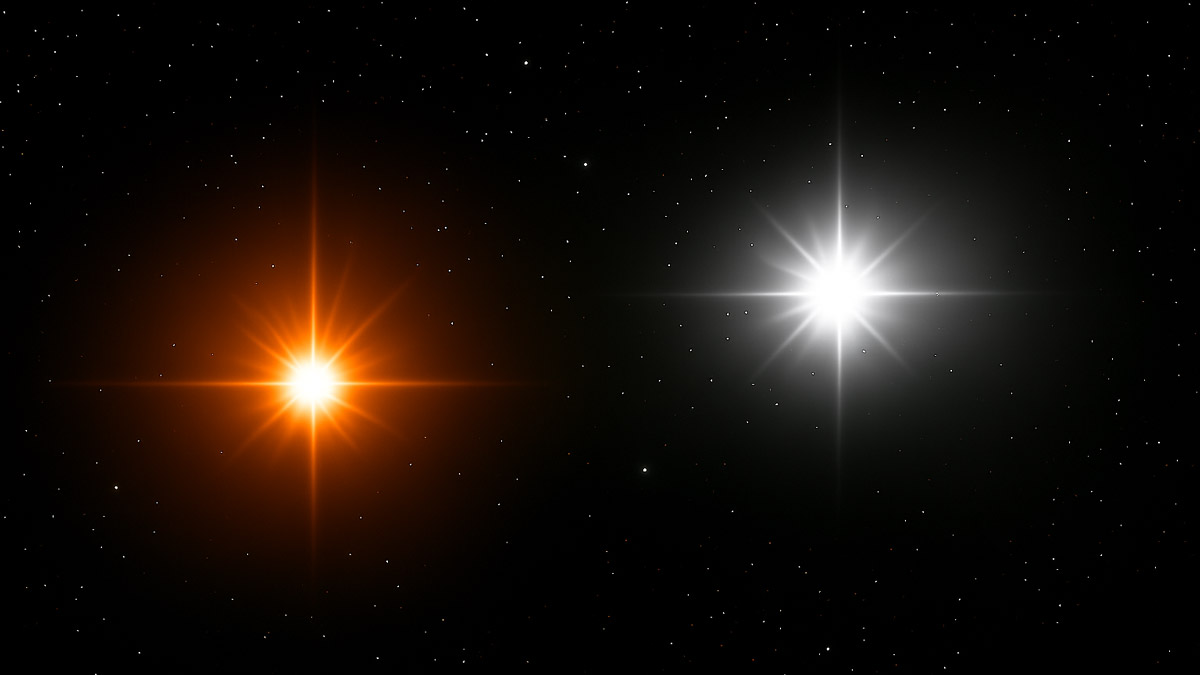
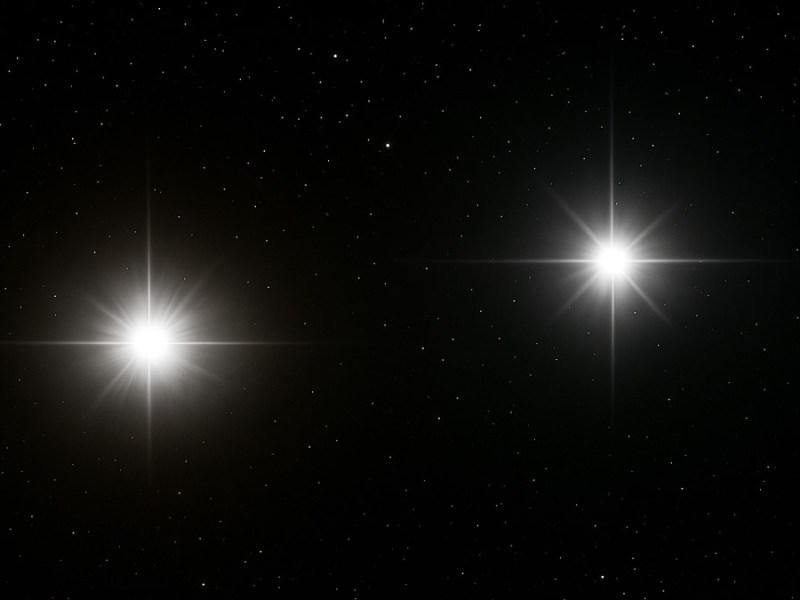
Beyond Fomalhaut’s spotlight, the constellation Piscis Austrinus hides a few quieter gems like the bright pair Beta Piscis Austrini and HD 214599, a triple star just south of Epsilon Piscis Austrini. By seeking out these subtle treasures, you can follow in William Herschel’s footsteps of discovery.
Herschel Reveals a Triple Star Over Time
On July 28, 1783, William Herschel observed the wide pair of stars that make up HD 214599 and noted their uneven brightness. That same night, he suspected the fainter star might itself have a very close companion.
But the view was compromised as the star sat low in the southern sky, where the atmosphere shimmered, blurring fine detail. Years later, on October 25, 1797, Herschel confirmed the close companion, writing: “A division can hardly be perceived. But the situation [altitude] is so low, that certainly the greatest difficulty of seeing the stars arises from that cause.”
The Three Stars of HD 214599
Through a telescope, the first sight is a wide double: an orange‑yellow primary star at magnitude 6.4, paired with a dimmer magnitude 7.5 secondary, separated by a generous 86 arcseconds. This spacing makes the pair easy to spot even with smaller telescopes.
As Herschel discovered, the secondary star itself has a close companion. This “third” star shines at magnitude 8.6 and lies just 3 arcseconds away. According to Stelle Doppie, all three stars are physically related, forming a true triple system.
My Observations
| Date | November 14, 2025 |
| Time | 8:33 p.m. |
| Location | Tampa, FL |
| Magnification | 169x |
| Scope | Meade 8″ SCT |
| Eyepiece | 12mm |
| Seeing | Average |
| Transparency | Average |
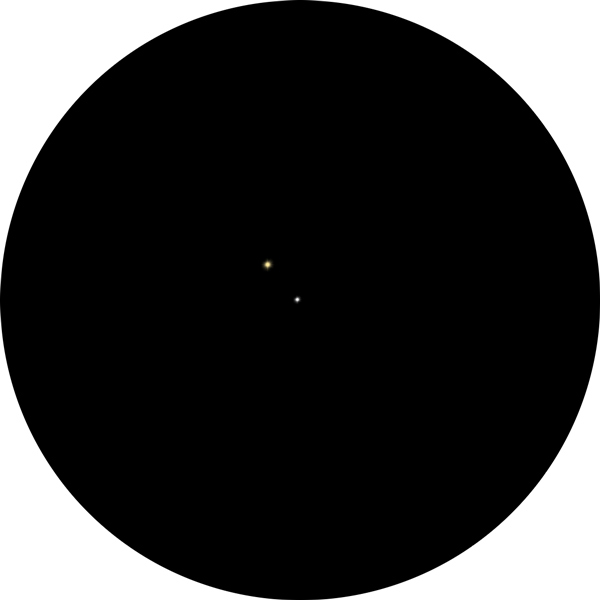
Through my telescope, the brighter primary glows a soft orange, almost pink. I couldn’t make out any color in the secondary, so I sketched it as white. After observing this system and packing up the scope, I realized there’s actually a third star involved—but with the 12 mm eyepiece I used for the sketch, it remained hidden. Like Herschel, I’ll need to return with higher magnification to coax that third star into view.
Key Stats
| Constellation | Piscis Austrinus |
| Best Viewing | Autumn |
| Visual Magnitude | +4.28 | +7.12 | +8.61 |
| Separation | AB = 86.51″ BC = 3.08″ |
| Position Angle | AB = 157.3° AB = 70.1° |
| Distance | 366 light-years |
| Milky Way Location | Orion Spur |
| My Viewing Grade | B |
| Designations | SAO 191308, HIP 111879, HR 8619, SAO 191309, H 6 119, H VI 119 |
Sources and Notes
Handprint. (n.d.). William Herschel’s Double Star Catalog. Retrieved December 1, 2025, from https://www.handprint.com/ASTRO/Herschel_All.html
HR8619 – Star in Piscis Austrinus. (n.d.). TheSkyLive.com. Retrieved December 1, 2025, from https://theskylive.com/sky/stars/hr-8619-star
Stelle Doppie. (n.d.). [Entry 100744]. Retrieved December 1, 2025, from https://www.stelledoppie.it/index2.php?iddoppia=100744
Sketch by Wayne McGraw
 The Garden Astronomer