
December 24, 2025 | 4:30 a.m.
It might seem like interstellar comets are a new phenomenon in our solar system. We saw ‘Oumuamua in 2017, 2I/Borisov in 2019, and now Comet 3I/ATLAS. It feels as if someone from outside our neighborhood is throwing cosmic snowballs our way.
But these visits have probably always happened. What has changed is our ability to notice them. Thanks to new sky-survey telescopes and more advanced detection software, we can now see what has always been out there.
The Discovery of Comet 3I/ATLAS
Arriving from the direction of the constellation Sagittarius, Comet 3I/ATLAS drew attention on July 1, 2025, showing up as a small dot moving across a busy starfield. The ATLAS (Asteroid Terrestrial-impact Last Alert System) discovered this new comet from one of its observatories in Río Hurtado, Chile.

From then on, speculation focused on its origins and composition.
Speculation and Science
Some folks wondered whether Comet 3I/ATLAS might be something unnatural, like a spacecraft or an alien UFO. This made it an internet sensation. Harvard astronomer Avi Loeb has shared his reasons for this idea. While the media has run with the comet-as-an-alien story, Loeb has never said with 100% certainty that the comet is unnatural.
As he shared in an October 29, 2025, interview, “3I/ATLAS is most likely a comet of natural origin, but there are 8 anomalies that endow it with a rank of 4 on the Loeb scale.” Loeb provides more detail in a recent article he published on Medium.
Why Astronomers Are Confident 3I/ATLAS Is a Comet
There’s an old saying: if it walks like a duck, swims like a duck, and quacks like a duck, it’s probably a duck. Its motion, its interaction with sunlight, and its outgassing all match well-understood cometary behavior. Publications such as BBC Sky at Night Magazine have outlined why this visitor fits comfortably within what we already know about cometary behavior.
A Rare Visitor, Passing Only Once
Even so, something is compelling about it. Comet 3I/ATLAS is only the third confirmed interstellar object ever observed passing through our skies. It is not bound by the Sun’s gravity, moving too fast to remain part of our solar system.
Like a stone released from a slingshot, it will sweep past once and never return. That alone makes it intriguing and worth our time as amateur astronomers to capture a fleeting glimpse.
Personal Observation on Christmas Week
For all the excitement surrounding Comet 3I/ATLAS, it proved to be a somewhat elusive target. For much of its journey, it stayed either too close to the Sun or poorly placed in the sky for easy observing, especially from my latitude. It wasn’t until it had passed the Sun and slipped back into darker morning skies that it finally felt within reach.
By then, my attention had drifted. The autumn brought comets Lemmon and SWAN. Like many observers, I found myself chasing the brighter, more cooperative targets instead. ATLAS faded into the background of my observing plans.
Then came the peacefulness of Christmas week.
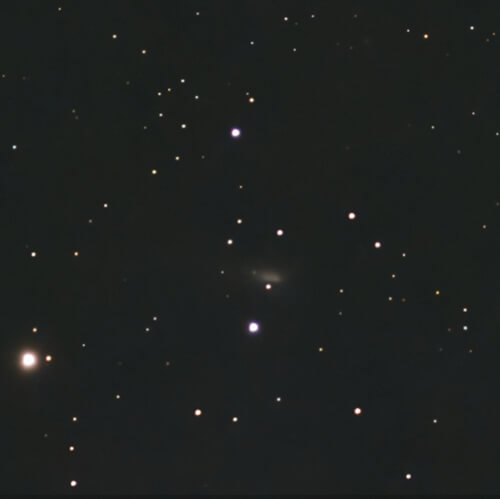
On Christmas Eve morning, I woke early to a clear, dark sky along with a mind that simply refused to fall back asleep. With nothing to lose, I set up my Seestar and telescope while the rest of the world slept. Almost as an afterthought, I checked on Comet 3I/ATLAS and was surprised to find it relatively high in the sky in Leo.
So I turned the Seestar toward it.
Nine minutes later, there it was: a tiny, faint, hazy patch of light. Not dramatic, but real. And that was enough.
I felt thankful for the chance to say hello, then goodbye, to a comet that drew the interest of many. A farewell to a special visitor, closing out the year not with spectacle, but with a time of tranquility, patience, and wonder.
Sources and Notes
Loeb, A. (2025, December). Updating the Loeb classification scale of 3I/ATLAS. Medium. https://avi-loeb.medium.com/updating-the-loeb-classification-scale-of-3i-atlas-eb495684462e
Norris, M. (2025, November 11). Comet 3I/ATLAS is not ‘aliens’. Here’s the science to prove it. BBC Sky at Night Magazine. https://www.skyatnightmagazine.com/news/3i-atlas-not-aliens
Wright, J. T. (2025, November 9). Loeb’s 3I/ATLAS “Anomalies” explained. AstroWright. https://sites.psu.edu/astrowright/2025/11/09/loebs-3i-atlas-anomalies-explained/
 The Garden Astronomer