
The constellation Cepheus offers a wealth of deep-sky targets. Among them, the multiple star system STT 461, associated with the star 15 Cephei, makes for an enjoyable stop on autumn and winter nights.
When I look at STT 461, I agree with Bob Argyle and others who say it appears more like a star cluster or an asterism than a multiple-star system. At first, it even reminded me of a small Coathanger asterism, just without the hook.
Identifying the Stars in STT 461
I’m thankful for the work of amateur astronomers John Nanson and Greg Stone, whose explanations have helped me better understand STT 461. Using their insights, I’ve labeled each component in a Seestar S50 image I captured.

Astronomer Bob Argyle notes that there is very little relative motion within this group. According to the Stelle Doppie database, it remains uncertain whether these stars are physically related (see below for more). As Argyle explains, if the stars do lie at roughly the same distance as 15 Cephei, the system would be located about 1,500 light-years away.
From my reading and research on Stelle Doppie, here’s my take on the system:
15 Cephei, Component A, is the brightest member of the group at a magnitude of 6.66. It’s a BIV blue-white star.
Its close companion, component B, does not appear in the Seestar image above, as it is considerably fainter at magnitude 11.4 and lies only about 11 arcseconds from Component A. I was able to pick it out with an 8mm eyepiece on my Meade 8-inch SCT. Stelle Doppie notes that it’s uncertain if these two are a true binary.
Component C is the dimmer star, magnitude 10.03, along the line of brighter stars extending from Component A. It has a yellow hue and is classified as a KOII star, making it unique among the other white stars.
Component D lies outside that line of brighter stars, occupying its own area. It has a magnitude of 7.84.
Component E is the brighter star appearing at the center of the line of stars. It shines nearly as bright as A at magnitude 6.96. What’s interesting is that Stelle Doppie notes that A and E are physically related.
Component F is at the end of the line of bright stars, shining at magnitude 8.14. On his observation page, John Nanson notes that Component F appears to be unrelated to the system and doesn’t label it. Even so, I have labeled it here as F for reference, since Stelle Doppie notes that it’s uncertain whether Components E and F are related.
My Observations
| Date | December 20, 2025 |
| Time | 10:45 p.m. |
| Location | Tampa, FL |
| Magnification | 169x |
| Scope | Meade 8″ SCT |
| Eyepiece | 12mm |
| Seeing | Average |
| Transparency | Average |
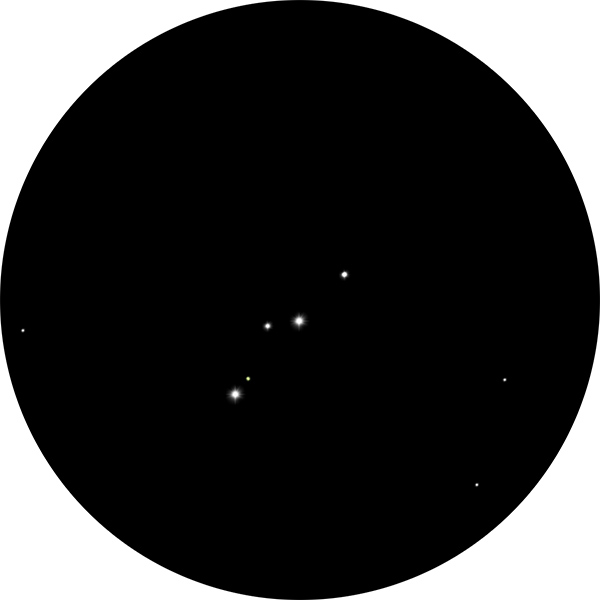
STT 461 is well worth a visit when navigating Cepheus. Through binoculars, it appears as a small cluster of stars, but through a telescope, the space between the stars widens.
While it remains unclear whether these stars are truly related, the system serves as a reminder that not every beautiful stellar gathering needs a tidy explanation to be meaningful.
Sources and Notes
Nanson, J. (2010, September 6). OΣ 461 (STT 461) Cephei, a quintuple system, and a 4 AM walk in the moonlight [Blog post]. Star-Splitters. https://bestdoubles.wordpress.com/2010/09/06/o%CF%83-461-stt-461-cephei-a-quintuple-system-and-a-4am-walk-in-the-moonlight/
Stelle Doppie. (n.d.). Double Star Database: STF 461. Stelle Doppie. https://www.stelledoppie.it/index2.php?iddoppia=97918
The Webb Deep-Sky Society. (2016). Double Star of the Month Archive 2016. https://www.webbdeepsky.com/double-stars/2016/
Sketch and Seestar Image by Wayne McGraw
 The Garden Astronomer