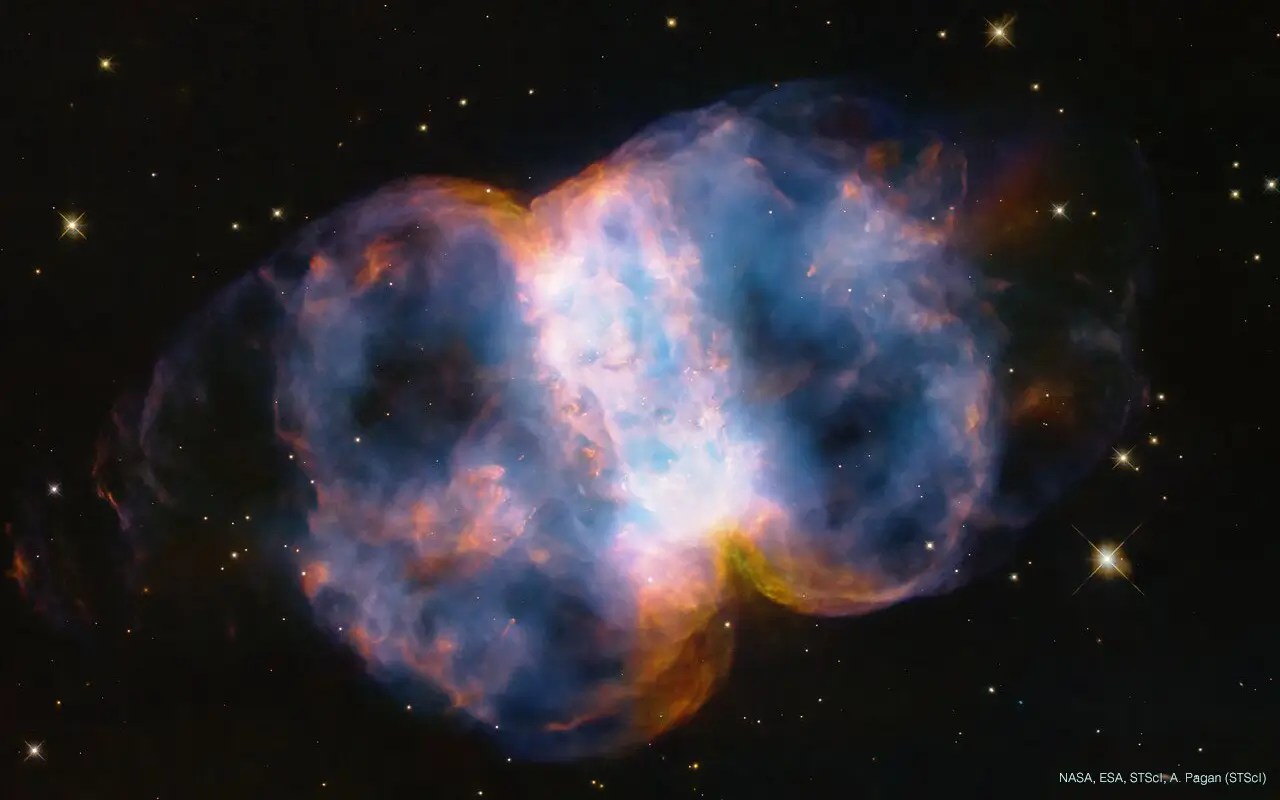
In late autumn and early winter, the constellation Perseus rides high in the sky. Among its treasures is the Little Dumbbell Nebula. Astronomers call it the Little Dumbbell Nebula because its twin lobes echo the shape of Messier 27, only reduced in scale and brightness.
For the suburban astronomer, it may appear as a small elongated smudge. See my observation below. For those with larger telescopes (8-10 inches), the central bar becomes a little clearer. Depending on sky conditions, you might even see a faint halo, like butterfly wings, around the bar.
Regardless of your consitions, this planetary nebula is worth the trip to find even though it shines dimmer at a 10.1 magnitude.
A Bipolar Planetary Nebula
In simple terms, many planetary nebulae appear round or oval. This shape comes from a dying star shedding its outer layers more or less evenly into space as it reaches the end of its life.
But we see Messier 76 a little differently.
M76 is a bipolar planetary nebula. Its gas was expelled along two opposite directions rather than forming a smooth, spherical shell. The central star funneled material into twin lobes that expanded outward from the core.
What makes M76 interesting is that we are viewing this bipolar structure almost edge-on, which emphasizes its narrow waist and elongated shape. From our perspective, the overlapping lobes give the nebula its distinctive barbell, or “butterfly,” appearance.
The Butterfly and a Scorching Star
The thick body in the center (the torus) is almost edge-on to us. Imagine a donut tilted so you’re looking at it from the side rather than from above. That’s why it looks like a thick bar or “body” rather than a ring. We’re seeing the side of the torus rather than looking straight down into the hole.
Meanwhile, the lobes, or wings, extend outward from the torus and are also mostly sideways to us, which makes them appear faint and stretched out.
I was especially interested to learn, from a 2013 paper titled “A Herschel study of NGC 650,” that the central star is an absolute scorcher. In its process of becoming a white dwarf, its temperature is around 165,000–178,000 °C (297,000–320,000 °F). Now that’s hot!
Regardless of your condition, this planetary nebula is worth the trip to find, even though it shines faintly at around magnitude 10.1.
My Observation of M76
| Date | December 15, 2025 |
| Time | 10:35 p.m. |
| Location | Tampa, FL |
| Magnification | 169x |
| Scope | Meade 8″ SCT |
| Eyepiece | 12mm |
| Seeing | Average |
| Transparency | Average |
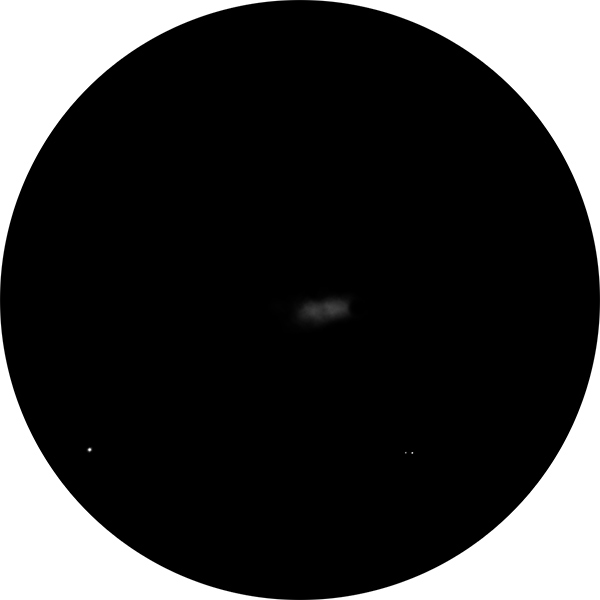
Through my 8-inch telescope under suburban skies, Messier 76 appears as a slightly elongated smudge. Using a 12 mm eyepiece, the central bar is visible, but as I increase magnification, the image unfortunately dims or washes out. Due to the neighboring light pollution, I can’t make out the butterfly wings this time. I’m looking forward to returning under darker skies to try again.

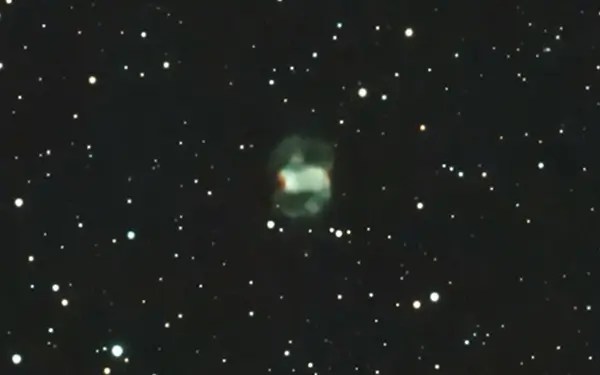
To see more, I let my Seestar S50 camera have a go. Given the nebula’s small size, it remains compact in the frame, but after 32 minutes of exposure, the two lobes become apparent, protruding from the brighter central bar. They shine with a faint greenish hue, hinting at the nebula’s classic butterfly shape that’s so hard to capture visually in suburban conditions.
Key Stats
| Constellation | Perseus |
| Best Viewing | Late autumn, early winter |
| Visual Magnitude | +10.1 |
| Distance from Earth | ~2,500–3,000 light-years |
| Diameter | 1.7 ly |
| Apparent Size | ~2.7′ × 1.8′ |
| My Viewing Grade | C+ |
| Designations | NGC 650 / NGC 651, Butterfly Nebula, Barbell |
Historical Observations
Messier 76 was first spotted on September 5, 1780, by Pierre Méchain who was a friend and collaborator of Charles Messier. A month later, on October 21, Messier followed up on Méchain’s findings to record the object.
Messier wrote: “Nebula at the right foot of Andromeda, seen by M. Méchain on September 5, 1780, & he reports: ‘This nebula contains no star; it is small and faint’.”
Seven years later, on November 21, 1787, William Herschel identified the lobes, or wings, noting: “Two nebulae close together. Both very bright. Distance 2′. One is south preceding and the other north following.”
It was American astronomer Heber Doust Curtis, who worked at the famous Lick Observatory, who designated M76 as planetary nebula in 1918.
Sources
Banner photo: ESA/Hubble. (2024). Little Dumbbell Nebula (M76). ESA/Hubble. https://esahubble.org/images/heic2408a/ESA/Hubble
Messier 76. SEDS Messier Database. Retrieved January 3, 2026, from http://www.messier.seds.org/Mdes/dm076.html
van Hoof, P. A. M., Van de Steene, G. C., Exter, K. M., Barlow, M. J., Ueta, T., Groenewegen, M. A. T., … Wesson, R. (2013). A Herschel study of NGC 650. Astronomy & Astrophysics, 560, Article 7. https://doi.org/10.1051/0004‑6361/201221023
Sketch and Seestar Image: Wayne McGraw
 The Garden Astronomer