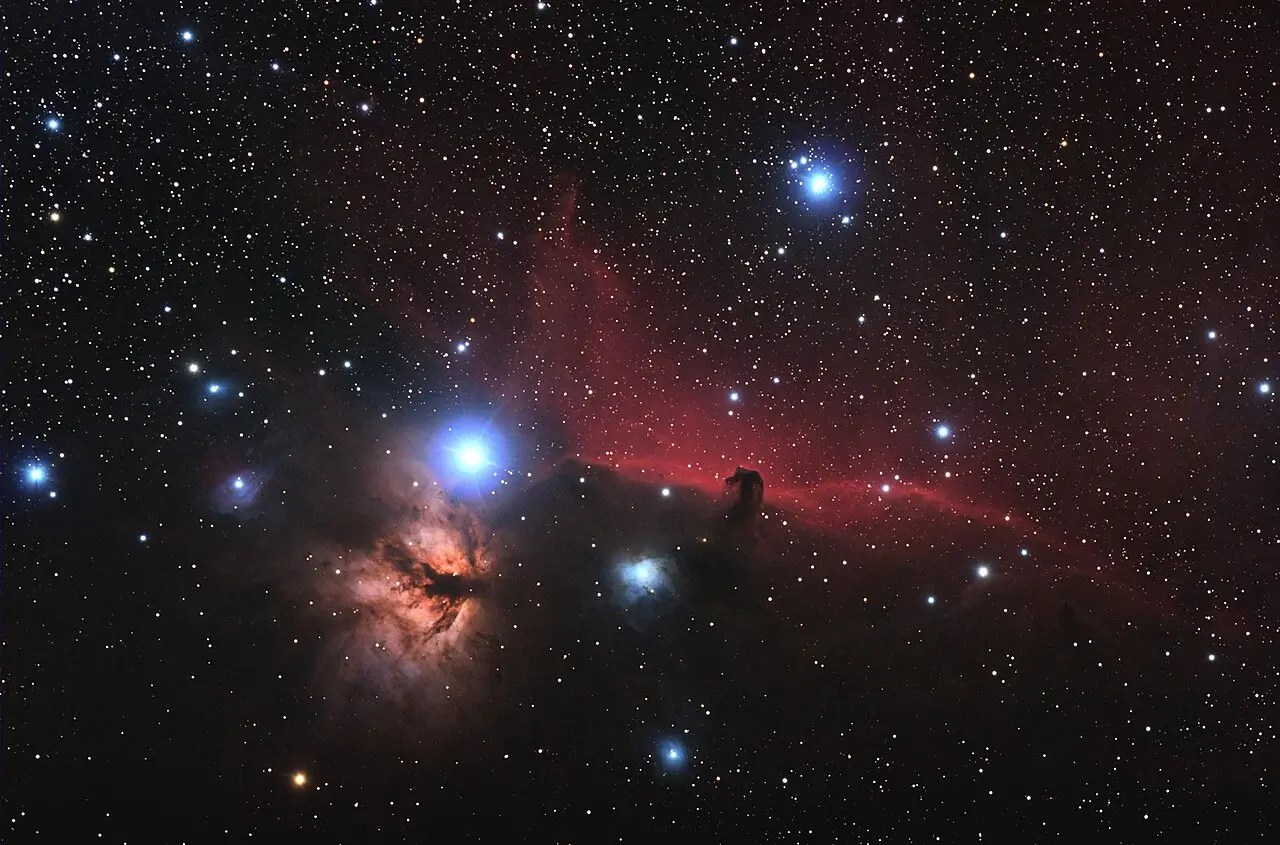
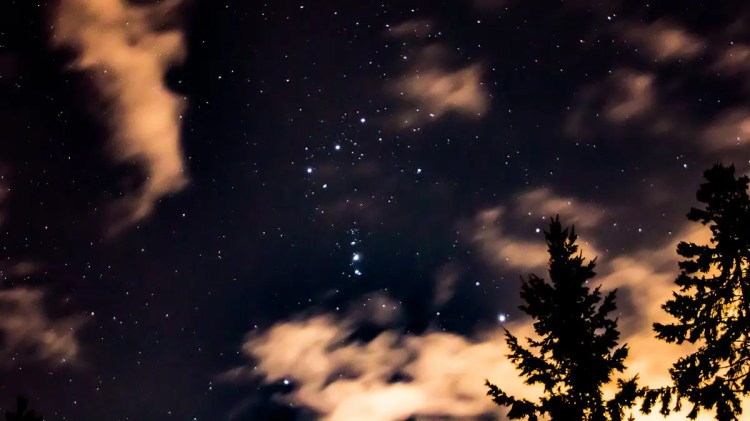
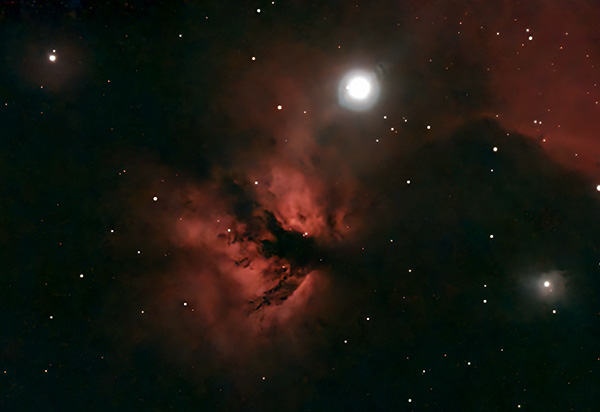
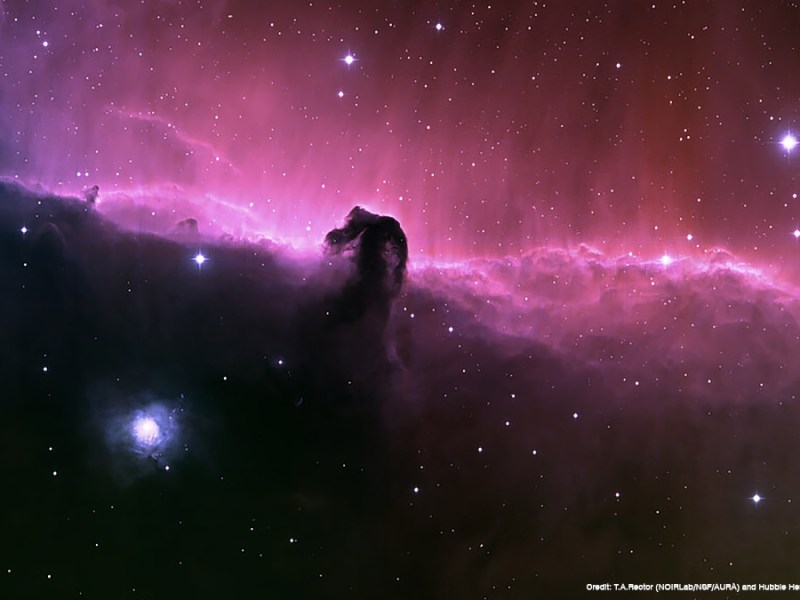
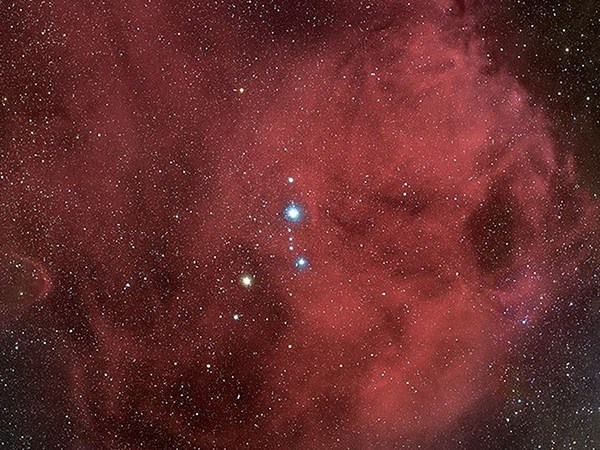
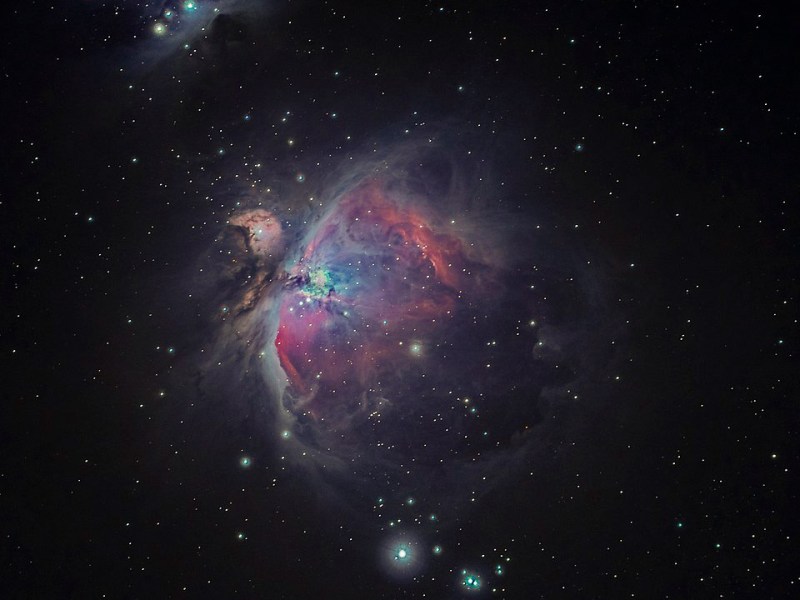
Orion the Hunter stretches across the heavens on winter nights. Look for his famous “belt” of three stars in a neat row. The leftmost star, Alnitak, is your guide. Right next to it is the Flame Nebula, and just below is the famous Horsehead Nebula.
The Flame Nebula is an emission nebula. These nebulae glow because their gas clouds are energized by nearby stars. In the case of the Flame Nebula, the massive star Alnitak provides some of this energy. However, it is actually a hidden star called IRS2b that is showering the gas with ultraviolet radiation.
What Makes the Red Color
This radiation is stripping electrons from hydrogen atoms, and when those electrons rejoin the atoms, the gas glows in the beautiful, deep red light we see.
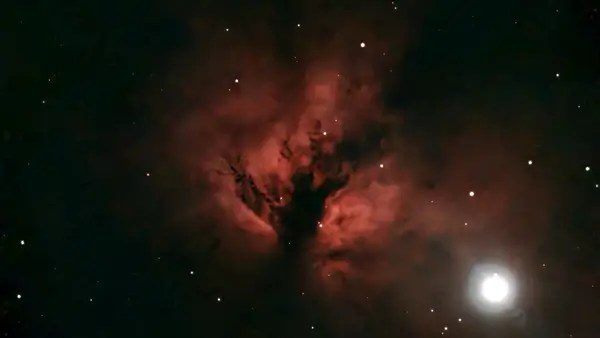
This is why H II (H-alpha) telescope filters work on a nebula like the Flame. They isolate that specific red hydrogen emission while blocking out background light, allowing the nebula’s structure and contrast to stand out better.
In 2003, researchers published a study using infrared spectroscopy to see through the thick dust of the Flame Nebula and identify the hidden star IRS2b. They also found a young cluster of stars buried deep inside the nebula. By measuring the amount of ultraviolet radiation IRS2b produces, the researchers showed that it provides exactly the energy needed to generate both the radio signals and the glowing light we observe from the nebula.

Viewing the Flame Nebula
Dark, moonless skies are best for observing the nebula. However, from suburban skies, it’s still doable with a few conditions. While it’s possible to catch with a 6-inch scope, an 8-inch or larger scope gives you feasible chances. Also, a UHC or H-beta filter works better visually. Also, Alnitak’s glare makes it one of the harder visual nebulae, even with filters. Many observers first detect it as dark lanes cutting into a faint glow rather than a bright cloud.
Even with these challenges, the Flame Nebula is worth a try from suburban skies, and if you use a scope like the Seestar, you can enjoy the nebula in all its crimson glory.
My Observations
| Date | November 6, 2020 |
| Time | 11:51 p.m. |
| Location | Seattle, WA |
| Magnification | 169x |
| Scope | Meade 8″ SCT |
| Eyepiece | 12mm |
| Seeing | Average |
| Transparency | Average |
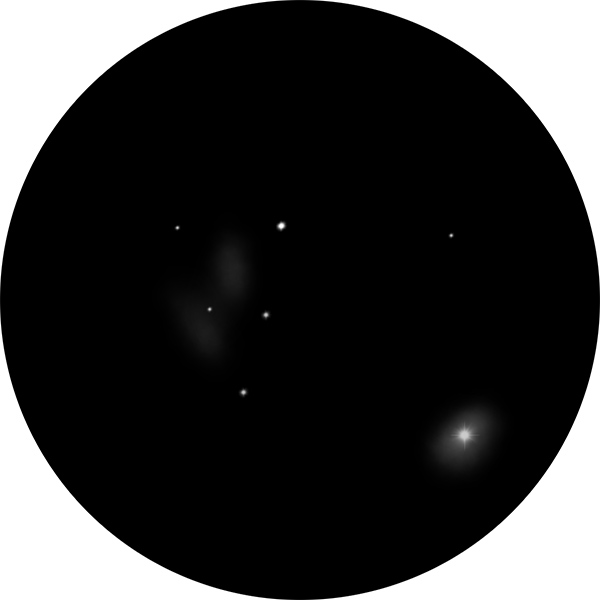
On a cold November night in suburban Seattle (40°F), I revisited Alnitak through my telescope. In my original sketch, I’d marked faint nebulosity, unsure if it was real. I spotted two very faint wisps of the Flame Nebula nearby. Years later in 2026, photographing the region with the Seestar revealed the full crimson glow, confirming what my eyes had hinted at years before in the darker days of the COVID pandemic.
Key Stats
| Constellation | Orion |
| Best Viewing | Winter |
| Visual Magnitude | +10 |
| Absolute Magnitude | -0.5 |
| Distance from Earth | 1,350 ly |
| Diameter | 12 ly |
| Apparent Size | 30 x 30 arcmin |
| Milky Way Location | Orion Spur |
| Designations | NGC 2024, Sharpless 2-277 (Sh2-277), LBN 952, Ced 55 |
Sources and Notes
Banner photo: Ljubinko Jovanovic | Creative Commons 3.0 | Source
Bik, A., Lenorzer, A., Kaper, L., Comerón, F., Waters, L. B. F. M., de Koter, A., & Hanson, M. M. (2003). Identification of the ionizing source of NGC 2024 (arXiv:astro-ph/0303029). arXiv. https://arxiv.org/pdf/astro-ph/0303029

 The Garden Astronomer
