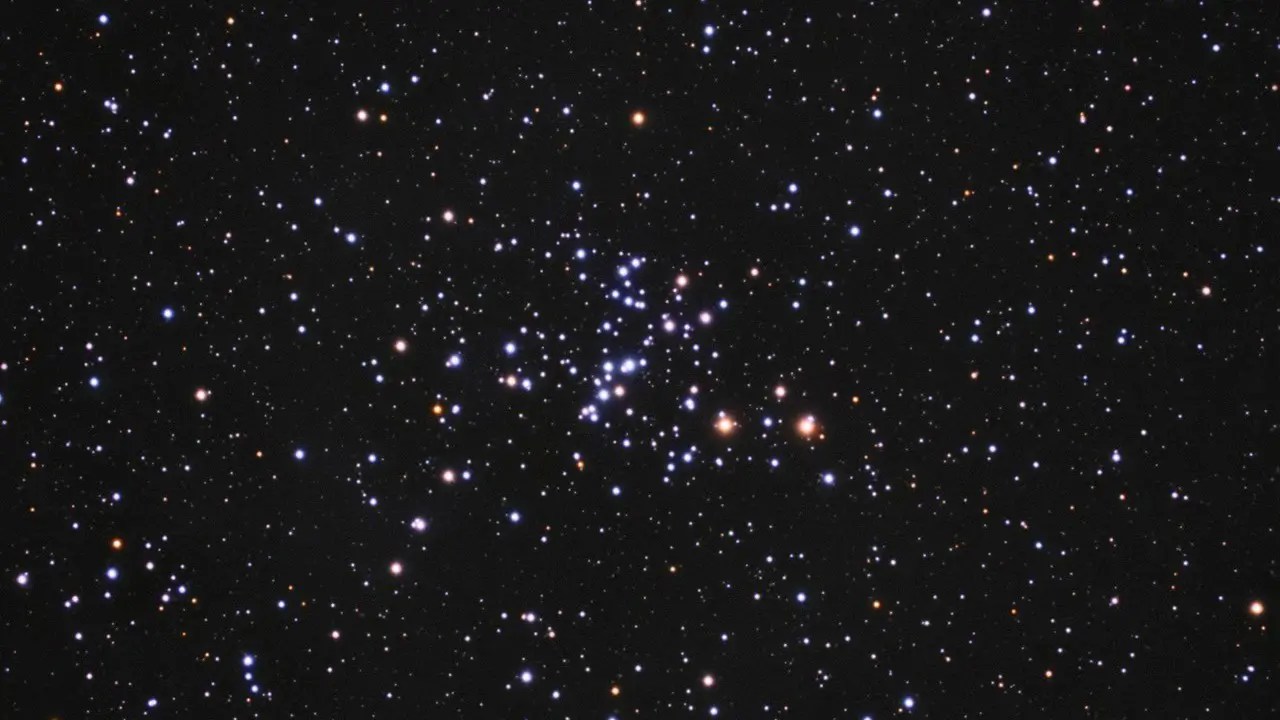
On winter and early spring nights, northern observers can spot the constellation Puppis low on the southern horizon. Puppis represents the “poop deck,” the elevated platform at the rear of a ship. Historically, it was part of the large ship constellation Argo Navis—a pretty great name if you ask me.
It’s here that we arrive at Messier 93, the last object Messier personally observed for his catalog. He recorded it on March 20, 1781, at age 51. The catalog continued to grow afterward through discoveries by his colleague Pierre Méchain, as well as the inclusion of several previously known objects.
Messier 93’s Cluster of Stars
Messier 93, also cataloged as NGC 2447, is an open cluster located roughly 3,380 light-years from Earth. It’s fairly young, with 80 known stars and likely many more. A notable feature is its population of Blue Giant (B9) stars. These are icy blue-white in color, alongside a healthy number of variable stars.
Observing the Cluster
With a magnitude of +6.1, M93 is fairly easy to find. Under suburban, moonless skies, binoculars can reveal a smudge of light. A small to intermediate telescope (3–4 inches) brings out more of its color and distinct wedge-shaped structure.
If you haven’t yet explored this “very beautiful” cluster—as Caroline Herschel described it—head back to the poop deck and take a look!
My Observations
| Date | January 17, 2026 |
| Time | 12:30 a.m. |
| Location | Tampa, FL |
| Magnification | 15x |
| Binoculars | 15mm x 70mm |
| Seeing | Above Average |
| Transparency | Above Average |
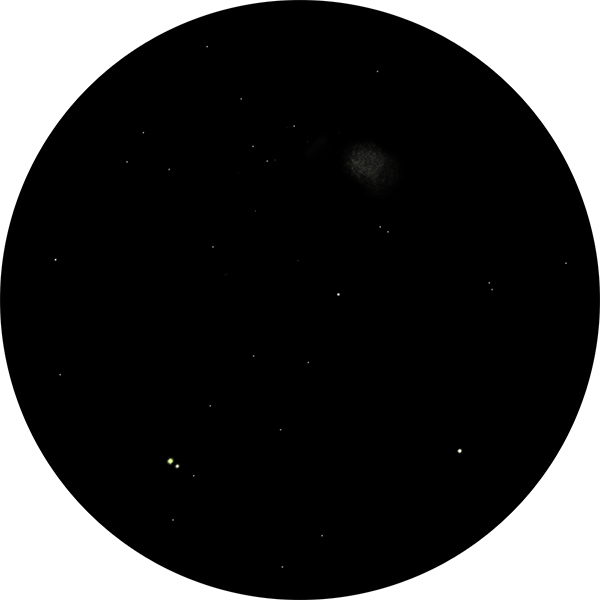
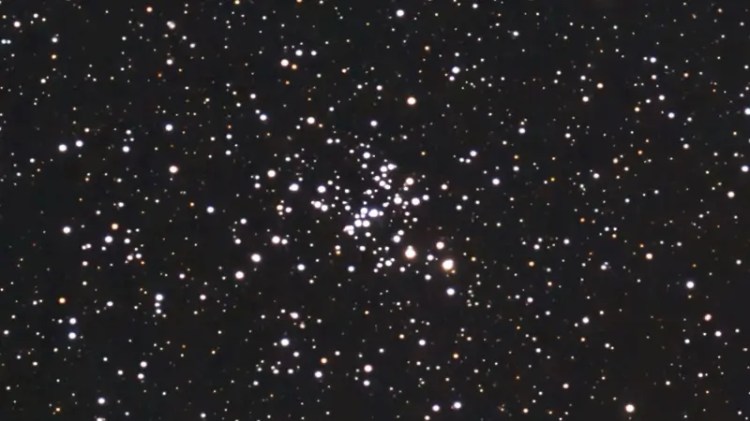
Late this January evening, I leave my larger telescope inside and opt for binoculars to tour the sky. While the Seestar captures M93, I use my Celestron SkyMaster 15×70 binoculars. The night is moonless and frigid for Florida, hovering around 39 °F. But I’ll take these lower temperatures for a crisp sky.
I first locate Sirius, then scan downward until I reach the noticeable yellow star Wezen in Canis Major. Gradually sweeping left, I spot M93 as a faint smudge among a few stars. In the lower quadrant of my view, I see the yellow star Asmidiske (Xi Puppis) and a nearby companion.
As I was sketching the region, a meteor streaked right out of the cluster and extinguished before it left my view. What a great way to end the evening!
Key Stats
| Constellation | Puppis |
| Best Viewing | Winter–Early Spring |
| Visual Magnitude | +6.1 |
| Distance from Earth | ~3,600 light-years |
| Diameter | ~15 light-years |
| Apparent Size | 15 arcminutes (the core) |
| Milky Way Location | Orion Spur |
| My Viewing Grade | B |
| Other Designations | M93, NGC 2447, Critter Cluster |
Historical Observations
Charles Messier’s record on March 20, 1781: “Cluster of small stars, without nebulosity, between the Greater Dog and the prow of the ship.”
Caroline Hershel’s record on February 26, 1783: “Nebula, about 1 1/4 deg north preceding the bright star in the Ship preceding the 1st Navis [Puppis] towards 23 Canis majoris. My Brother examined it with [magnification] 460 and found not less than 20 stars, with 227 above 40. With a compound eyepiece perhaps 100 and 150 very beautiful, nothing nebulous among them. Messier has it not.”
For my historical observations, visit messier.seds.org.
Sources and Notes
Banner top photo of Messier 93 by Sergio Eguivar. Used under the Creative Commons Attribution-Share Alike 4.0 International license.
da Silveira, M. D., Pereira, C. B., & Drake, N. A. (2018). Red giants and yellow stragglers in the young open cluster NGC 2447. Monthly Notices of the Royal Astronomical Society, 476(4), 4907–4931. https://doi.org/10.1093/mnras/sty265
Messier 93 (M93). SEDS Messier Database. Retrieved January 17, 2026, from http://www.messier.seds.org/Mdes/dm093.html
Messier 93. (n.d.). In Wikipedia. Retrieved January 17, 2026, from https://en.wikipedia.org/wiki/Messier_93
Sketch and Seestar image by Wayne McGraw
 The Garden Astronomer