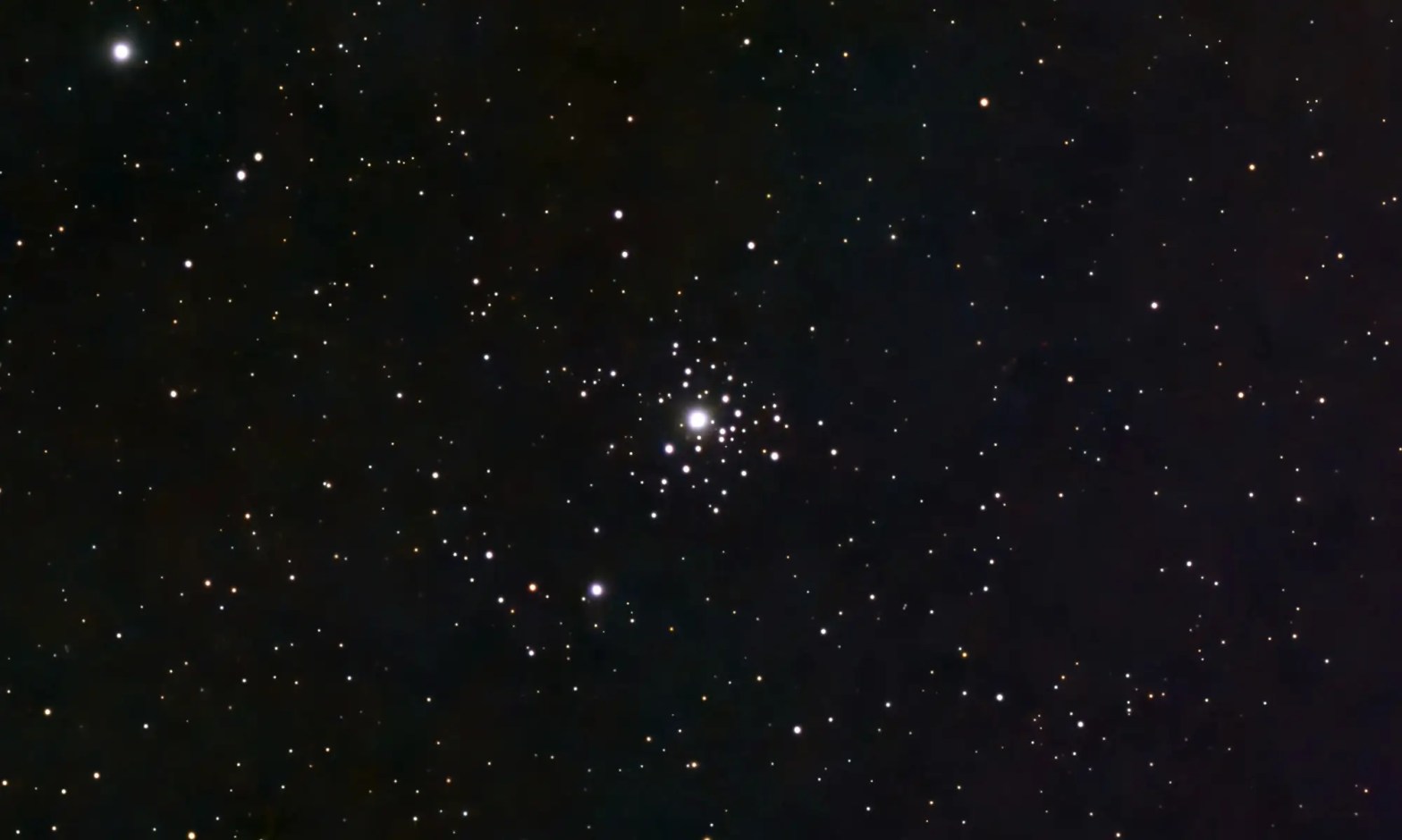
On winter evenings when Orion dominates the sky, and Sirius burns bright, the 4th-magnitude star Tau Canis Majoris lies nearby in the constellation Canis Major. Take a closer look, and you’ll find it serving as a beacon at the heart of the NGC 2362 star cluster, also known as Caldwell 64.
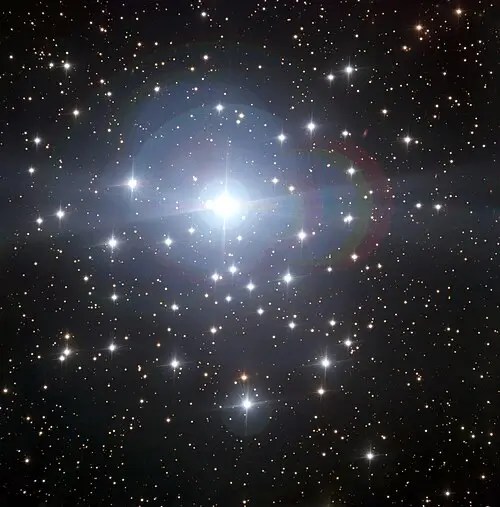
ESO | Creative Commons 4.0 License
The Mexican Jumping Star
Tau Canis Majoris is one of the most luminous stars visible in our galaxy. Classified as a hot O-type blue supergiant, it shines roughly 50,000 times the luminosity of the Sun! Its intense radiation gives it a pale, electric blue-white color, and its brilliance sets it apart from the cluster’s other stars.
This radiance is also responsible for its nickname, the “Mexican Jumping Star.” When viewed through a modest telescope, the fainter stars packed closely around Tau Canis Majoris seem to flicker, as your eye struggles to balance their light against the star’s overwhelming glare.
The Sparkling Cluster
Far from being a solitary beacon, Tau Canis Majoris reigns over the quaint open cluster. The cluster boasts some 40–50 prominent, unevolved B-type stars, along with several hundred fainter members—many likely still gravitationally bound.
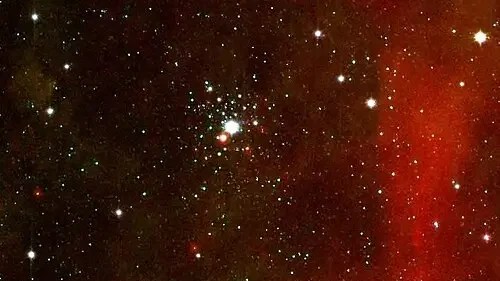
NASA/JPL-Caltech/Harvard-Smithsonian CfA | Public Domain
Lying roughly 5,000 light-years away, NGC 2362 is one of the more distant open clusters easily accessible to amateur telescopes. In cosmic terms, it’s barely out of the cradle at around 5 million years old. We know from observations that star formation here happened rapidly in a single burst, and today this box of jewels has been stripped of the gas and dust, marking the end of its star-forming era.
Viewing the Dazzling Diamonds
In binoculars under dark skies, NGC 2362 appears as a soft, fuzzy glow hugging bright Tau Canis Majoris. Some have even remarked that it looks like a small comet in the eyepiece.
Bump up to a smaller telescope (3–5 inches), and the view is already rewarding. At moderate power (50–100×), Tau dominates the field like a dazzling diamond, with a handful of faint companions popping into view when you use averted vision.
Take it up another notch to medium-sized scopes (6–10 inches), and the view brings more life into the cluster. At 100–200× on a steady night, you’ll resolve more individual, glittering stars arranged in a slightly pyramidal pattern around the brilliant central beacon.
The First Observers
The Sicilian astronomer Giovanni Battista Hodierna first recorded the cluster in his 1654 published work. A century later, on March 4, 1783, William Herschel observed it. From that day forward, NGC 2362 has remained a beloved gem of winter skies.
It’s easy to overlook because it doesn’t compete for attention like other deep-sky objects in the region. But it’s worth every second of the hunt! So swing your scope toward Tau Canis Majoris and peer into a pocket of the universe where newborn stars still shine with fierce, youthful fire.
My Observations
| Date | February 6, 2026 |
| Time | 11:30 p.m. |
| Location | Tampa, FL |
| Magnification | 169x |
| Scope | Meade 8″ SCT |
| Eyepiece | 12mm |
| Seeing | Average |
| Transparency | Average |
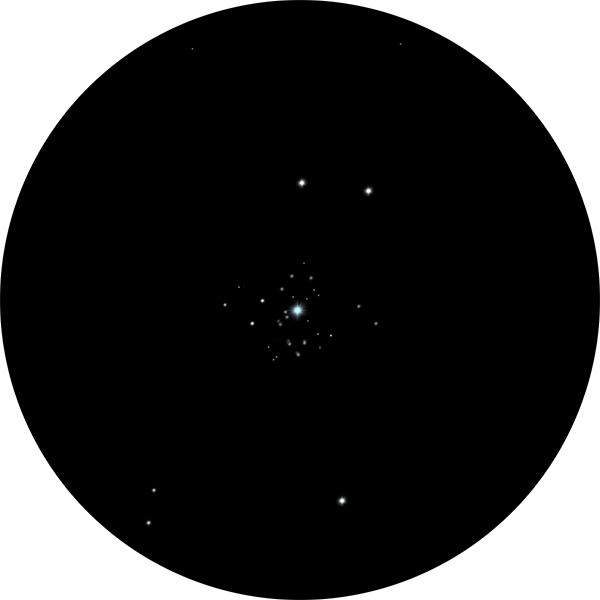
The Gulf Coast hasn’t felt like itself lately. Nights have slipped colder than expected. But this past week has offered crisp, steady skies, as if the air itself had been rinsed clean. On evenings like this, I’m especially grateful for familiar companions: my SCT for lingering at the eyepiece, and the Seestar S50 for easing me into the night.
NGC 2362 is a small but exquisite gem. At its heart, Tau Canis Majoris glows a soft, luminous blue. I first went looking with binoculars, but under Tampa’s nearby lights, the surrounding stars fade into the glow, leaving only a faint breath of “fuzz” around the central light.
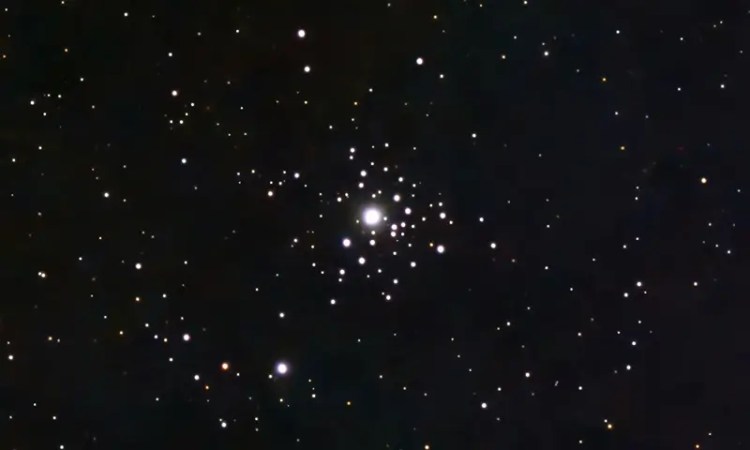
Tampa, Florida, at 11:30 p.m. on February 6, 2026
Key Stats
| Constellation | Canis Major |
| Best Viewing | Winter |
| Visual Magnitude | +3.79 |
| Absolute Magnitude | -7.06 |
| Distance from Earth | 4,800 ly |
| Diameter | ~ 7 ly |
| Apparent Size | ~ 5 arcmin |
| Milky Way Location | Orion Spur |
| My Viewing Grade | B+ |
Sources and Notes
Dahm, S. E. (2008). NGC 2362: The terminus of star formation. arXiv. https://arxiv.org/abs/0808.3815
Frommert, H., & Kronberg, C. (n.d.). NGC 2362. Students for the Exploration and Development of Space (SEDS). http://www.messier.seds.org/xtra/ngc/n2362.html
Moitinho, A., Alves, J., Huélamo, N., & Lada, C. J. (2001). NGC 2362: A link between star-forming clusters and older open clusters. The Astrophysical Journal, 563(2), L73–L76. https://doi.org/10.1086/338503
 The Garden Astronomer

