
On late winter and early spring evenings, the constellation Puppis climbs into view. For observers in the Northern Hemisphere, it rides high in the southern sky. Farther south, it passes nearly overhead. Within the poop deck lies Upsilon Puppis, a wide double star that separates easily in binoculars.
An Optical Pair
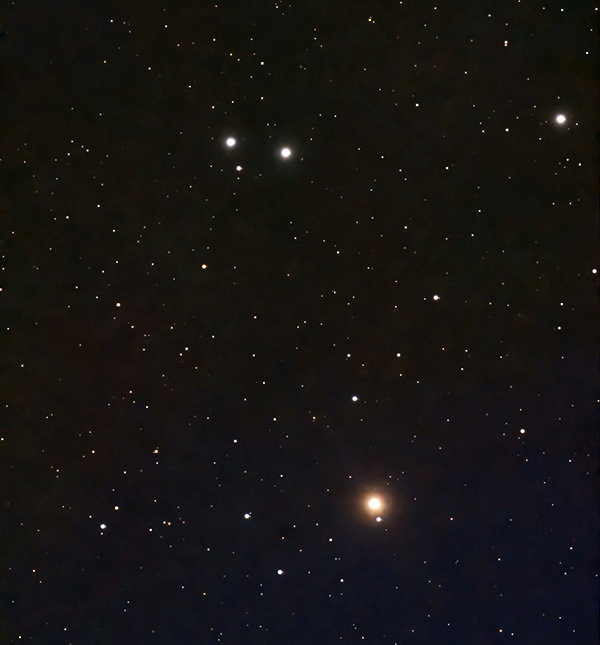
The two stars are designated υ¹ Puppis (also known as NV Puppis) and υ² Puppis (NW Puppis). Though they appear about 4 arcminutes apart—roughly 240 arcseconds—their closeness is an illusion of perspective.
From our vantage point on Earth, they share nearly the same line of sight, yet in reality they are separated by considerable distances: υ¹ Puppis lies about 933 light-years away, while υ² Puppis is farther still at roughly 1,089 light-years.
Luminous, Hot Stars
Both stars are impressive in their own right. Each is a hot, blue-white B-type star, far more massive and luminous than our Sun. υ¹ Puppis shines at approximately magnitude +4.7, bright enough to be seen with the unaided eye under good conditions. While υ² Puppis appears slightly dimmer than its neighbor at magnitude +5.1, that faintness is mostly a matter of distance and perspective. Intrinsically, it is enormously powerful.
A Fine Target for Binoculars
Finding the pair is a pleasure. Begin with bright Pi Puppis, shining at magnitude 2.7 with a noticeable warm, orange tint in this part of the sky. It stands out among the surrounding stars. From there, drift just slightly north through Puppis’ dense starfields.
In a steady pair of binoculars, Upsilon Puppis resolves cleanly into two blue-white pinpoints, comfortably separated. The spacing of about 4 arcminutes makes them easy to distinguish.
My Observations
| Date | February 8, 2026 |
| Time | 11:30 p.m. |
| Location | Tampa, FL |
| Scope | Seestar S50 |
| Seeing | Above Average |
| Transparency | Above Average |
Key Stats
| Constellation | Puppis |
| Best Viewing | Late Winter to Early Spring |
| Visual Magnitude | +4.67 | +5.1 |
| Separation | ~200″ (4 arcminutes) |
| Milky Way Location | Orion Spur |
| My Viewing Grade | A |
| Designations | υ¹ Puppis = SAO 198019, HR 3109, HD 64739; υ² Puppis = SAO 198026, HR 3117, HD 64760 |
Sources and Notes
Webb Deep-Sky Society. (2026, January 27). Double star of the month in constellation. Webb Deep-Sky Society. https://www.webbdeepsky.com/double-stars/constellation
Sketch by Wayne McGraw
 The Garden Astronomer