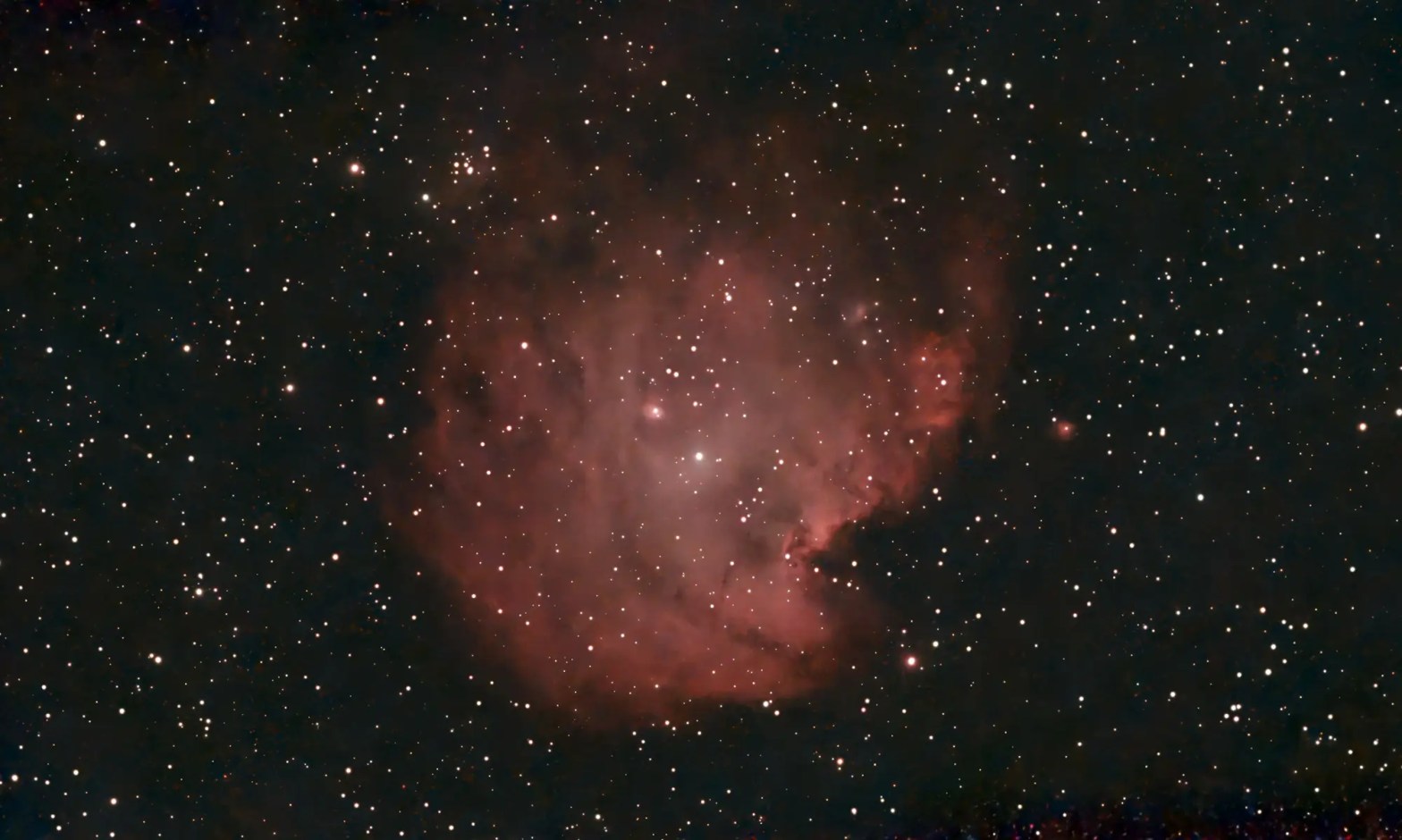
Orion the Hunter stretches across the heavens on winter nights. Most eyes go straight to his famous belt, the M42 nebula, and the bright stars Betelgeuse and Rigel. But raise your gaze to his outstretched arm, and you’ll find a vast, glowing cloud. That’s the Monkey Head Nebula.
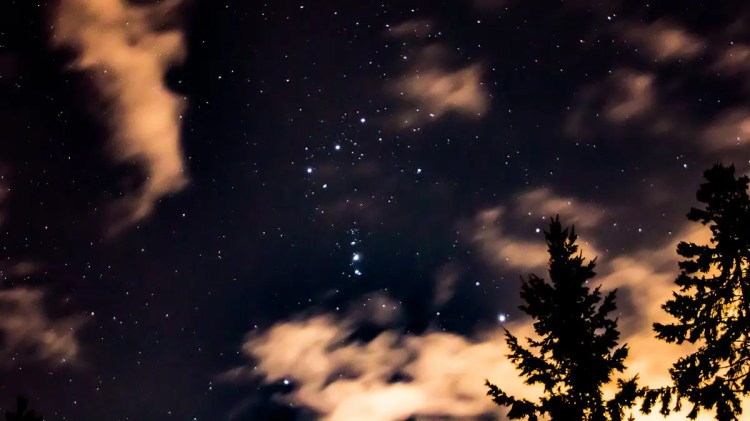
The nebula sits about 6,400 light-years away, far deeper in space than Orion’s more famous nebulae. To find it, locate the star Propus near the Gemini border, then nudge your telescope just south into Orion.
What Makes the Monkey Head
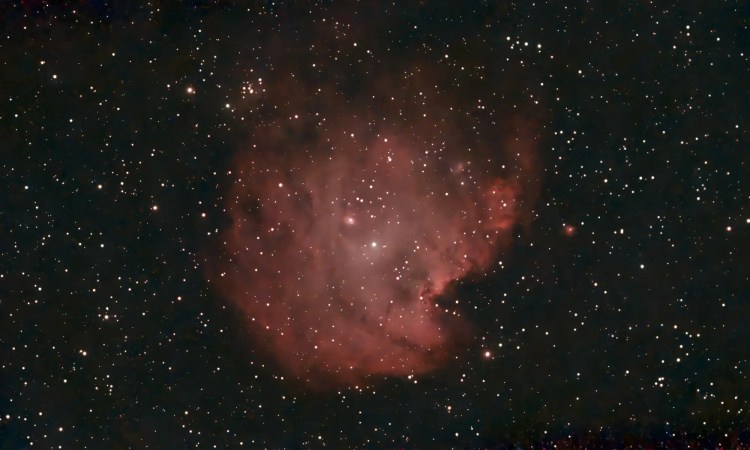
Near the heart of the Monkey Head Nebula lies HD 42088—a massive, hot O-type star shaping everything around it. Its intense ultraviolet radiation energizes the surrounding hydrogen gas, causing the nebula to glow red. This gives the nebula that nice crimson hue in astrophotos!
But that’s only part of the story.
A 2011 study reveals that the Monkey Head Nebula is home to a small family of young star groups, all formed together about five million years ago. Most are still in their early stages, just beginning their long journey toward maturity. These newborn stars send out steady streams of particles that press against the surrounding gas and dust. Over time, those unseen stellar winds shape and sculpt the nebula, carving it into the rising forms we see today.
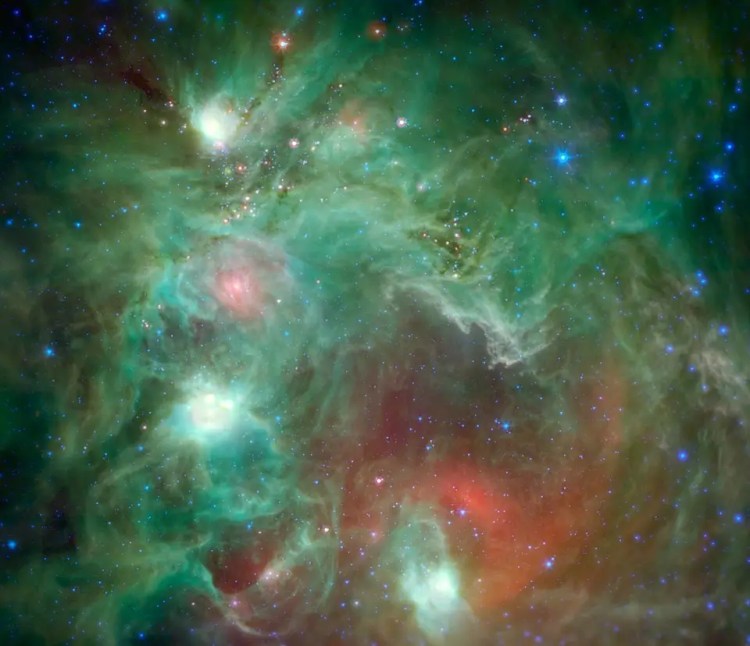
Dark lanes of dust drift through the brighter glow. Together, they give the nebula its distinctive look. In visible light, the shape suggests the face of a monkey—though that illusion vanishes in infrared, where an entirely different structure comes into view.
Disovery
At the center of the nebula lies the open star cluster NGC 2175, first noted by Giovanni Battista Hodierna in the 17th century. It would be nearly two hundred years before the German astronomer Karl Christian Bruhns formally recorded it in 1857.
The surrounding glow came later.
In 1877, French astronomer Édouard Stephan pointed an 80-centimeter reflector toward the region and detected the faint nebulosity that wraps around the cluster. What had once been a simple gathering of stars revealed itself as something more—light and gas woven together in the dark.
My Observations
January 16, 2026 — 10:50 p.m.
Over the last few years, I made several attempts from my suburban location in Seattle to pick out the faint haziness of the Monkey Head Nebula through my 8-inch SCT. Each time, I came away empty-handed, despite various filters in place. I credit the failure to suburban sky glow. Perhaps I’ll get my chance on a future winter night from a darker location.
On this Florida evening, I turned the Seestar S50 toward Orion and let it run. What the eye could never coax out of a Seattle sky, the camera found without hesitation.
Key Stats
| Constellation | Orion |
| Best Viewing | Winter |
| Visual Magnitude | +6.8 |
| Distance from Earth | ~6,400 ly |
| Apparent Size | 40 x 30 arcmin |
| Milky Way Location | Orion Spur |
| Designations | NGC 2174, Sharpless 2-252 (Sh2-252) |
Sources and Notes
Banner photo: Wayne McGraw
Bonatto, C., & Bica, E. (2011). Uniform detection of the pre-main sequence population in the 5 embedded clusters related to the H II region NGC 2174 (Sh2-252). arXiv. https://arxiv.org/abs/1103.2293
Constellation Guide. (n.d.). Monkey Head Nebula (NGC 2174). https://www.constellation-guide.com/monkey-head-nebula/
ESA/Hubble. (2014). New Hubble image of NGC 2174. https://esahubble.org/images/heic1406a/
NASA/JPL. (n.d.). NGC 2174 — Spitzer Space Telescope infrared image. NASA Jet Propulsion Laboratory.
Wikipedia contributors. (2024). NGC 2174. Wikipedia. https://en.wikipedia.org/wiki/NGC_2174
 The Garden Astronomer