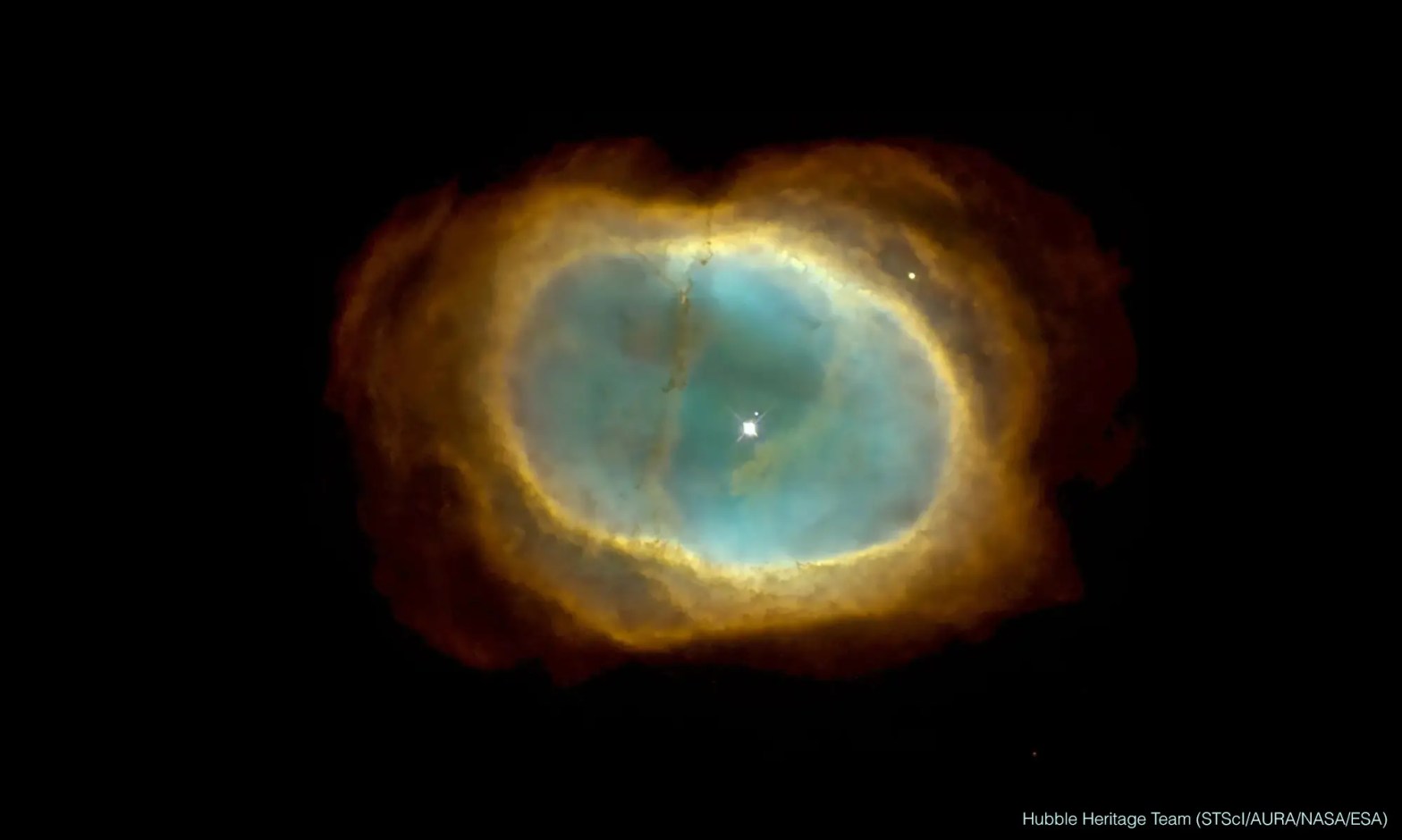
Sweeping the southern skies from the Cape of Good Hope on March 2, 1835, John Herschel came upon a glowing nebula now known as the Eight-Burst Nebula. Cataloged as NGC 3132 and Caldwell 74, it has since become one of the showpiece planetary nebulae in the southern sky. It resides in the constellation Vela, the Sail.
A Dying Star’s Swan Song
Planetary nebulae have nothing to do with planets. Early observers peering through modest telescopes saw these circular glowing discs and thought they resembled the pale orbs of Uranus or Neptune.
I’ve found this to be true myself. Upon seeing Uranus for the first time from the suburbs, I realized how much it appeared like the planetary nebulae I’ve observed.

In reality, a planetary nebula is the final act in the life of a Sun-like star. When a medium-mass star exhausts its nuclear fuel, it swells into a red giant and then sheds its outer layers in great expanding shells of gas. What remains at the center is the hot, dense stellar core — a white dwarf. This star’s intense ultraviolet radiation excites the surrounding gas.
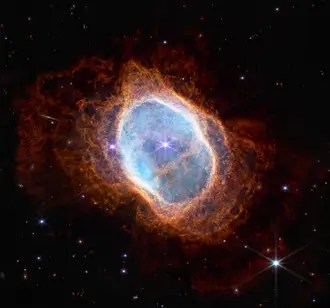
Caldwell 74 is an example of this process. The expanding shell of ionized gas spans roughly 0.4 light-years and glows with the distinctive blue-green color. Its nickname, the Eight-Burst Nebula, comes from the complex overlapping ring-like filaments visible in long-exposure photographs we enjoy.
The Star That Fooled Astronomers
When you look at the nebula through a telescope, a bright 10th-magnitude star sits prominently at its heart. For years, astronomers naturally assumed that this was the dying star responsible for creating the nebula. They were wrong.
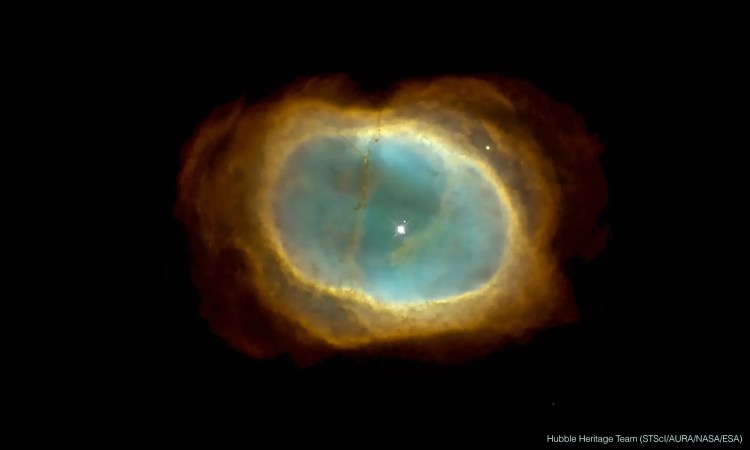
The Hubble Heritage Team (STScI/AURA/NASA)
In the mid-1970s, astronomer R. Mendez (building on his 1975 analysis) suspected that this bright central star could not produce the intense ultraviolet radiation needed to energize the nebula. Something else had to be there.
In 1977, astronomer Luboš Kohoutek and colleagues confirmed it. They imaged a tiny, 16th-magnitude white dwarf lurking just 1.7 arcseconds away from the bright star. This hot stellar remnant is the true architect of the nebula! This is the star that ran out of fuel, shed its outer layers, and created the glowing shell we see today. The bright A-type star is merely a gravitationally bound companion along for the ride.
My Observation
March 21, 2026, at 10:30 p.m.: I set out that evening with modest expectations. From my vantage point north of Tampa, the southern horizon is a stubborn place, with the city’s persistent glow. The nebula sat low, and through my 8-inch SCT, it simply wouldn’t reveal itself. I swept the area more than once, hoping for even the faintest hint, but the light and the trees conspired against me.
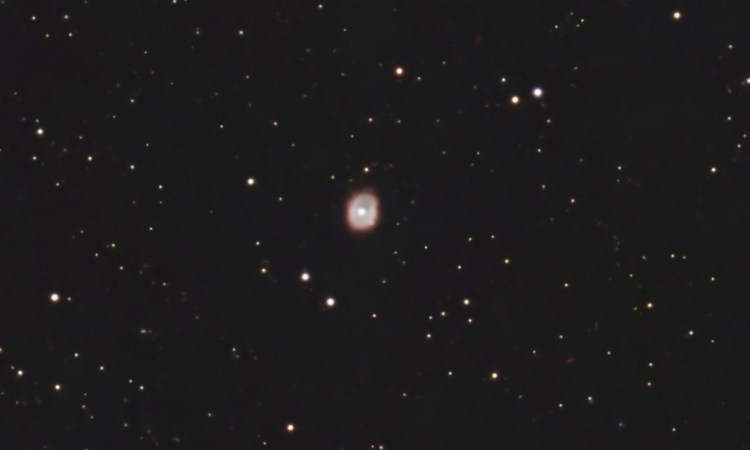
So I changed course. I mounted the Seestar S50 on a taller tripod, lifting it just enough to peer over the line of townhomes and trees.
Compared to larger targets like the Helix Nebula, it remains a tiny presence in the frame, resisting any attempt to dominate the image. But perhaps that’s part of its charm.
Down low in the southern sky, through the haze of a Florida suburb, this little nebula revealed itself in the Seestar. A gem, tucked just above the horizon, waiting for the patient observer to meet it halfway.
Key Stats
| Constellation | Vela |
| Best Viewing | Late Winter–Spring |
| Visual Magnitude | +9.2 |
| Distance from Earth | ~2,000 light-years |
| Diameter | ~0.4 light-years |
| Apparent Size | 45″ × 30″ |
| My Viewing Grade | C+ |
| Designations | NGC 3132, Caldwell 74, Eight-Burst Nebula, Southern Ring Nebula |
Sources and Notes
Banner photo: NASA. (n.d.). A glowing pool of light. NASA Science. https://science.nasa.gov/missions/hubble/a-glowing-pool-of-light/
De Marco, O., et al. (2022). The messy death of a multiple star system and the resulting planetary nebula as observed by JWST. Nature Astronomy, 6(12), 1421–1432. https://doi.org/10.1038/s41550-022-01845-2
Méndez, R. H. (1978). A-type central stars of planetary nebulae – II. The central stars of NGC 2346, He 2-36 and NGC 3132. Monthly Notices of the Royal Astronomical Society, 185(3), 647–660. https://doi.org/10.1093/mnras/185.3.647
Monteiro, H., et al. (2025). The planetary nebula NGC 3132 revisited: High definition 3D photoionization model. Monthly Notices of the Royal Astronomical Society, 539(2), 1756–1774. https://doi.org/10.1093/mnras/staf488
Sahai, R., et al. (2023). The Binary and the Disk: The Beauty is Found within NGC 3132 with JWST. The Astrophysical Journal, 943(2), 110. https://doi.org/10.3847/1538-4357/aca7ba
 The Garden Astronomer