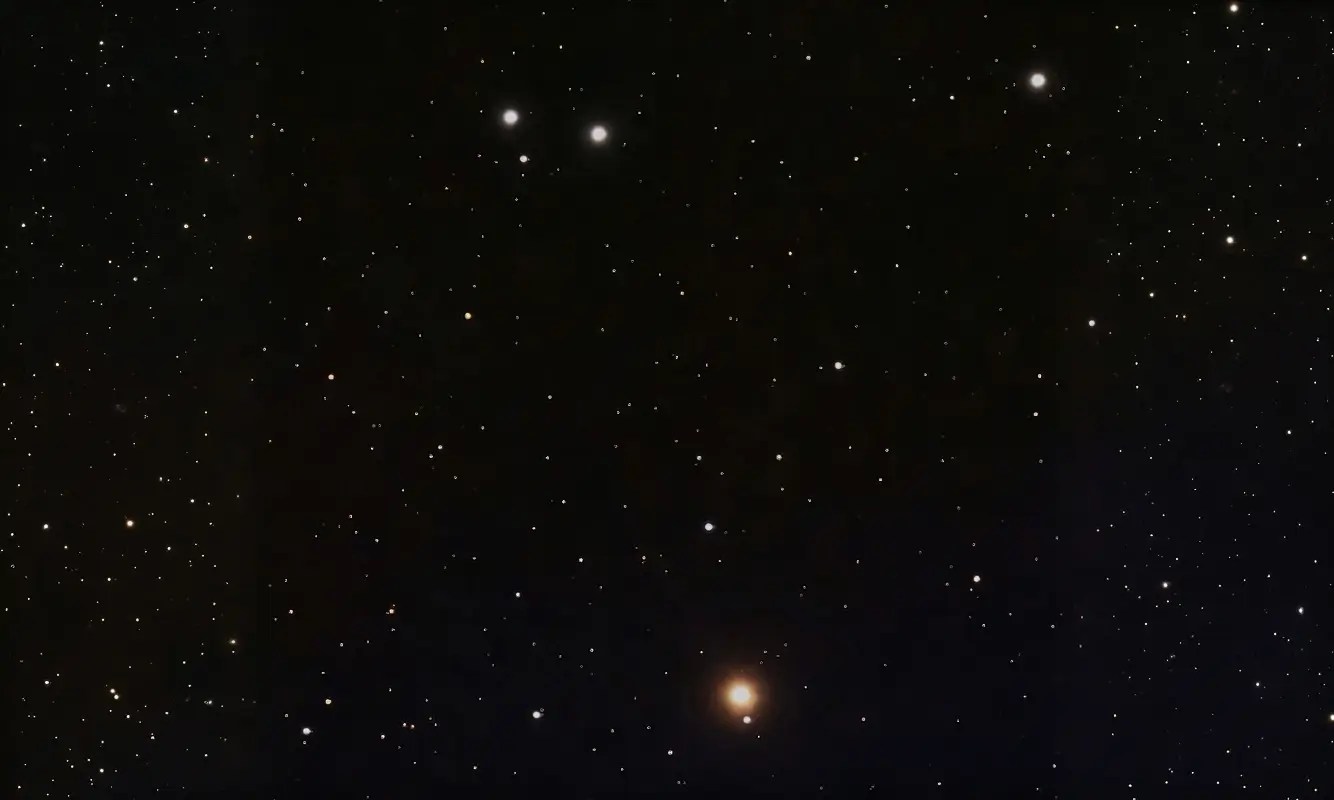
In the rich star fields of the constellation Puppis lies the often overlooked Pi Puppis Cluster, also known as Collinder 135. For observers in the Southern Hemisphere, and those far enough south in the Northern Hemisphere, it offers a sparkling view of a loose gathering of bright stars rather than a tightly packed cluster.
Stellar Highlights
At the heart of the cluster, Pi Puppis (also named Ahadi) glows with a steady orange light, a supergiant that anchors the group at a visual magnitude of 2.71. It’s an elder presence among its companions.
Around it, the cluster takes on a different character. Several of the fainter stars—those hovering near fifth magnitude—are not as constant as they first appear. NV Puppis is a Gamma Cassiopeiae–type variable, while nearby NW Puppis pulses more subtly as a variable star.
Though some studies question whether it’s a true physical cluster versus a chance alignment, modern data support it as a real grouping at similar distances.
Discovery
The cluster was cataloged by Swedish astronomer Per Collinder in 1931 as part of his extensive survey of open clusters. His catalog focused on large, relatively nearby groupings of stars, objects that often did not appear in earlier lists because they lacked the dense, compact appearance that astronomers of the time typically favored.
My Observations
| Date | March 21, 2026 |
| Time | 10:30 p.m. |
| Location | Tampa, FL |
| Magnification | 15x |
| Binoculars | 15mm x 70mm |
| Seeing | Above Average |
| Transparency | Above Average |
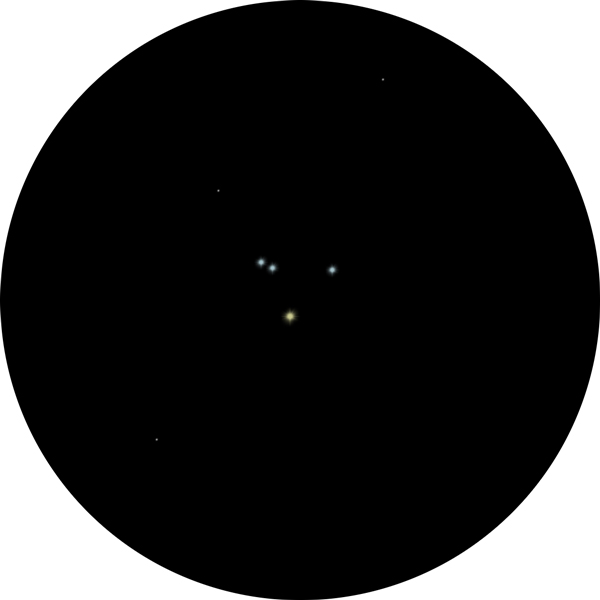
Tonight, as I watched Orion drifting toward the southwest horizon, I picked up my binoculars and began a familiar star-hop. Starting at brilliant Sirius, I moved southward (to the left), across the lower southern sky to the warm yellow glow of Wezen, and then onward to the bluish light of Aludra.
From there, I had my bearings. I dipped lower, just above the treetops, and there it was—Ahadi—anchoring the loose Pi Puppis Cluster.
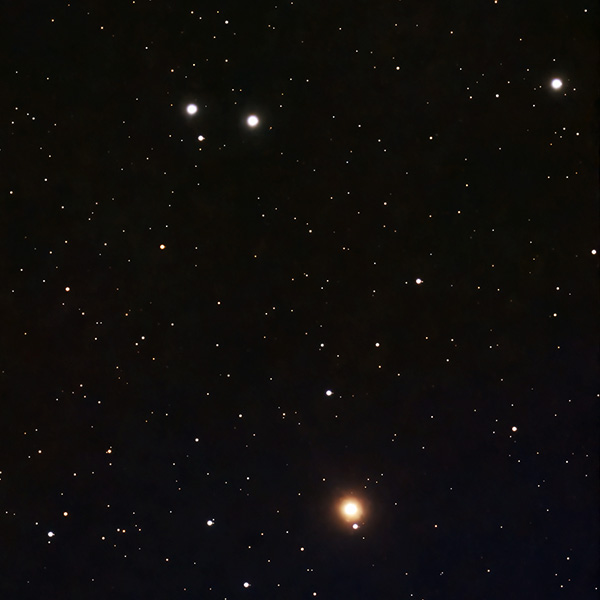
The suburban glow rising from Tampa washed away much of the fainter stellar detail. In the binocular field, the cluster resolved into a simple triangle-like shape made up of bluish stars, with Ahadi completing the pattern. It’s not a dense or dramatic cluster, but there’s still beauty in its geometry.
Key Stats
| Constellation | Puppis |
| Best Viewing | Winter–Early Spring |
| Visual Magnitude | +2.1 |
| Distance from Earth | ~975 light-years |
| Apparent Size | ~50 arcminutes |
| Milky Way Location | Orion Spur |
| My Viewing Grade | B |
| Other Designations | Pi Puppis Cluster, Cr 135, C 0715-367 |
Sources and Notes
Photos and sketches by Wayne McGraw
Collinder 135. (n.d.). In Wikipedia. Retrieved March 24, 2026, from https://en.wikipedia.org/wiki/Collinder_135
Pi Puppis Cluster. (n.d.). eSky. Retrieved March 24, 2026, from https://www.glyphweb.com/esky/clusters/cr135.html
Pi Puppis. (n.d.). In Wikipedia. Retrieved March 24, 2026, from https://en.wikipedia.org/wiki/Pi_Puppis
 The Garden Astronomer